News


Underground Detention and Retention Systems: Ponds, Basins, and Tanks
12 Nov 2026Underground Detention and Retention Systems: Ponds, Basins, and Tanks
An underground detention system borrows stormwater and gives it back; an underground retention system keeps water in place for good. The underground retention pond once meant a hole in the ground ringed with grass. Today it has buried equivalents — basins, vaults, and modular tanks hidden under parking lots. This page defines both duties, settles the detention-versus-retention vocabulary, and walks the forms and design factors an underground system takes.
What Are Underground Detention and Retention Systems?
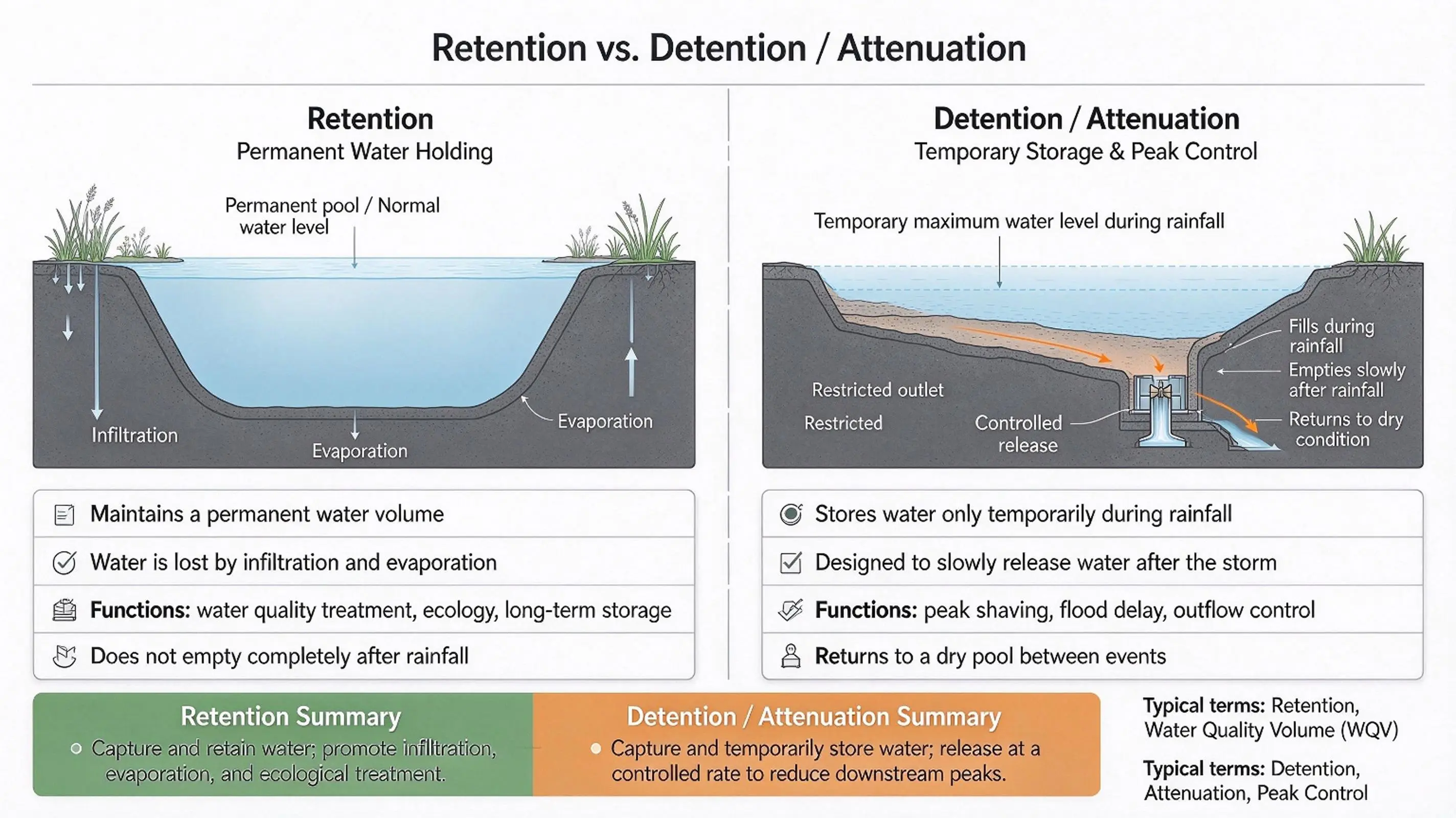
Both systems manage the moment a storm delivers more water than a site may release. An underground stormwater detention system receives runoff, holds it temporarily, and lets it out through a controlled outlet at the rate the permit allows. A stormwater retention system keeps a designed volume in place — a permanent pool in a pond, a dead-storage layer in a tank. It releases only the excess.
The vocabulary shifts by structure type. Above ground, engineers speak of detention basins and retention ponds. Buried, the same duties run inside detention vaults, retention tanks, and modular matrices. An underground detention basin is simply the buried version of the surface basin; an underground retention system applies the same translation to the keeping-water duty. When plans say storm water detention system, they mean the borrowing duty regardless of spelling.
Retention vs. Detention: The Key Differences
The one-line rule: retention stores water, detention only borrows it.
| Question | Detention | Retention |
|---|---|---|
| What happens to the water? | Held, then released slowly | A permanent volume stays on site |
| Between storms | Empties completely | Keeps its permanent pool or dead storage |
| What the permit calls it | Detention, attenuation (US codes) | Retention, water quality volume |
| Typical purpose | Flood control at the peak | Water quality, groundwater support, reuse feed |
| Typical buried form | Vault, pipe bed, crate matrix with outlet control | Vault or matrix with a permanent storage layer |
Two vocabulary notes prevent permit-counter confusion. First, "attenuation" names the same borrowing duty. Attenuation is the standard term in US stormwater codes, and an attenuation tank is the hardware serving it. The principle is detailed on the stormwater attenuation tanks hub. Second, Australian plans say "OSD" — on-site detention — for the same duty. If an ordinance says detention, attenuation, or OSD, the borrowing hardware above is what satisfies it.
From Ponds to Tanks: The Forms Underground Systems Take
The form list is short, and each form fits a site type:
• Open detention basin — a graded, grassed basin that fills and empties. Cheapest per volume; consumes land and needs maintenance mowing.
• Retention pond — a basin with a permanent pool. Adds water quality settling and amenity value where land allows.
• Underground vault — a rigid precast box under heavy pavement. Traffic-rated from the first module.
• Pipe arch or tank battery — large-diameter pipe or linked tanks bedded in stone. Fits long, narrow corridors along roads.
• Modular crate matrix — geocellular polypropylene wrapped in membrane. The structure is explained on the geocellular crates page, and the detention product line starts at the detention module series.
Every buried form trades surface land for excavation cost. The trade favors underground systems wherever the surface has value — parking, logistics yards, dense housing.
Design Factors for Underground Systems
Design starts with the permit's two numbers: the storm the system must handle and the rate it may release. From there, four factors shape the structure:
• Loading class. Traffic above dictates the vertical rating — engineered modular systems document verified ratings above 45 to above 85 tonnes per square meter.
• Cover depth. Standard modules handle typical cover of about 3.5 meters in engineered installations; deeper or shallower conditions move the design between product lines.
• Inspection access. Every system needs sumps and ports; modular designs allow unit-by-unit inspection and swap.
• Groundwater and soils. Buoyancy and bedding follow the site survey, not the catalogue.
NZ and other international markets read the same logic — modular systems adapt to local loading and seismic requirements, with certification confirmed per market. Underground detention system design documents the whole set: plan geometry, outlet sizing, and the maintenance schedule.
Cost Drivers
Underground detention system cost follows the same three inputs that price every buried structure: storage volume, loading class, and ground conditions. Residential underground detention system cost lands at the small end of that scale. Traffic-rated commercial matrices price by rating class as much as by volume. Because those inputs vary site by site, published per-unit prices mislead more than they inform. Request a quotation built on the three inputs through YY Tank, with a quote in four hours and a layout inside 24. For the tank-specific side of the family, our stormwater detention tanks guide covers sizing and cost drivers in depth.
Frequently Asked Questions
What is an attenuation crate?
An attenuation crate is a structural polypropylene module that interlocks into a buried matrix for temporary stormwater storage. Sealed with a membrane and fitted with a flow-control outlet, the matrix detains runoff and releases it slowly. The crates themselves are the load-bearing skeleton of that matrix.
What is the purpose of an attenuation basin?
An attenuation basin breaks the peak of a storm. It receives runoff faster than the downstream network can accept, holds the difference temporarily, and releases it at the permitted rate. The purpose is flood and erosion control downstream — plus usable land upstream when the basin sits underground.
What is a stormwater retention system?
A stormwater retention system keeps water on site instead of borrowing it. Retention ponds hold a permanent pool; underground retention seals stored water for reuse, then pressurizes it back out for irrigation and washdown. Detention drains down between storms — retention does not, and that difference drives the choice.
What is an attenuation tank?
An attenuation tank is a storage structure fitted with a flow-control outlet, so it meters runoff instead of spilling it. The structure is usually a modular matrix or a vault. It is the structural hardware for the attenuation duty that US codes typically require on new development. The same structure, sealed and pressurized, serves reuse instead.
What is the difference between retention and detention ponds?
Retention ponds keep a permanent pool of water; detention ponds empty between storms. Retention stores water for the long term, supporting water quality and groundwater; detention only borrows water at the peak and returns it slowly. Many sites combine both in one basin — a permanent pool below, temporary storage above.