News


Stormwater Detention Tanks & Vaults: Sizing and Cost Drivers
12 Nov 2026Stormwater Detention Tanks & Vaults: Sizing and Cost Drivers
A stormwater detention tank is a buried structure that holds runoff at the peak of a storm and releases it at a controlled rate. A flow-control outlet meters the outflow to whatever the permit allows. Between storms the tank drains down completely and stands ready for the next event. This page compares the three detention forms — vaults, ponds, and modular tanks — and shows what drives their size and cost.
Detention Vault vs Detention Pond vs Detention Tank
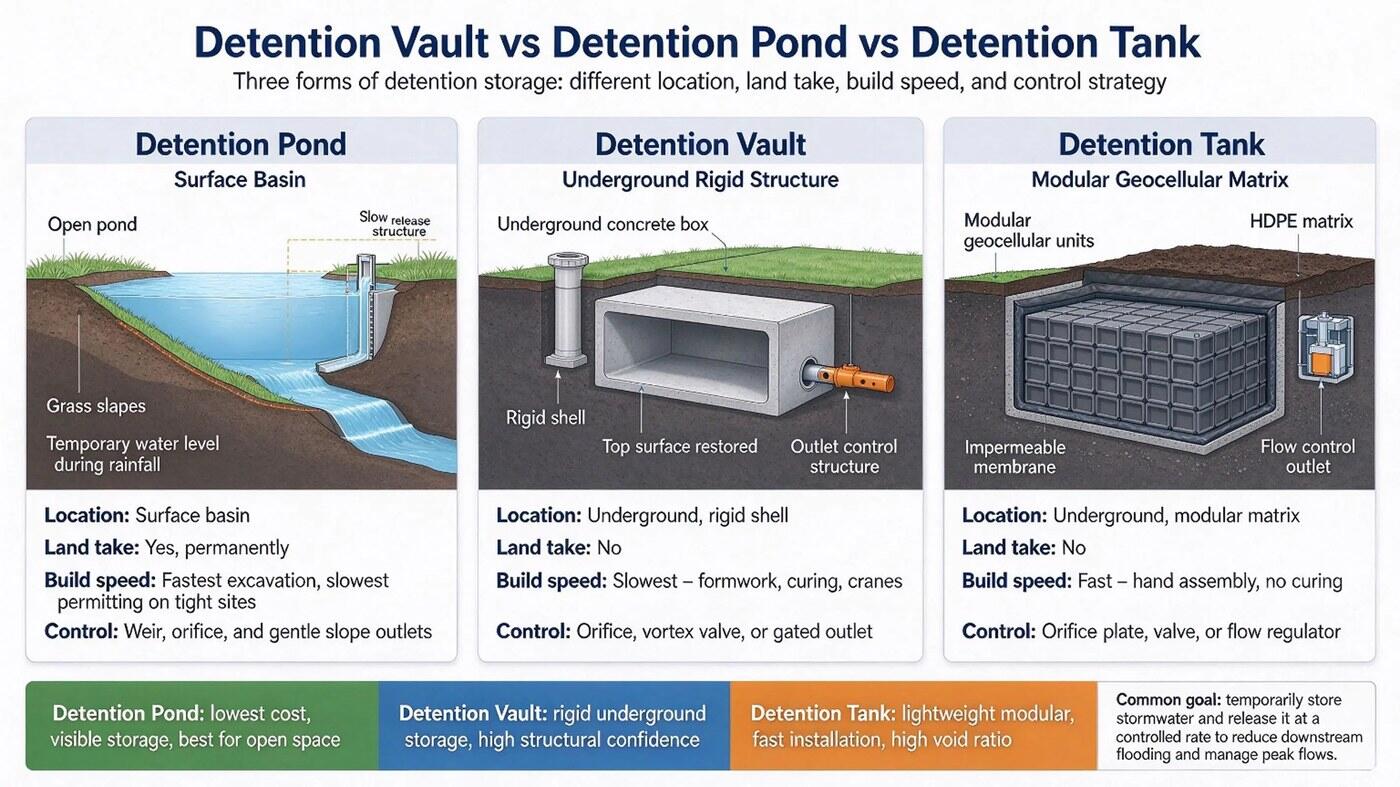
All three forms do the same job: store the peak, release it slowly. They differ in where they sit and what they cost you in land.
A detention pond is a surface basin. Excavators shape it, grass grows on the slopes, and the pond takes land out of service for good. Most basins are also built shallow on purpose, because an open pond that people and pets can reach needs safety ledges and gentle slopes.
A detention vault is an underground rigid structure — most often cast-in-place concrete — with an outlet control inside. It frees the surface completely. The trade is schedule: formwork, curing, and crane time make a vault one of the slower structures to build.
A detention tank built from modular geocellular polypropylene is the third form. Interlocking plates assemble into a structural matrix by hand, sealed with an impermeable geomembrane and fitted with the same flow-control outlet. The verified void ratio is ≥92%, so every cubic meter of matrix nets 920 liters of storage. Load-rated models carry verified vertical loads from >45 to >85 T/m², and deep-burial variants accept cover to 8 m. The matrix stores the peak while parking, lawns, or traffic lanes stay in service above it.
One detail is common to all three: the outlet control. An orifice plate, a vortex valve, or a weir is sized to the permitted discharge. That device is what turns a hole in the ground into a detention structure.
| Form | Where it sits | Land taken | Build speed |
|---|---|---|---|
| Detention pond | Surface basin | Yes — permanently | Fastest excavation, slowest permitting on tight sites |
| Detention vault | Underground, rigid shell | No | Slowest build (formwork, cure, cranes) |
| Modular detention tank | Underground, geocellular matrix | No | Fast — hand assembly, no curing |
Detention vs Retention in One Sentence
Retention keeps a permanent pool; detention only borrows stormwater and releases it after the peak. That single difference decides which structure your ordinance asks for. For the full side-by-side of both duties, see the underground detention and retention systems guide.
How Detention Tanks Are Sized
Two regulatory numbers set the target: the design storm return period your drainage authority requires, and the maximum discharge it permits. One site calculation follows. Runoff volume equals catchment area times rainfall depth times runoff coefficient (V = A × P × C). The storage the tank must provide is that runoff volume minus whatever may leave during the storm at the permitted rate.
As a planning-scale example, a 400 m² catchment at 800 mm of annual rainfall yields roughly 272 m³ of runoff per year. The design-storm fraction of that, less the permitted release, is the volume to buffer.
Depth is a design input too. Typical cover runs to 3.5 m, and deep-burial variants are rated to 8 m. Below the array, the base slab and any anti-flotation anchoring follow from the ground survey, not from guesswork. Every one of these numbers comes from the site plan and the local manual — the tank hardware adapts to them, never the reverse.
What Drives the Cost of a Stormwater Detention Tank
Detention pricing is project-based, and three inputs move it most: storage volume, loading class, and ground conditions. Volume scales the matrix directly. Loading class matters because a lane for fire trucks demands a higher rating than a landscaped swale. Ground conditions set the excavation, the base slab, and any anchoring the water table forces.
Top stormwater detention tank systems for subdivisions share one trait: they phase. Each housing phase adds a module array through standard pipe couplings instead of rebuilding a basin. The detention tank size on the first phase is decided by that phase's catchment alone.
For mid-sized construction companies, the best stormwater detention tanks are the ones that cut the critical path. Modular PP weighs roughly 1/30 of the equivalent concrete structure and installs 60%+ faster, with no curing. It also needs more than 30% less excavation than a gravel bed for the same storage. Modern projects count the sustainable-construction column as well: less haul-off, less concrete, and a surface that stays in revenue use.
Price quotes come from the same three inputs. Send them to the manufacturer and the quote reflects your site, not an average. In New Zealand, the same modular duty applies under local council design guides — confirm the approval path early.
Model-level specs and the detention product line sit on the stormwater detention modules page. The wider attenuation duty behind detention is covered under stormwater attenuation tanks.
Frequently Asked Questions
What is a detention pond?
A detention pond is a surface basin that receives stormwater runoff and holds it temporarily. An outlet structure releases the water slowly after the peak passes, so downstream pipes and channels are not overwhelmed. The pond drains down between storms and fills again with the next one. It is the traditional form of detention, and it costs surface land — which is why tight sites move the same duty underground.
What is an attenuation pond?
An attenuation pond does the same job as a detention pond. It buffers the peak and releases water at a controlled rate. "Attenuation" is the structure-level way of describing temporary storage with a controlled outlet. If your plans say attenuation, the hardware is the same family as detention. The duty can sit in a basin on the surface or in a rated tank below it.
What is a stormwater detention vault?
A stormwater detention vault is an underground, box-like structure that detains runoff and releases it through a flow-control outlet. Vaults were traditionally cast in concrete; modular geocellular matrices now serve the same duty with hand-assembled plates and a geomembrane liner. Either way the vault sits below grade, the surface above stays usable, and the structure empties between storms.
How deep can a detention pond be?
Most detention ponds are built deliberately shallow. Safety and maintenance access limit free depth on any basin people can reach. The exact depth allowed on your site comes from the local drainage code, not from the hardware. Underground detention tanks remove that constraint: rated modules accept deep cover and heavy traffic loads that an open pond never could.
Send your target volume, loading class, and ground conditions to YY Tank — engineering responds within 4 working hours and an engineered layout follows within 24.