News


Infiltration Trenches: Design, Details, vs French Drain
27 Nov 2026Infiltration Trenches: Design, Details, vs French Drain
An infiltration trench is a shallow, stone-filled excavation that receives stormwater and lets it soak into the native soil through its bottom and sides. A perforated pipe runs along the stone to spread the flow; a geotextile wrap keeps the stone from silting shut. Nothing pumps, nothing discharges — the trench ends the drainage line by handing the water to the ground. This page walks the cross-section, the design inputs, a sizing example, and the honest list of sites where infiltration trenches work and do not.
Infiltration Trench Details: The Cross-Section
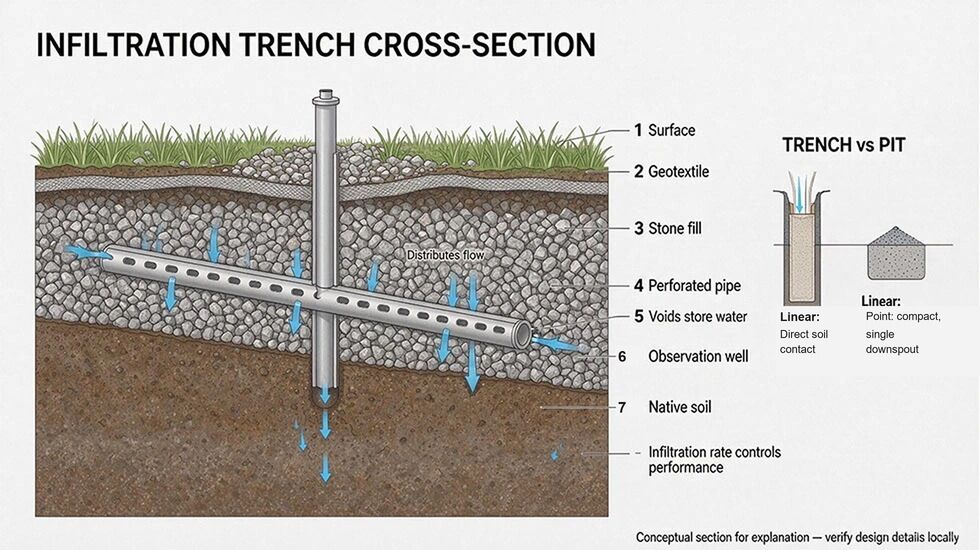
The detail drawing reads top to bottom in six layers, and each layer has a job.
1. Grass or gravel surface — the visible layer, chosen for the traffic the line must take.
2. Geotextile separation — fabric that keeps surface soil out of the stone void while letting water through.
3. Stone fill — washed, uniformly graded aggregate that forms the void the water occupies. The void ratio of the stone bed is the trench's storage capacity.
4. Perforated distribution pipe — a slotted pipe set in the stone, sloped gently, that spreads inflow along the whole line instead of dumping it at one point.
5. Observation well (recommended) — a small standpipe to the surface for inspecting how fast the trench drains.
6. Native soil — the working layer. Its infiltration rate decides everything, and no layer above it can compensate for a soil that will not drink.
An infiltration pit is the same assembly concentrated into a point rather than a line. It is the compact answer for a single downspout where a long trench does not fit. The line form remains the default, because length is what buys contact area with the soil.
Design Inputs for an Infiltration Trench
Four inputs drive infiltration trench design, and the site hands you three of them.
Soil infiltration rate. Measured, not assumed — a simple double-ring or test-pit test at trench depth settles it. Sandy soils drink fast; clays barely drink at all. This single number eliminates more sites than every other input combined.
Groundwater and bedrock depth. The trench bottom needs vertical separation from seasonal high groundwater and impermeable layers, so the water has somewhere to go. Local codes set the minimum separation.
Contributing area and runoff volume. The catchment feeding the trench, times the design storm, gives the volume the stone void must hold while it drains.
Location and load. Trenches sit upslope and away from foundations, and they do not take traffic loads the way engineered pavement does. Setback rules come from the local authority.
One safety rule outranks the rest: infiltration is a soil privilege, not a hardware feature. Where the test says the ground will not drink, no trench design fixes it — that site belongs to storage and controlled release instead.
Siting adds its own short list of refusals. Trenches stay clear of building foundations, property lines, and steep slopes, at the setbacks the local code sets. They avoid utility corridors that a future excavation would open. And they live upslope of anything that resists water, because a soaking trench turns its surroundings into the wet edge of the site.
A Simple Trench Sizing Example
A worked example fixes the logic better than a formula alone. Take a 200 m² roof draining to one line, a design storm of 40 mm, and a runoff coefficient near one for roofing. The runoff volume is area × depth × coefficient: 200 × 0.040 × 1.0 = 8 m³. If the stone bed offers roughly 30% void, the stone volume needed to hold 8 m³ of water is about 27 m³. That lands on the order of an 18 m line, 1 m wide and 1.5 m deep — before any safety factor the local manual adds. The numbers here are illustration; the design that gets built comes from the measured soil rate and the local requirements, not from an example.
The volume formula behind the example is the same one used across water planning: catchment area × rainfall depth × runoff coefficient. A 400 m² roof at 800 mm of annual rain sheds about 272 m³ a year. The design storm slice of that is what the trench must swallow in one event.
Infiltration Trench vs French Drain
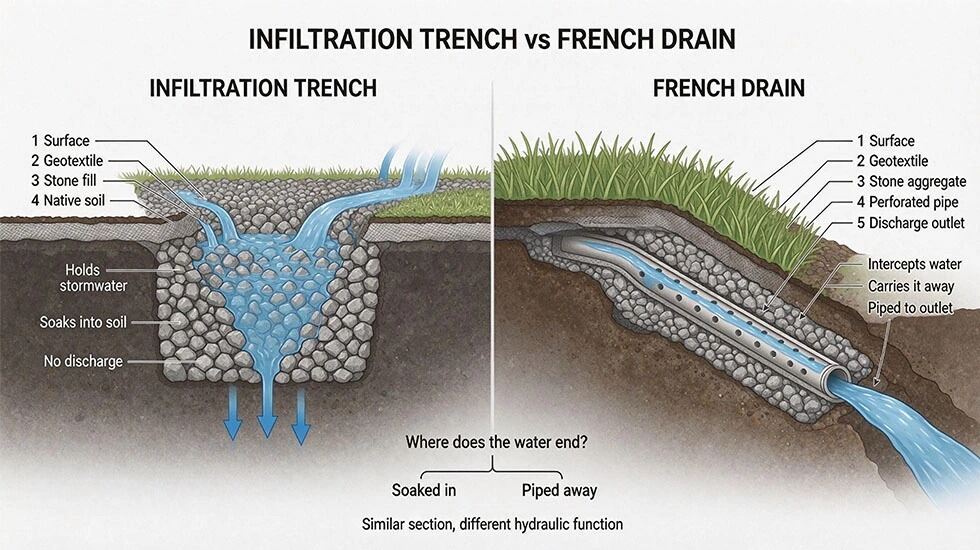
The two look alike in a ditch and do different jobs. A french drain exists to protect a structure: it intercepts groundwater or surface water and carries it away by pipe to a discharge point. An infiltration trench exists to end the water's journey. It holds the storm in stone and lets the soil absorb it, with no discharge at all. Pipe and stone appear in both, which is why the confusion persists. The question that separates them is where the water ends up — piped away is a french drain; soaked in is an infiltration trench.
When a Trench Works — and When Storage Wins
Infiltration trenches are the right answer on soils that drain, water tables that sit deep, and catchments that fit a line on the plan. They recharge groundwater, reduce the discharge the permit counts, and cost little once the dig is budgeted.
They are the wrong answer where clay or a high water table closes the soil. That failure mode is common enough to check first, not last. Where the soil says no, the same volume goes into storage instead: a sealed structure that holds the storm and releases it slowly. The modular form of that alternative — rated crates in a matrix — is described under geocellular crates, and the dedicated product line sits on the infiltration system page for sites where the soil cooperates. The system-level design frame around all of it — which duty a site owes and why — is covered on the what is stormwater management hub, with the network context on the stormwater drainage systems page.
In short: test the soil, size the void, and let the ground's answer choose between a trench and a tank.
Trenches that last share one maintenance habit: someone watches the drain-down. After a big storm the observation well shows water; a day later it should show stone. Standing water past a day means the soil has slowed or the stone has silted. The line gets attention while the fix is still small.
YY Tank engineers the tank side of that decision.
Frequently Asked Questions
What is water infiltration?
Water infiltration is the process of water on the surface soaking downward into soil and rock. It is how rainfall refills soil moisture and groundwater, and it is the mechanism every drainage-by-soil design relies on. Surfaces that seal — pavement, compacted clay — block infiltration, which is why paved sites shed water instead of absorbing it.
What is the simplest definition of infiltration?
Infiltration is water entering the ground. Infiltration is water entering the ground; every technical version elaborates that one line. The soil's acceptance rate, measured in depth per unit time, decides whether it works quickly or barely at all.
What are infiltration trenches?
Infiltration trenches are shallow, stone-filled lines that receive stormwater and release it into the surrounding soil. A perforated pipe spreads the flow through the stone; geotextile keeps soil out of the void. The trench holds the storm temporarily in the stone's air space while the ground draws it away. It is drainage with no outlet — the soil is the outlet.
What is the main difference between a rainwater tank and a stormwater tank?
A rainwater tank stores water as a resource: sealed, kept dark, and drawn down for use. A stormwater tank manages water as a liability. It holds runoff only until it can be released slowly or soaked away, and it empties between storms. Infiltration is the third path — no liner, no outlet, and the soil does the emptying. The duty decides the hardware.