News


Yingyuan Holds First Business Meeting with Saudi Geosynthetic Partner
27 Nov 2026Yingyuan Holds First Business Meeting with Saudi Geosynthetic Partner
On 25 November 2026, Jiangsu Yingyuan Sponge City Technology Co., Ltd. held its first formal business meeting via video conference with a Saudi geosynthetic specialist that supplies major contractors and has experience with owner-approval procedures. The discussion covered the technical suitability of modular stormwater storage, the certification pathway and the pace of cooperation, and both sides agreed on a phased approach: a trial order first, product and delivery validation second, a longer-term partnership after that.
Why Saudi Arabia Is Rethinking Stormwater Management
Saudi Arabia's desert climate delivers concentrated rainfall with high evaporation. Urban drainage has traditionally been designed to move stormwater away as fast as possible. As major developments and urban renewal projects advance, project owners are looking beyond drainage alone—toward detention, retention and reuse. That shift creates demand for integrated stormwater detention modules, a category where local supply capacity remains limited.
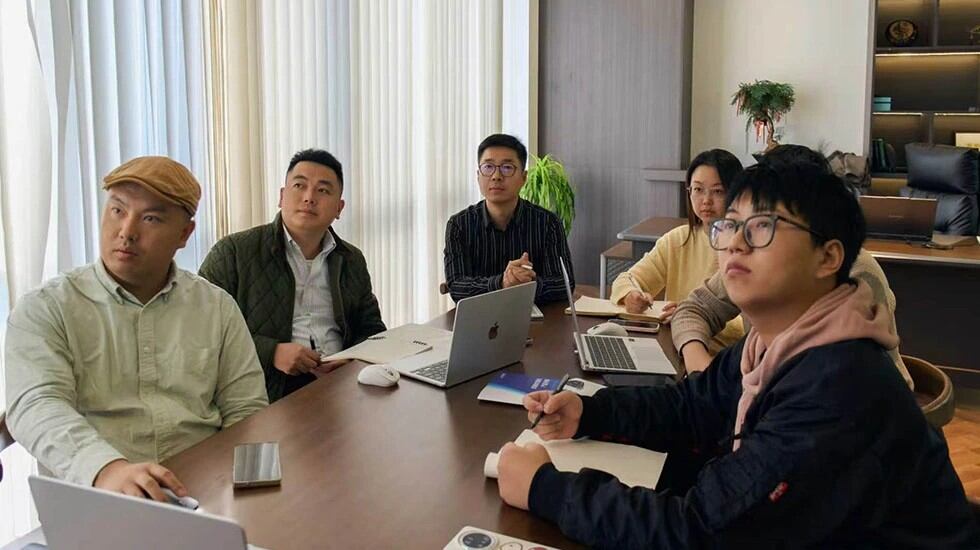
The Saudi participant is more than a conventional trading company. It specializes in geosynthetic applications, including reinforced soil structures, drainage and soil protection, and its in-house engineering team handles design and detailed engineering work. Because the company already serves major contractors and has been through owner-approval procedures, it understands local technical requirements and project-entry steps first-hand.
That background shaped the discussion. Rather than a narrow request for quotation, the meeting examined whether Yingyuan's products could qualify for Saudi project systems—and what technical and procedural steps that would take.
Four Load Classes, One Modular System
Yingyuan's product range is built around two operating variables: ground loading and soil cover depth. Instead of a one-size-fits-all approach, four models cover different load classes and site conditions.
| Model | Dimensions (mm) | Load capacity (surface load) | Typical applications |
|---|---|---|---|
| 1000-HD | 1000 × 500 × 200 | >85 t/m² vertical, >45 t/m² lateral; max. install height 8 m | Roadways, ports, logistics yards, deep-cover areas |
| 1000-EW | 1000 × 500 × 200 | >70 t/m² vertical, >30 t/m² lateral; max. install height 5 m | Roadways and high-load, deep-burial conditions |
| Model | Dimensions (mm) | Load capacity (surface load) | Typical applications |
|---|---|---|---|
| 1200-SD | 1200 × 600 × 300 | >85 t/m² vertical, >30 t/m² lateral; max. install height 5.4 m | Underground garages and specialized engineering applications |
| 1200-EW | 1200 × 600 × 300 | >45 t/m² vertical, >15 t/m² lateral; max. install height 3 m | Sidewalks, medium-load parking areas |
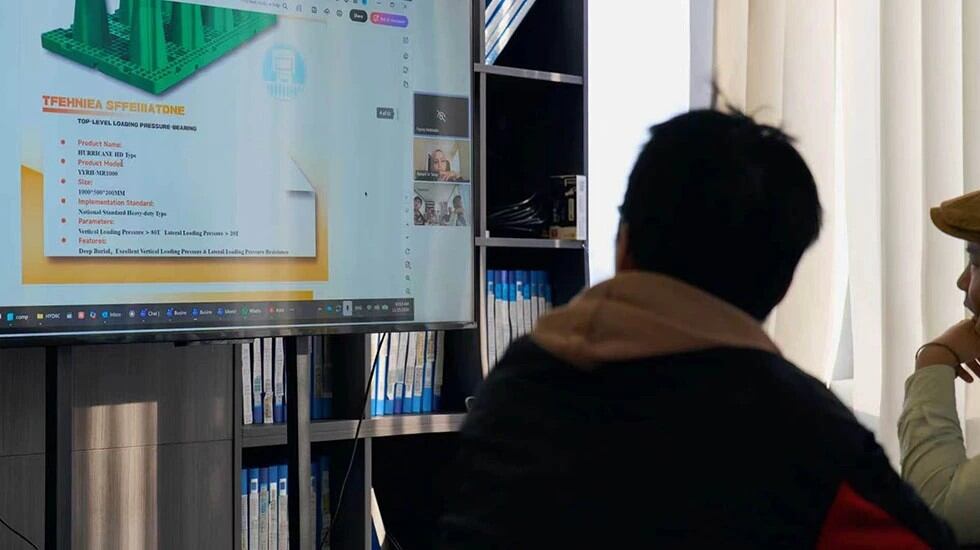
The Saudi engineering team showed clear interest in this tiered logic. Local projects often involve multiple stacked layers topped with a concrete or panel-based structural layer, which demands both vertical load-bearing capacity and lateral stability. The 1000-HD model addresses exactly this context: an 8 m maximum installation height and more than 85 t/m² vertical capacity accommodate combined requirements beneath roadways and in deep-cover areas.
Material formulation and structural design can also be matched to project-specific load requirements. Yingyuan can use virgin material, recycled material or a blend, with wall thickness and formulation selected to meet the required load class rather than applying one specification everywhere. In practice, a single product family can serve different zones within the same project—higher-load configurations for main access roads, lighter specifications for landscaped and amenity areas—so you avoid sourcing separate systems from multiple suppliers.

It is worth being precise about the module's role. The modules provide the storage-and-controlled-release function: temporarily holding peak rainfall volumes that exceed the drainage network's discharge capacity, then releasing water at a controlled rate or directing it for reuse. They are not standalone water tanks. They form part of an integrated system that also includes upstream debris and pollutant interception and downstream treatment.
If you are selecting modules for a project, you can request the product catalog and parameter sheets to compare load classes, dimensions and burial depths side by side.
Getting Products Into Saudi Projects: SABER and Test Reports
Market access centers on the SABER conformity-assessment process. Standard test reports covering indicators such as density and water absorption will be required. In practice, the division of work looks like this:
• Certification responsibility: the Saudi partner, as importer, handles SABER registration and customs clearance; Yingyuan provides supporting test reports and technical documentation.
• Testing laboratories: Yingyuan proposes CNAS-accredited laboratories for material-performance testing, of which China has a substantial pool.
• Third-party assessment: a factory assessment by an organization such as TÜV may be involved. Based on the partner's prior sourcing experience, performance test reports are generally the main requirement, while an on-site factory audit is not necessarily mandatory.
• Local testing capacity: Saudi Arabia currently has limited facilities for this product category, so samples may need to be sent to Europe. Complete, traceable and properly documented test reports therefore carry real value in your market-entry process.
Both sides share the view that certification and testing are manageable and should not block cooperation. The real work lies in preparing documentation and coordinating procedures—certification support can be planned alongside the first order rather than after it.
A Phased Route: Trial Container First
A one-container trial order is the agreed starting point, and the reasoning is practical. Capacity can be scheduled to match project phasing, but ocean freight requires several weeks, so shipment planning starts early and the arrival date of the first shipment becomes a factor in project scheduling. A single container gives you a manageable initial stock level while both sides assess the delivery process under real conditions.
The sequence is designed to surface risks early:
1. Formal RFQ: the Saudi partner issues a request specifying excavation conditions, material requirements, project location and required volume—the four details essential to accurate selection and pricing.
2. Quotation and technical package: Yingyuan returns a quotation with a complete package—product list, company profile, technical documentation, installation videos and test reports—that the partner can present to its end customers.
3. Trial shipment: one container serves as initial stock and as a practical test of coordination under real delivery conditions.
4. Longer-term arrangements: subject to trial results and market feedback, the parties discuss a longer-term framework.
Exclusivity was not finalized. The Saudi partner expressed interest in an exclusive agency arrangement; Yingyuan remains open to agency, factory-level cooperation and distribution. The shared approach is to complete documentation and quotation first, validate through a trial order, and then discuss exclusivity if the cooperation proves mutually beneficial. The partner also raised a contract-manufacturing opportunity—molds and other plastic products built from samples it would supply—and Yingyuan confirmed it has mold-development capabilities, to be discussed separately.
Installation Quality Decides Field Performance
One point came up repeatedly: the field performance of modular stormwater systems depends heavily on installation quality. The Saudi partner asked specifically whether Yingyuan could send technical personnel to guide its installation team on site.
Yingyuan confirmed its willingness to provide that support and to include installation instruction videos in the technical package. The aim is to reduce construction risk during first application. The details that matter most are alignment between stacked module layers, connections to inspection chambers and drainage networks, and the correct sequence for laying the impermeable liner. Deviations here directly affect load-bearing and watertight performance, and drawings alone rarely communicate every installation detail.
The two sides also agreed that whenever the partner receives a relevant local inquiry, it will share the information promptly so both teams can follow up together. This direct coordination matters where language differences complicate technical communication—end customers' engineering questions often need answers straight from the manufacturer, and fewer intermediaries means less information loss.
Work With Us
If you are evaluating stormwater detention modules for a project in Saudi Arabia, the fastest route to an accurate quotation is to send us four details:
1. Excavation depth — the available soil cover above the module system.
2. Load requirements — expected surface loads and traffic class above the installation.
3. Project region — location and site conditions.
4. Required volume — the storage capacity your project needs.
With these four inputs, you can contact our team to request a quotation, a test report list and the full technical package. We will also outline the certification documentation sequence for SABER conformity assessment, so your procurement and engineering teams can plan entry into the Saudi market with clear timelines. If a trial order makes sense for your first project, we can schedule a container shipment and validate the delivery process together before scaling up.
Yingyuan Sponge City Technology operates two production bases in Jiangyin and northern Jiangsu, providing one-stop service for PP stormwater modules across Jiangsu, Zhejiang and Shanghai, with nationwide delivery available. Our products are also exported to overseas markets.