Search
News


Contact
Send
Residential and Commercial Rainwater Collection Systems
17 Nov 2026Residential and Commercial Rainwater Collection Systems
Residential rainwater collection systems are the capture, storage, and delivery hardware that turns roof runoff into usable water. The same logic scales from one rain barrel on a bungalow to a buried modular field under a housing development. What changes between those poles is volume, burial, and pumping — not the idea. This guide sorts the market into four tiers, prices each honestly, and shows where homes and commercial buildings make different choices.
The Four Tiers of Residential Rainwater Collection Systems
Pick a tier by two questions: how much water the household wants, and how invisible the hardware must be.
| Tier | Typical kit | Storage range | Fits |
|---|---|---|---|
| Small (entry) | Rain barrel at one downspout, spigot, overflow | Tens of gallons | Watering cans, garden hoses, first-time buyers |
| Standard home | Gutter mesh, first-flush diverter, pump, one tank | A few hundred gallons | Garden irrigation, car washing, toilet supply where allowed |
| Stand-alone | Gravity tank on a stand, no mains connection | Hundreds of gallons | Cabins, sheds, off-grid plots with no metered supply |
| Large property | Buried cistern or modular tank field, pump set | Thousands of gallons | Large lots, estates, homes with high irrigation demand |
A small rainwater collection system costs little and installs in an afternoon, but it empties in one dry week. It is the right answer for a first tank and the wrong answer for a garden that drinks daily. The standard home tier is where most residential rainwater collection systems actually sit: one protected tank, one pump, and clean-enough water for everything outdoors.
A stand-alone rainwater collection setup trades capacity for independence — no mains, no bills, and no backup. It suits cabins and outbuildings where the meter never reaches. The large tier moves underground, which is where the tank stops competing with the patio for space and starts serving irrigation at estate scale.
One component note before the tiers mislead anyone: filtration is part of every tier above the first, and it has its own selection logic. This page stays at the system level; the equipment itself is a separate decision.
A rainwater collection system for home use is chosen from the demand backward and the budget forward. The tier that satisfies both is the right one. Start small only when the demand is genuinely small. Start underground when the surface has better uses than a tank. Both rules fail in the same direction — underestimating demand, then adding capacity in awkward increments later.
Commercial and Multi-Unit Systems
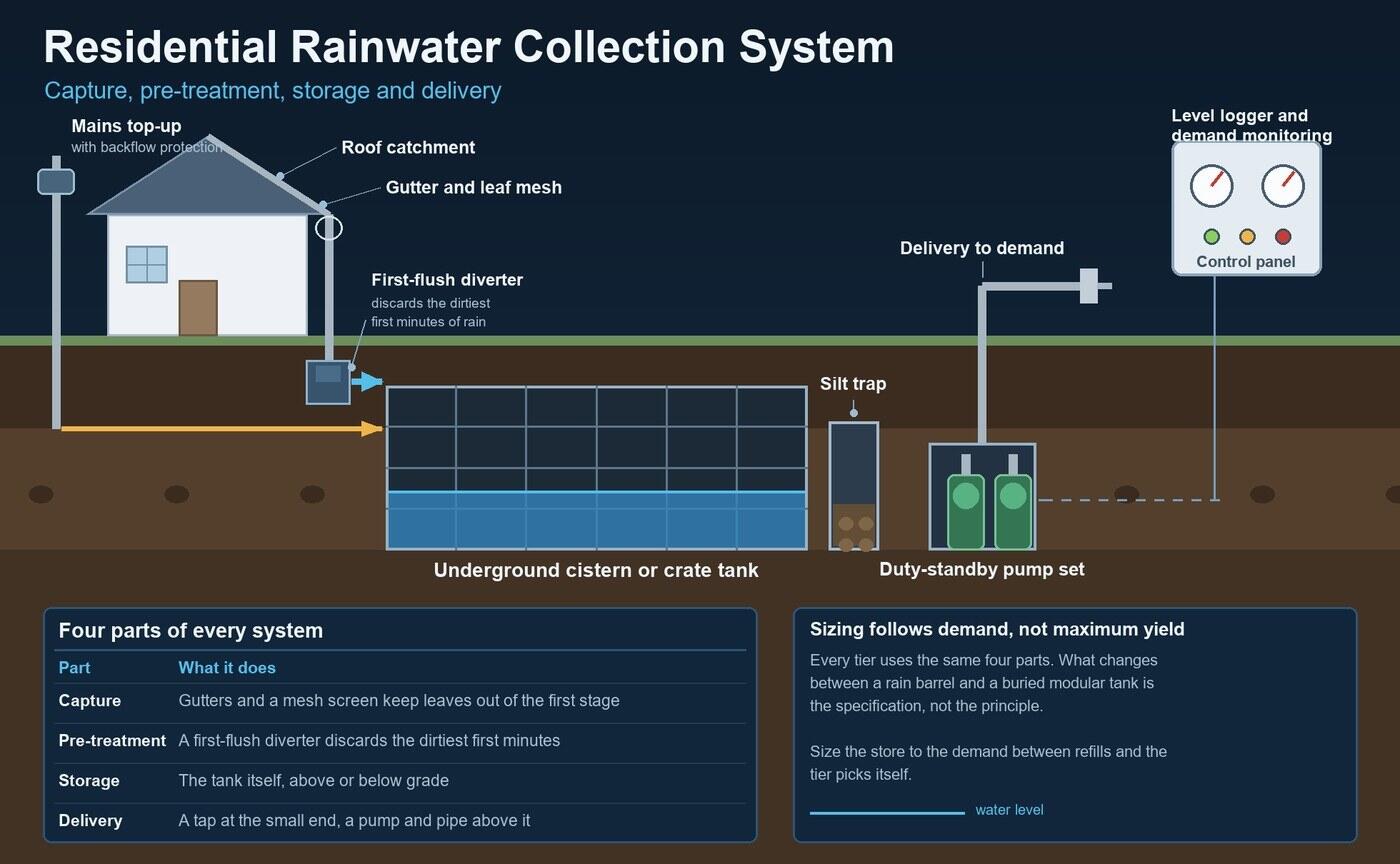
Commercial rainwater collection systems follow the same capture-store-deliver pattern at a different order of magnitude. Office campuses, hotels, and vehicle fleets wash and irrigate with harvested water to cut metered demand. Rainwater harvesting for commercial developments usually justifies itself on three lines: the water bill, the stormwater fee, and the sustainability score the building reports.
The equipment list grows with the building, not the principle. A large roof adds first-flush diversion and finer pre-filtration before storage. Delivery moves from a single pump to duty-standby sets, and controls start logging levels and demand. Large rainwater harvesting systems also plan for the weeks when the tank runs dry. A mains top-up with a legal backflow arrangement keeps the supply honest without wasting the harvest.
For rainwater harvesting systems for multi-unit developments in Ireland, the pattern is proven across apartment and housing schemes. Roof collections from each block feed a shared buried tank, and the stored water serves toilet flushing and external taps. An underground array under parking keeps the amenity space intact. Sizing follows the same catchment math as any other project — the local rainfall record matters more than the postcode. Suppliers ship engineered kits internationally, so the manufacturer you buy from does not need to be local.
The best integrated rainwater harvesting and treatment technology, in practice, is the boring kind. Catchment, pre-treatment, storage, pump, and controls get specified as one matched line, rather than assembled from five catalogues. Integrated specification is what makes the water quality predictable and the warranty enforceable.
What a System Costs
Installed cost anchors from current market guides:
• A rain barrel setup runs $300–$1,200 installed — the entry tier, pump excluded.
• Cistern and tank systems run $2,500–$15,000 depending on volume and burial.
• Complete retail packages for large homes quote $8,160–$21,500.
• A delivery pump adds $80–$700; basic filtration hardware adds $300–$500 on small systems.
Residential rainwater collection cost rises with burial, not with ambition. Buried systems carry excavation in the price; surface tanks do not. The full cost stack, line by line, is broken down in the rainwater harvesting system cost guide.
Before the quote, one check that costs nothing: the local rules on collection. No state bans residential collection outright today, but registration and volume limits exist in a few — the is rainwater harvesting illegal guide tracks them state by state.
The payback math is measurable. Every 1,000 liters saved is up to $4.60 off the water bill where metered rates apply. A documented academic case recovered a $22,386 investment at roughly $2,236 per year — about a ten-year payback — on irrigation displacement alone.
Two habits keep a budget honest once the anchors are on the table. Get the excavation quoted separately from the tank, because ground quotes swing wider than hardware prices ever do. And carry the pump and controls as their own line, since they are the parts most often value-engineered out and then blamed for the shortfall.
Sizing After You Pick a Tier
Tier first, numbers second. The yield formula is V = A × P × C: roof area times rainfall depth times runoff coefficient. A 400 m² roof at 800 mm of annual rain sheds about 272 m³ per year. Most households cannot store that much, which is why realistic demand — not maximum yield — sizes the tank. Work the numbers properly with the catchment area calculator tool, then come back to the tiers with a volume in hand.
Demand-side math runs in the other direction. A household that irrigates a garden several times a week will cycle a few hundred gallons repeatedly. That rhythm favors a standard tank refilled often. An estate with pasture taps or a large landscape draws thousands of gallons between storms, which is the large tier's case. Size the store to the demand between refills, and the tier picks itself.
What Every Tier Shares
Four parts appear at every scale, only the spec changes. Capture: gutters and a mesh screen that keeps leaves out of the first stage. Pre-treatment: a first-flush diverter that discards the dirtiest first minutes of a storm. Storage: the tank itself, above or below grade. Delivery: a spigot at the small end, a pump and hose line above it. Specifying those four as one matched line is what separates a system from a pile of parts.
The system overview behind every tier — capture, conveyance, treatment, delivery — lives on the rainwater harvesting system pillar page. If the tank belongs underground, the buried rainwater harvesting tank product page is the hardware starting point for excavation-ready volumes.
Keeping a Collection System Honest
Three checks keep any tier working through the year. The gutter mesh and first-flush diverter get a seasonal clean, because capture quality decides storage quality. The tank gets a level check and an overflow test after the first big storm of autumn, which is when blockages show themselves. The pump gets its filter and float checked before the irrigation season, when it will be asked to work.
Underground tiers add one more habit: the access chamber is opened and the inlet screen looked at. That takes minutes and prevents the only failure mode buried storage really has — silt arriving where it cannot be swept out. None of these checks needs a contractor; all of them need a calendar entry.
Frequently Asked Questions
What are the two methods used for rainwater harvesting?
The two methods are surface collection and rooftop (ground) collection. Rooftop harvesting gathers rain from the roof through gutters into storage — the method behind nearly every residential and commercial system on this page. Surface methods collect runoff that flows across land, which is common in agriculture and large landscape schemes.
Is harvesting rainwater worth it?
It is worth it when the demand is steady and the roof is big enough to feed it. The documented case above paid back in about ten years at $2,236 saved per year against a $22,386 install. Gardens, laundry-to-landscape lines, and commercial wash-down demand reach payback fastest. A barrel used three months a year will not, and honesty about that keeps the decision credible.
Where to buy water tanks near me?
Rainwater tanks reach buyers through three channels: factory-direct manufacturers, regional distributors, and retail chains for small barrels. Small barrels are a same-day retail purchase. Buried tanks and modular systems are normally factory-direct, because the tank is engineered to the site rather than picked off a shelf. Any of the three channels can be right — the volume and the burial decide.
What states have banned collecting rainwater?
No U.S. state bans residential rainwater collection outright today. A few states regulate it with registration or volume limits, and several actively encourage it with rebates. The state-by-state rules, with the statutes named, are covered in the dedicated legality guide.
How much does it cost to install rainwater harvesting?
Installed costs run from $300–$1,200 for a rain barrel setup to $2,500–$15,000 for cistern and tank systems, with large complete packages quoting $8,160–$21,500. Pumps add $80–$700 and basic filtration $300–$500 on small systems. Burial is the biggest single cost lever, because excavation enters the bill. The cost guide linked above carries the full stack.
Request a tier recommendation with your roof area and demand — contact YY Tank for a system layout.