News


Underground Water Tank for Home: Sizing & Pumps
10 Nov 2026Underground Water Tank for Home: Sizing, Pumps, and Installation
An underground water tank for home use sits beneath the lawn or driveway and holds water where nobody can see it. The homeowners in this scenario want the same thing: reliable storage without surrendering the yard to a plastic tower. An underground water tank for home duty delivers exactly that trade — excavation and a pump on one side, a full surface above on the other. This page walks the sizing logic, the pump decision, and the installation sequence in order.
Why Put a Water Tank Underground?
Burial solves three household problems at once. The tank disappears, so the surface stays a garden, a patio, or a play area. The soil protects the tank from frost and sunlight, extending its working life. And storage at depth holds a stable temperature — underground tanks keep water near 12–15 °C, which suppresses algae and keeps the water fresher between uses.
Homeowners often arrive searching an underground water reservoir tank, meaning the same thing in different words: a buried reservoir dedicated to the household. Reservoir-style storage is simply the largest expression of the idea — capacity measured in thousands of liters rather than garden barrels.
What Size Underground Tank Does a Home Need?
Home water storage tank systems divide by duty, and the duty sets the volume:
• Garden and landscape irrigation — the smallest duty. A modest buried tank covering dry spells between rains is enough for most yards.
• Toilet flushing and laundry — the mid band. Supply tracks the household's indoor non-potable demand.
• Whole-house backup or off-grid supply — the largest band. Sizing starts from the household's daily consumption and the longest dry stretch on local records.
A useful anchor: a 1,000-gallon class tank with a pump is the practical entry point for household supply duty, not merely irrigation. Larger volumes follow the same math at scale — our underground rainwater storage comparison guide carries the sizing bands from 5,000 gallons upward. For drinking-grade ambitions, the storage is only part of the chain. Treatment and local approval come first, and the equipment category is covered in our underground water storage tank guide.
Choosing an Underground Water Tank with Pump
The pump is what turns a buried tank into household pressure. An underground water tank with pump duties needs three decisions:
• Pump type. A submersible pump sits inside the tank, quiet and protected from frost. An external pump stays accessible for service but needs a frost-proof location.
• Pressure duty. Irrigation tolerates modest pressure; household fixtures expect city-like pressure and flow. Size the pump to the worst fixture, not the average one.
• Controls. A pressure switch or a variable-speed controller keeps delivery steady. Harvesting systems add a mains top-up valve so the tank never runs dry.
Hardware budgeting follows published retail anchors: pumps run $80–$700 depending on duty, and small-system filtration adds roughly $300–$500 where the use case needs it. When the search starts from "underground water tank for home with pump", this trio — pump type, pressure duty, controls — is the actual specification. One more selection note. Harvesting systems that feed a garden rarely need more than a small transfer pump, while whole-house pressure duty justifies a variable-speed unit.
Installation Sequence
A buried residential tank goes in as a project, not a purchase. The sequence looks like this:
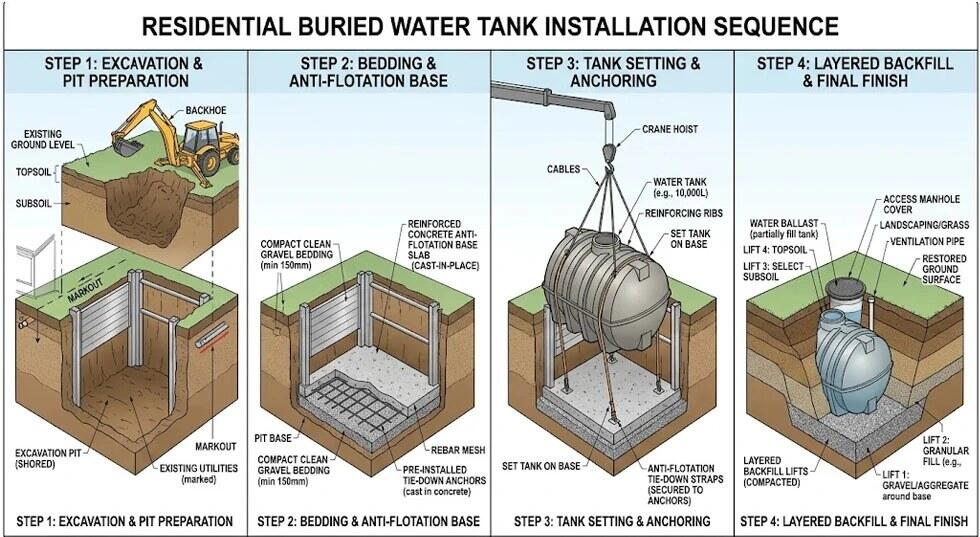
1. Survey. Locate utilities, check the water table, and confirm the tank position clears foundations and tree roots.
2. Excavate. Dig the pit to the tank's footprint plus working clearance, with a bedding layer at the base.
3. Set and level. Lower the tank onto the bedding and level it. High water tables call for anti-flotation measures — a concrete base slab or geogrid anchoring, decided by the site survey rather than guesswork.
4. Plumb. Connect inlet from the downpipes or supply, overflow to a safe discharge, and the pump outlet to the service line.
5. Backfill and finish. Backfill in layers, compact gently, and restore the surface above.
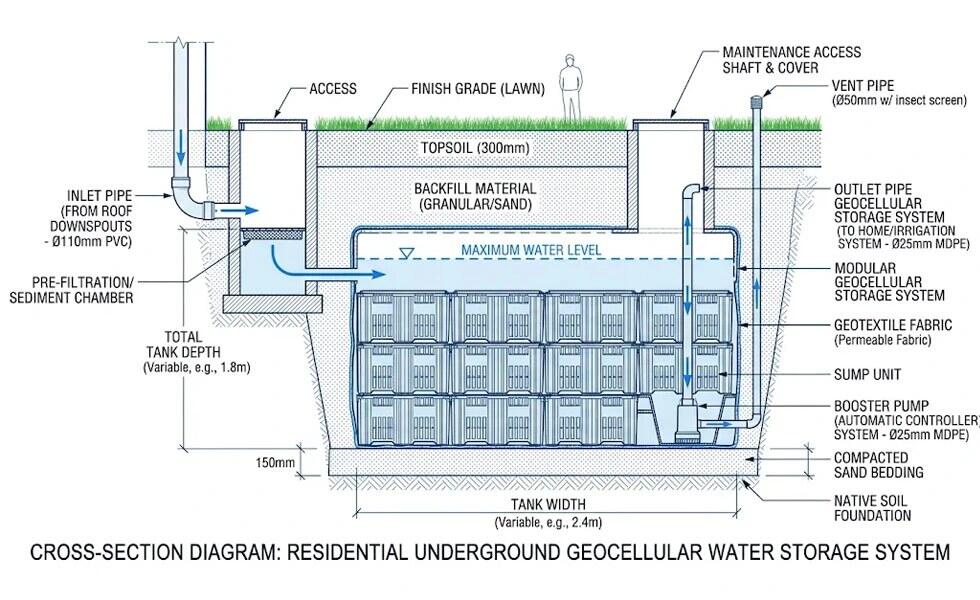
Step 3 is where the water table argues with the plan. Anti-flotation is cheap at design time and expensive after the first wet season.
Where the Family Fits
A household tank is the small end of a storage family. The category overview — materials, sizes, and duties — lives on our underground water storage tank hub. The harvesting role pairs it with roof capture on the rainwater harvesting tank product page. For a sized layout of a home installation, send the household size, duty, and location rainfall to YY Tank. We return an engineered layout within 24 hours.
Frequently Asked Questions
How much does a 200 litre water storage tank cost?
A 200-liter tank is about 53 US gallons — rain-barrel class, above-ground territory rather than buried. Complete rain barrel installations run $300–$1,200, and a bare 200-liter barrel typically lists in the low hundreds of dollars before fittings. At that scale you are buying garden convenience; buried household supply starts an order of magnitude larger.
How do I install a water tank?
For an above-ground tank: choose level ground, set a stable base, connect the inlet and overflow, and fit the tap or pump. For a buried tank, the sequence adds excavation, bedding, anti-flotation checks, and layered backfill — see the installation section above. Local codes govern plumbing connections, so involve a licensed installer.
How do water tanks work?
A water tank is a sealed reservoir with three openings. The inlet admits water, the outlet serves the tap or pump, and the overflow spills what the tank cannot hold. Gravity fills it; a pump or elevation head delivers from it. Sealed storage keeps out light and insects, which is what keeps the water usable between fills.
How many litres per square metre is 50 mm of rain?
Fifty millimeters of rain delivers 50 liters per square meter — one millimeter of rain equals one liter on each square meter. A 100 m² roof under that storm therefore sheds about 5,000 liters before losses, and roof coefficients trim the harvest to roughly 85–90% for typical roofing.