News


Underground Stormwater Storage: Tanks, Modules, and Ponds
12 Nov 2026Underground Stormwater Storage: Tanks, Modules, and Ponds
Stormwater storage is the practice of holding runoff back in a tank, a modular matrix, or a pond. The water then leaves the site slowly instead of all at once. Put that storage underground and the surface above stays in service. The stormwater tank meaning, in plain terms, is a buried structure whose job is buffering. It receives what a storm delivers and meters what it releases. This page compares the storage forms and lists the specification numbers that matter.
What Is Stormwater Storage?
A site does three things with stormwater: convey it, store it, and treat it. Storage is the middle duty, and it exists because rain arrives in bursts while drains accept flow at a fixed rate. Storage absorbs the difference.
Underground storage earns its place on two arguments. Land above a buried structure remains a parking lot, a yard, or a road — surface ponds surrender that land permanently. And buried storage sits at stable temperature, near 12–15 °C, which matters where stored water is later reused. Stormwater storage systems therefore dominate commercial and municipal plans wherever land value is real.
The category overlaps its neighbors. A storage structure fitted with a sealed membrane and reuse pump becomes a harvesting reservoir; fitted with a flow-control outlet, it becomes a detention system. The duty is chosen by fittings — the storage volume is the shared foundation.
Storage Forms: Tanks, Modular Systems, and Ponds
| Form | Structure | Best for | Trade-offs |
|---|---|---|---|
| Single-shell tank | One-piece concrete, HDPE, or PP vessel | Small volumes, simple sites | Capacity limited by transport size; excavation per unit |
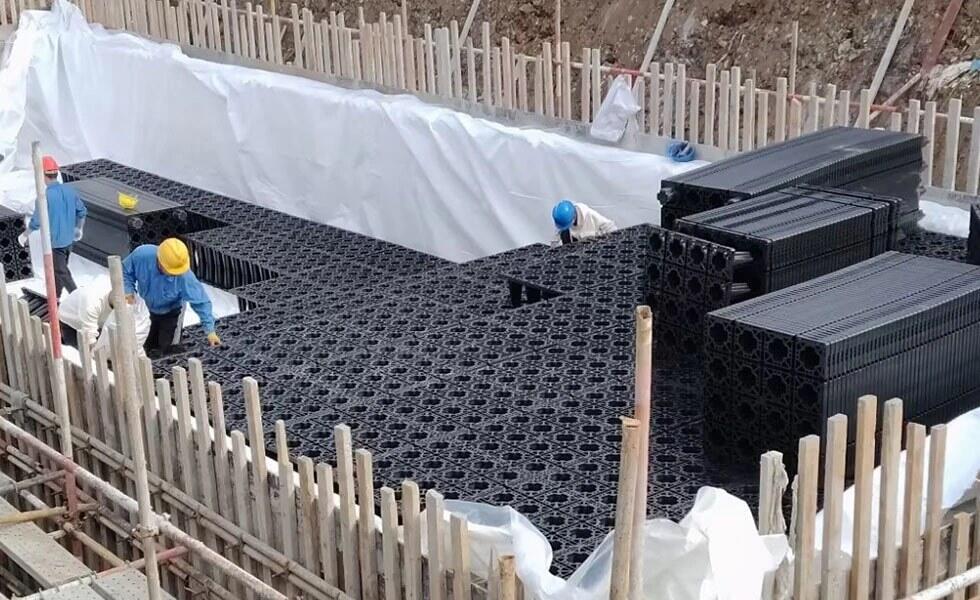
| Modular matrix | Geocellular PP crates, wrapped or open-based | Large volumes under parking and landscapes | Needs membrane/wrap detailing; module inspection |
| Open pond | Graded surface basin | Large sites with spare land | Consumes land; safety and algae management |
| Vault | Rigid precast box | Heavy traffic areas | Crane install; higher unit cost |
For most underground stormwater tanks projects, the choice narrows to shell versus matrix. The best underground stormwater tanks configuration is the one whose loading rating, volume, and footprint match the site — brand names sort downstream of those three.
Maintenance profiles differ more than purchase prices. A single-shell tank is inspected through one access opening, so a missed problem stays hidden until it surfaces. A modular matrix offers ports across the bed, and a damaged module can be swapped without touching its neighbors. Ponds demand the most routine work — mowing, sediment removal, and safety inspections — which is exactly the labor burial eliminates.
Modular systems carry the strongest specification story. Geocellular polypropylene modules interlock into a matrix with at least 92% void ratio — each cubic meter of structure nets about 920 liters of storage. Verified vertical ratings run from above 45 to above 85 tonnes per square meter, and standard modules handle typical cover of about 3.5 meters. Individual modules are inspectable and replaceable, which is what "storage units" means at the maintenance counter.
Why Put Stormwater Storage Underground
Three drivers recur in project files. Land value leads: a buried matrix preserves the surface that a pond would consume. Compliance follows: ordinances cap discharge rates, and storage is how a site meets them. Climate resilience finishes the case — storage sized for today's storms buffers tomorrow's larger ones.
Location shapes the specification too. California projects, for instance, pair storage with retention and treatment duties under state stormwater permits, so the storage volume grows beyond flood control alone. Confirm the permit before sizing — it names the release rate and the water quality volume the structure must honor.
Sizing and Specification Basics
Sizing starts from the permit, not the catalogue. The required volume equals the design storm's runoff minus what may release during the storm; the difference is what the structure holds. Commercial quotations price three inputs together: storage volume, loading class, and ground conditions. That is why underground stormwater tanks price per project rather than per sticker.
For sale listings rarely disclose those inputs, so treat catalogue pricing as a starting conversation rather than a number. Send the three inputs to YY Tank for a quotation within four hours, with an engineered layout inside 24.
The duty splits at the fittings. Storage that meters a release serves the detention duty — its vocabulary and design live under underground detention and retention systems. Storage that keeps water for reuse crosses into harvesting, covered under underground rainwater collection systems. The attenuation principle behind most permit requirements is explained on the stormwater attenuation tanks hub. The full storage category — materials, sizes, and reuse duties — lives on the underground water storage tank hub.
Frequently Asked Questions
What is the purpose of an underground water tank?
An underground water tank stores water beneath the surface so the land above stays usable. In stormwater duty it buffers runoff and meters the release; in harvesting duty it holds rain for reuse. Burial also protects the water from frost and sunlight, keeping it cool and stable.
How long will a 10,000 gallon water tank last?
A well-made tank outlasts its warranty by a wide margin, and most buried polypropylene and concrete systems are designed for decades of service. Longevity depends on material, installation quality, and groundwater conditions rather than a fixed calendar. Ask the manufacturer for the design life and the warranty terms in writing.
What is an underground detention system?
An underground detention system is a buried storage structure that holds runoff during a storm and releases it slowly through a controlled outlet. It drains down completely between storms, which distinguishes it from retention, which keeps a permanent volume. The full comparison of the two duties lives in the detention-and-retention guide.