News


Underground Rainwater Storage: PP Module vs Traditional Tank
22 Oct 2026Underground rainwater storage eliminates the surface footprint problem that plagues above-ground tanks while providing thermal stability that keeps stored water cool and inhibits bacterial growth. But within the underground category, two fundamentally different technologies compete for project specifications: modular PP (polypropylene) crate systems and traditional monolithic tanks (concrete, steel, or fibreglass).
This comparison dissects the engineering, logistics, and financial trade-offs across eight dimensions, using real product data and project references.
Eight-Dimension Comparison Table
| Dimension | PP Modular Crate | Concrete Tank | Steel / Fibreglass Tank |
|---|---|---|---|
| Void ratio | 92% (usable volume per installed m³) | 100% (monolithic chamber) | 100% |
| Weight per m³ | 15–25 kg (modules only) | 500–800 kg | 150–300 kg |
| Installation time | 1–2 days per 10 m³ | 5–7 days per 10 m³ | 3–5 days per 10 m³ |
| Heavy machinery | Not required (hand assembly) | Crane required | Crane/lift required |
| Load capacity | 20–85 tonnes/m² depending on model | 40–60 tonnes/m² (structural) | 15–30 tonnes/m² |
| Design life | 50 years | 40–60 years (with maintenance) | 15–30 years |
| Transport efficiency | 1,200+ modules per 40HQ container | 1 tank per flatbed truck | 1–2 tanks per truck |
| Size flexibility | Infinitely scalable by adding modules | Fixed at manufacture | Fixed at manufacture |
Installation Speed: The 60% Advantage
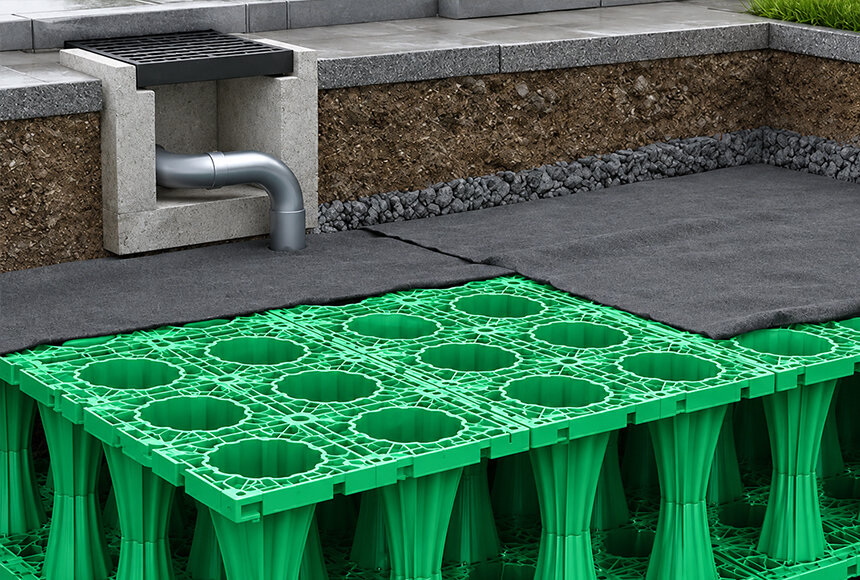
The installation speed gap between PP modules and concrete tanks is the single largest cost driver on commercial projects. PP modules arrive on site as flat-pack or pre-assembled units weighing 5–12 kg each. Workers snap them together using interlocking columns and ribs — no welding, no bolting, no crane.
A typical 50 m³ system installs in 3–5 working days with a crew of 3–4 people. The same volume in concrete requires formwork, reinforcement, pouring, curing (7-day minimum), and waterproofing — stretching the timeline to 15–20 working days.
The labour savings compound on large projects. For a 500 m³ municipal installation, PP modules might be fully assembled in 4–6 weeks, while a concrete tank of equivalent volume could require 3–4 months including curing time. Project scheduling around wet weather becomes less risky with the faster installation method.
Void Ratio: Why 92% Matters More Than 100%
At first glance, a monolithic concrete tank with 100% void ratio seems superior to a PP module array at 92%. The reality is more nuanced.
The 92% void ratio of PP modules refers to the proportion of the module's external volume that is open space available for water storage. The remaining 8% is the structural column-and-rib framework that gives the module its load-bearing capacity. This framework also serves a secondary purpose: it distributes overburden loads evenly across the base, reducing point-loading stress on the foundation slab.
A concrete tank achieves 100% void because it is a hollow chamber. But the walls must be 150–200 mm thick to resist soil pressure, consuming excavation volume that a modular system uses for storage. When you account for wall thickness, the effective storage per cubic metre of excavation is often comparable between the two approaches — with PP modules winning on projects where the tank footprint is constrained by adjacent structures or utilities.
Load Capacity: From Garden to Highway
PP modules span a wider load range than any single alternative technology. Yingyuan's product line covers:
Entry 1200 (45T/m²): Gardens, pedestrian areas, light landscaping
Standard 1000 (70T/m²): Driveways, car parks, residential roads
Large 1200 (85T/m²): Commercial car parks, access roads
Hurricane HD (85T+/m²): Highway verges, airport aprons, container yards
The Hurricane HD achieves its extreme load rating through a reinforced column geometry that was tested under sustained compressive loads in a CNAS-accredited laboratory per CJ/T 542-2020 heavy-duty requirements. Third-generation PP module technology — benchmarked against the Polypipe Polystorm Xtra at 80 tonnes/m² — has made it feasible to install rainwater storage beneath active traffic lanes.
By contrast, concrete tanks typically max out at 40–60 tonnes/m² for standard precast units, and achieving higher ratings requires custom engineering that adds cost and lead time. Steel tanks are generally limited to 15–30 tonnes/m² unless additional structural reinforcement is added above the tank.
Transport and Logistics: The Container Advantage
Shipping PP modules is a volume game. A standard 40HQ (High Cube) shipping container holds 1,200+ modules stacked flat. At 0.1 m³ per module (1000 x 500 x 200 mm), one container delivers 120 m³ of storage capacity. For a 200 m³ project, two containers suffice.
A concrete tank of equivalent volume cannot be shipped in containers at all. Precast sections require flatbed trucks with escort vehicles, and each trip delivers only one section. For international projects — Yingyuan exports to 30+ countries — the logistics cost difference is substantial.
First-generation hollow plastic boxes (60–70% void ratio) required more units per project, inflating shipping costs. Second-generation ribbed modules (85–90% void) improved the ratio. Today's third-generation units at 92% void deliver maximum storage per container load.
Use-Case Recommendations by Project Type
Once the required capacity is established through a proper storage volume calculation, selecting the right module grade becomes the next decision. The matrix below reflects how our engineering team maps project types to product lines.
| Project Type | Recommended Module | Why |
|---|---|---|
| Residential garden (< 20 m³) | Entry 1200 or Standard 1000 | Budget-friendly, light-duty sufficient |
| Commercial car park (50–200 m³) | Large 1200 or Hurricane HD | 85T load rating for vehicle traffic |
| Highway / airport (200+ m³) | Hurricane HD | Certified for extreme loads, D400 class |
| Municipal / large-scale (500+ m³) | Hurricane HD + inspection modules | Deep burial capability, access for maintenance |
| Agricultural irrigation | Standard 1000 or Large 1200 | Cost-effective for non-traffic areas |
Frequently Asked Questions
Are underground PP modules strong enough for vehicle traffic?
Yes. The Hurricane HD model achieves 85+ tonnes/m² compressive strength, which exceeds the D400 load class requirement for most highway and commercial vehicle applications. Third-generation PP modules, benchmarked against Polystorm Xtra at 80 tonnes/m², are specifically engineered for installation beneath active traffic areas.
How long do underground modular storage systems last?
PP modules carry a 50-year design life when properly installed with geotextile wrapping and symmetric backfill. The polypropylene material resists chemical corrosion, root penetration, and biological degradation. Independent creep testing under sustained load has confirmed structural integrity over extended test periods.
Is underground storage better than above-ground tanks?
Underground storage eliminates surface footprint, provides thermal stability (10–15 °C year-round at 1.5–2 m depth), and protects stored water from UV degradation and algal growth. Above-ground tanks are cheaper to install but consume usable land area and require periodic maintenance for corrosion and UV damage. For commercial developments where land value is high, underground PP modules deliver superior total cost of ownership. Our above-ground vs underground tank comparison examines this decision across eight separate factors.
What maintenance do underground modules need?
Annual inspection via the access well is the standard requirement. Check geotextile or membrane integrity, inspect inlet/outlet pipes for sediment build-up, and verify pump operation. Unlike concrete tanks, PP modules do not require crack repair, rebar corrosion treatment, or relining.
This article is part of our complete Rainwater Harvesting System: The Complete Guide to Collection, Storage and Reuse. For the above-ground vs underground question, see our detailed tank placement guide. For heavy-duty specifications, explore the Hurricane HD underground module.
For project-specific technical support, contact our engineering team with your site layout, design load class, and required storage volume. We typically return a preliminary module layout within 48 hours.