

Heavy-Duty Modular Stormwater
Engineered for 85-Tonne Axial Loads at 8 Metre Burial
When the stormwater tank sits under a truck yard, cargo apron, or port container stack, module selection is not about cost -- it is about structural survival. Yingyuan HD Heavy-Duty Series: SL-Zh-8 classified, 2 million fatigue cycles verified, 850+ kN/m² ultimate axial. No crane. No concrete. Just engineered geocellular load transfer.

When the Ground Above Carries 40 Tonnes
Why Lightweight Modules Fail Under
Heavy-Duty Loading

 The Heavy-Duty Problem Statement
In conventional stormwater engineering, parking lots, roadways, airport aprons, and port container yards are the domain of reinforced concrete. The reasoning is straightforward: a 40-tonne truck axle delivers a dynamic wheel load exceeding 80 kN through the pavement structure into the subgrade. A modular plastic tank -- any plastic tank -- intuitively appears inadequate. This intuition is correct for standard modules rated to 25-40 tonnes static axial. It is incorrect for a purpose-engineered heavy-duty geocellular system whose column architecture, material formulation, and connector design have been optimized specifically for dynamic, repetitive, high-magnitude loading. Yingyuan's HD series does not compete with standard modules on cost per cubic metre; it competes with cast-in-place concrete on constructability, carbon footprint, and maintenance accessibility -- while delivering equivalent structural performance.
The HD Series Design Philosophy -- Load Path EngineeringVerification Regime -- Not Just a Data Sheet Number
Three Heavy-Duty Case Studies From Design to Performance Verification
International Airport Cargo Apron
Southeast Asia
Engineering Challenge:The critical constraint was the construction window: the cargo apron could be closed for 21 days maximum (airline contractual penalty applied beyond Day 21). A concrete tank would require 45+ days including curing, making it unviable without an extended (and prohibitively expensive) apron closure. The HD modular system was the only solution that could be installed within the window.
Installation Narrative:Installation was completed by a 4-person crew in 14 days. Sequence: Day 1-2 excavation (2.5m deep below formation level, with 1:1.5 battered sides); Day 3-4 formation blinding and GTX-300 underlay installation; Day 4-5 GM-2.0 liner placement with factory edge preparation (panels pre-welded into 10m x 6m sheets at Yingyuan factory to reduce field welding by 60%); Day 6-9 module assembly (3 layers, approximately 900 modules per day peak rate with 4-person crew); Day 9-10 GTX-400 cushion and GM-2.0 top liner; Day 10-14 backfill in 300mm lifts with compaction testing every lift. Installation completed 3 days ahead of the 21-day window.
Performance Data:Post-construction monitoring (2 years): (a) surface settlement: maximum 8mm measured at 6-monthly topographic survey -- within the 25mm design allowance; (b) CCTV inspection at 12 months: no structural deformation, no clip disengagement, no liner wrinkle or tear; (c) hydraulic performance: discharge rate maintained at design 18.2 L/s via vortex flow control -- no siltation observed on CCTV; (d) groundwater monitoring: no perched water above liner, confirming liner integrity. Client has since specified HD modules for a second cargo apron expansion (design phase, 2025).
- ParameterValue
- Project typeAirport cargo apron stormwater detention
- LocationSoutheast Asia (client name NDA-restricted)
- Storage volume2,400 m³ (single tank, 60m x 20m x 2.0m module height = 5 layers of 400mm HD modules)
- Module countApproximately 24000 HD modules
- Burial depth5.2m from apron surface to module crown
- Design aircraftAirbus A350-900 (PCA 65/R/D/W/T pavement classification)
- Design loadGear load 270 kN per wheel (main landing gear, 6-wheel bogie)

Logistics Distribution Centre
HGV Parking Yard, Middle East
Engineering Challenge:The yard experiences approximately 200 HGV movements per day (arrival + departure = 400 load cycles/day). Over a 20-year design life, this accumulates to approximately 2.9 million cycles -- exceeding even the 2-million-cycle fatigue test. The concern was whether the fatigue performance extrapolates linearly beyond the test limit. Yingyuan's structural analysis demonstrated that the creep curve is logarithmic (deformation rate decreases with cycle count), so the additional 0.9 million cycles contribute less than 15% of the total projected creep. With a safety factor of 1.4 on the 2-million-cycle tested deflection (1.7%), the projected 50-year settlement is 21mm -- within the design limit.
Installation Narrative:Dual-zone installation: HD modules under the HGV yard with D400 ductile iron covers over inspection risers; EW modules under the adjacent landscaped buffer with A15 pedestrian covers for irrigation pump access. The two zones are hydraulically connected via twin 200mm PE pipes with non-return valves -- the detention zone overflows into the harvesting zone when the detention water level exceeds the VFC-controlled discharge rate. Installation duration: 18 days (6-person crew). Key productivity factor: the HD and EW modules share the same 1000x500mm footprint and clip geometry, so the crew could transition between zones without retraining or tool changes.
Performance Data:4 years in service. Key metrics: (a) no measurable surface settlement in HGV yard (laser-level survey, +/-3mm repeatability); (b) irrigation water supply from harvesting tank covers 70% of landscape demand annually (saves approximately 8,200 m³ of potable water per year); (c) VFC discharge maintained at design 8.2 L/s -- the calmed inlet has eliminated sediment re-suspension observed in the first 6 months before its retro-installation; (d) Estidama Pearl Rating System: 2 credits awarded for stormwater management. Client's FM team has adopted 6-monthly CCTV inspection protocol with no intervention required to date.
- ParameterValue
- Project typeLogistics centre stormwater detention + landscape irrigation harvesting
- LocationUnited Arab Emirates
- Storage volume1,100 lotal -- 800 m³ detention (HD), 300 m³ harvesting (EW, adjacent landscape zone)
- Module countApproximately 8000 HD + 3000 EW (11000 total)
- Burial depth3.0m (finished yard level), 4.2m at deepest point (drainage sump area)
- Design vehicle40T articulated HGV with 11.5T drive axle (D400 loading class)
Port Container Yard Stormwater Detention
Design Phase
Engineering Challenge:The port yard scenario differs from highway/airport loading in two critical respects: (a) the load is static (containers are stacked storage, not moving -- no dynamic amplification factor); (b) the load is uniformly distributed over the container footprint rather than concentrated through wheel contact patches. Yingyuan's engineering analysis confirms that 50 kN/m² uniform ground bearing is within the HD module's distributed capacity (850 kN/m² / 4.0 safety factor ≈ 200 kN/m² allowable working load). However, the container stack corner castings create localized point loads exceeding 200 kN/m² at the pavement-to-ground interface. The design response is a 400mm reinforced concrete load-spreading slab between the pavement wearing course and the module top -- this slab distributes the corner casting loads to the subgrade at a pressure below the module's allowable. Yingyuan's structural team is coordinating with the port's civil consultant on the slab design, with a target to commence installation in Q3 2026.
- ParameterValue
- Project typePort container yard stormwater detention (currently in detailed design)
- LocationSoutheast Asia
- Storage volume3,500 m³ (anticipated -- final volume subject to drainage strategy approval)
- Module countApproximately 35000 HD modules (estimated)
- Burial depth5.0m (container stacking area, design ground bearing pressure 50 kN/m² uniform)
- Design loadContainer stack -- 6-high fully loaded = 180T per stack base (4.5m x 2.4m footprint), uniform ground bearing 50 kN/m²
01
Dynamic Wheel Load
Not Just Weight, But RepetitionProblem: Static compressive strength (kN/m²) is necessary but not sufficient. A truck braking at 30 km/h applies 1.4-1.6x the static axle load. Over 20 years, a busy loading bay accumulates 300,000+ load-unload cycles. Standard modules (25-40T) are tested to a few hundred cycles, not a few hundred thousand. The failure mode is not sudden collapse but progressive creep -- each cycle adds 0.001-0.005% permanent deformation, accumulating to 50-100mm settlement over the design life. This settlement transmits through the pavement structure as rutting, cracking, and ultimately a pothole that exposes the module below.
Consequence: Pavement failure → water ingress into subgrade→ accelerated module degradation → tank collapse → total pavement reconstruction. Cost of failure: 5-15x the incremental cost of specifying HD modules initially.
Yingyuan Solution: HD module validated for 2 million fatigue cycles at 20-80% load range. Maximum cumulative creep 1.7% at end of test -- projecting to under 12mm settlement at 5m burial over 50-year design life. Reinforced connector clip maintains inter-module shear transfer throughout, preventing individual module settlement that creates differential pavement support.
Consequence: Pavement failure → water ingress into subgrade→ accelerated module degradation → tank collapse → total pavement reconstruction. Cost of failure: 5-15x the incremental cost of specifying HD modules initially.
Yingyuan Solution: HD module validated for 2 million fatigue cycles at 20-80% load range. Maximum cumulative creep 1.7% at end of test -- projecting to under 12mm settlement at 5m burial over 50-year design life. Reinforced connector clip maintains inter-module shear transfer throughout, preventing individual module settlement that creates differential pavement support.


Heavy-Duty Stormwater

Pain Point Diagnosis and Engineered Resolution
Pavement Structure (by others): Flexible or rigid pavement to AASHTO 1993 or DMRB CD 226 -- minimum 800mm cover from module crown to pavement surface for HS-25 loading
Load-Spreading Granular Layer (by others): Well-graded granular sub-base, 300mm minimum, compacted to 95% standard Proctor -- distributes point loads to module top plates
Geotextile Cushion (GTX-400): 400 g/m² high-tenacity continuous filament PP -- prevents sub-base particle migration into module void; puncture resistance ≥ 2.5 kN (CBR test)
HD Module Core: 1000×500×200mm modules, 92% void, 8-column architecture -- reinforced PE connector clips at 4 per face, top and bottom. Assembly by hand, no tools.
HDPE Liner (GM-2.0): 2.0mm HDPE geomembrane -- impermeable barrier; field-welded seams with extrusion welder; air-pressure tested at 200 kPa for 5 minutes per seam
Geotextile Underlay (GTX-300): 300 g/m² cushion geotextile -- protects liner from puncture by formation soil or hardcore
Formation (by others): Leveled and compacted to 95% standard Proctor -- 100mm sand blinding recommended if formation contains sharp fragments
Load-Spreading Granular Layer (by others): Well-graded granular sub-base, 300mm minimum, compacted to 95% standard Proctor -- distributes point loads to module top plates
Geotextile Cushion (GTX-400): 400 g/m² high-tenacity continuous filament PP -- prevents sub-base particle migration into module void; puncture resistance ≥ 2.5 kN (CBR test)
HD Module Core: 1000×500×200mm modules, 92% void, 8-column architecture -- reinforced PE connector clips at 4 per face, top and bottom. Assembly by hand, no tools.
HDPE Liner (GM-2.0): 2.0mm HDPE geomembrane -- impermeable barrier; field-welded seams with extrusion welder; air-pressure tested at 200 kPa for 5 minutes per seam
Geotextile Underlay (GTX-300): 300 g/m² cushion geotextile -- protects liner from puncture by formation soil or hardcore
Formation (by others): Leveled and compacted to 95% standard Proctor -- 100mm sand blinding recommended if formation contains sharp fragments
HD Heavy-Duty Technical Specifications Full Engineering Data
HD Module Mechanical Properties (CJ/T 542-2020, SL-Zh-8)
- ParameterValueTest Standard
- Ultimate axial compressive strength≥350 kN/m² (tested 850 kN/m²)CJ/T 542-2020 Appendix D
- Ultimate lateral compressive strength≥ 150 kN/m²(tested 450 kN/m²)CJ/T 542-2020 Appendix D
- Creep deformation (10,000 hr, 50% ultimate)≤ 2.0% (tested 1.7%)ASTM D2412 (adapted)
- Cyclic fatigue (2M cycles, 20-80% ultimate)No crack initiation; cumulative deflection 1.7%ASTM D2412 protocol
- Void ratio92%Volumetric displacement method
- Module weight (unfilled)6.7 kg (+/-0.3 kg)/
- Service temperature range-30C to +60C (continuous); -40C to +80C (intermittent)/
- MaterialRecyclable polypropylene (PP), UV-stabilized, carbon black 2.0-2.5%/
HD Module Geometry
- ParameterValue
- Nominal dimensions (LxWxH)1000 x 500 x 200 mm
- Column architecture8 columns (4 corner + 4 mid-side), hollow square section 100x50mm, wall thickness 6.0mm
- Top/bottom plate thickness5.5mm with orthogonal rib grid (rib height 15mm, spacing 40mm)
- Side panel (removable)Solid, 4.0mm thickness, snap-lock engagement to column
- Clip engagement featureDovetail slot, 40mm length, 0.20mm tolerance (+0.05/-0.05)
- Half-module variant500 x 500 x 200 mm (for edge fill)
Reinforced PE Connector Clip (HD-Specific)
- ParameterValue
- MaterialInjection-molded PP, rib-stiffened, UV-stabilized
- Tensile capacity (single clip)≥ 2.5 kN (ultimate)
- Clip spacing4 clips per module face (top) + 4 clips per module face (bottom)
- Creep relaxation (10,000 hr at 50% load)Clamping force retention ≥ 85%
- InstallationHammer-driven interference fit; audible click confirms full engagement
Companion Accessories for HD Systems
- ParameterValue
- GeotextileGTX-400 (400 g/m² high-tenacity PP) -- cushion layer above and below module matrix
- HDPE LinerGM-2.0 (2.0mm) -- impermeable barrier for detention systems; seam welded, air-pressure tested
- Inspection coverD400 ductile iron, 600mm clear opening, lockable, with concrete surround collar
- Inlet/outlet adaptor160mm or 200mm PE, sealed penetration with EPDM grommet
- Vortex flow control110mm hydro-brake, 316 stainless steel, no moving parts, no power required
HD System Performance Fact Map -- Quantitative Benchmarks
- ItemValue
- Module ultimate axial strength (tested)850 kN/m²
- Module ultimate lateral strength450 kN/m²
- Fatigue cycles validated (zero crack)2,000,000 cycles
- Creep deflection at 10,000 hr (50% load)1.7%
- Void ratio92%
- Module weight (unfilled)6.7 kg
- Storage per module (200mm height)401 litres
- Reinforced clip tensile capacity2.5 kN per clip
- Standard burial range0.8m cover to 4.0m depth
- Deep burial (with engineering review)4.0m to 6.0m depth
- 50-year projected settlement (5m burial, D400)18-25mm
- Installation rate (2-person crew)40-60 modules per 8-hour shift
- Concrete cost multiple at 5m burial2.3-4.1x modular system cost
- Carbon footprint (modular vs. concrete)40-60 vs. 250-350 kg CO₂/m³
- Containers: 40HQ module capacity~600 HD modules
- Verification report referenceSMETC-2023-SL-0472 (Shanghai Municipal)
Operational Advantages of HD Heavy Duty Modular System
No Crane Assembly
Self-Sufficient 2-Person Crew
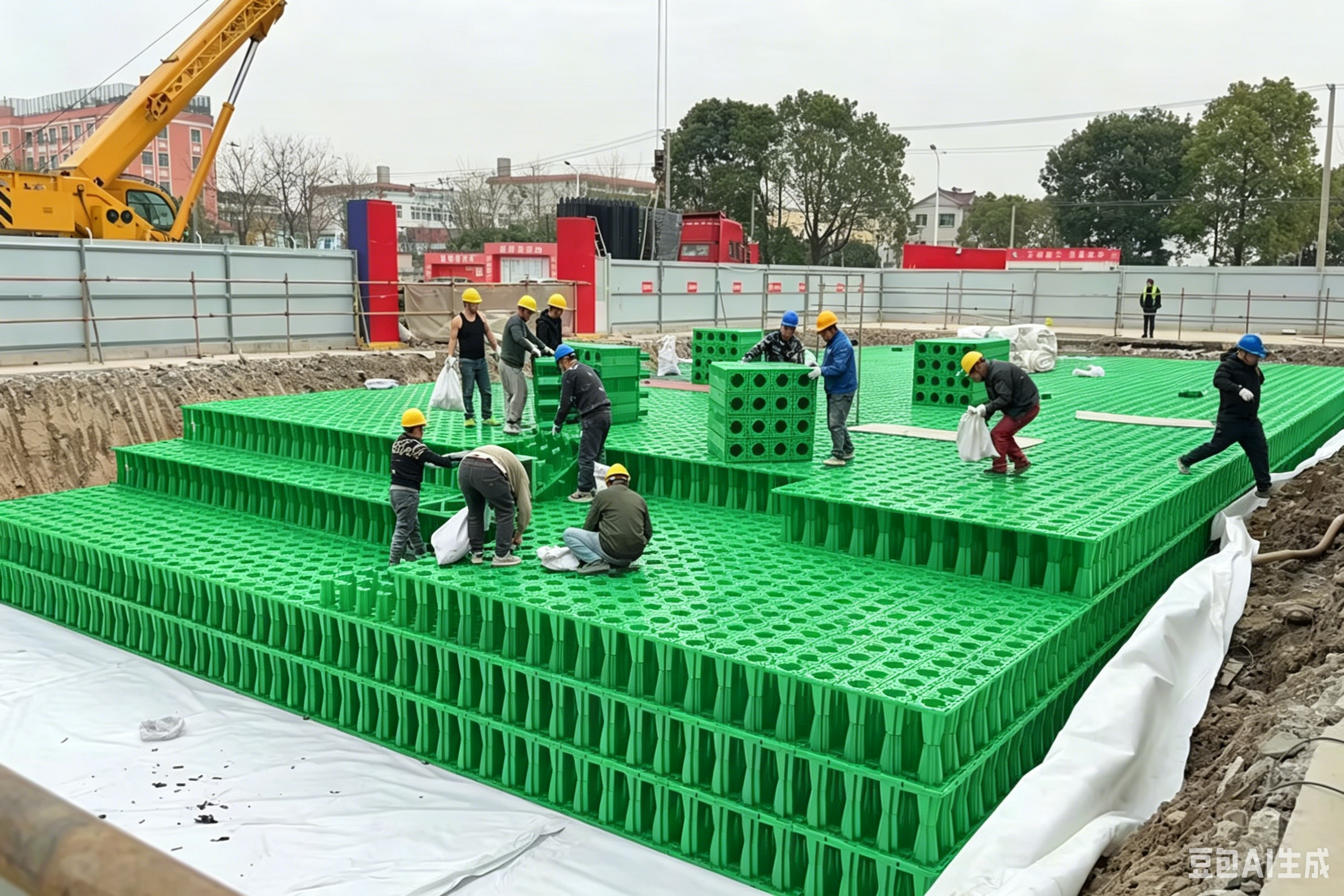
Each HD module weighs 6.7 kg -- liftable by one person repeatedly over an 8-hour shift. A 2-person crew assembles 40-60 modules per shift, placing approximately 30-45 m³ of storage volume per day. For a 500 m³ system, module assembly accounts for 5-8 working days. No crane means: (a) no crane hire cost (saves $1,500-3,000 per day for a mobile crane in urban areas); (b) no crane standing area required (critical on constrained sites with adjacent buildings or live traffic lanes); (c) no lifting plan or appointed person required; (d) work can continue in wind conditions that would suspend crane operations (common at airport and port sites). This is not a marginal convenience -- on one airport project, 6 of 14 installation days would have been lost to wind if crane-dependent.
No Crane Assembly
Self-Sufficient 2-Person Crew
Self-Sufficient 2-Person Crew
50-Year Design Life with Validated
Creep Performance
Creep Performance
Maintainable by CCTV
No Confined-Space Entry
No Confined-Space Entry
Progressive Collapse Resistance
Failure Containment by Design
Failure Containment by Design
Begin Your Heavy-Duty Stormwater Engineering Review
NO.1
Parameter Collection
You provide: required storage volume (m³), burial depth (m), traffic loading (vehicle type, axle load, daily frequency), groundwater level, and soil type (from borehole log if available). Send via the contact form or email info@yy-tank.com.
NO.2
Structural Assessment (2-3 Working Days)
Yingyuan's structural engineer reviews your parameters against the HD module capacity envelope. For standard configurations (within the verified range), a stamped design letter is issued confirming: module count and layout, geotextile/liner grades, clip specification, backfill specification, and projected 50-year settlement.
NO.3
Quotation and BOM
The design outputs feed into the BOM generator, producing a line-item quotation with SKU codes, quantities, unit pricing, and delivery schedule. A module placement drawing and liner seam plan are included as PDF attachments.
NO.4
Technical Support Through Installation
Optional: Yingyuan provides on-site technical supervision for the first 2 days of module installation (included with systems over 500 modules). Remote support via video call (WhatsApp/WeChat/Teams) is included with all orders.
Ready to evaluate HD Heavy-Duty for your project?
Engineering Response Within 3 Days
Heavy-Duty Modular vS Cast-in-Place Concrete Structural Design Comparison
Traditional Benchmark
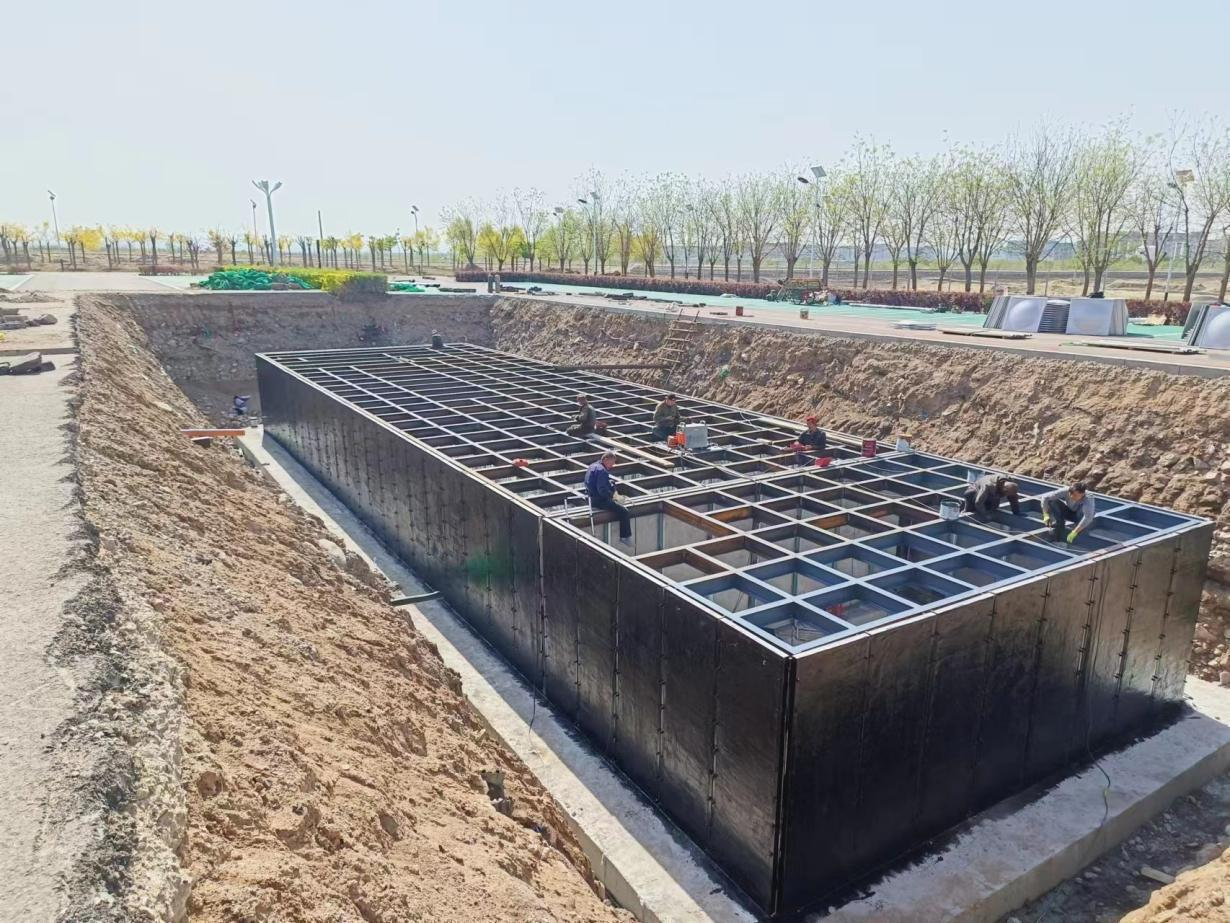
Traditional cast-in-place RC tank: wall thickness 500mm+ at 5m burial (flexural reinforcement governs), double-layer rebar cage, 28-day cure, confined-space entry for inspection and maintenance. Construction duration 35-50 days for 500 m³. Installed cost 2.3-4.1x modular system at depth. Carbon: 250-350 kg CO₂/m³. No void ratio concern (hollow tank) but cost-per-m³-stored is nonlinear with depth.

Yingyuan Approach
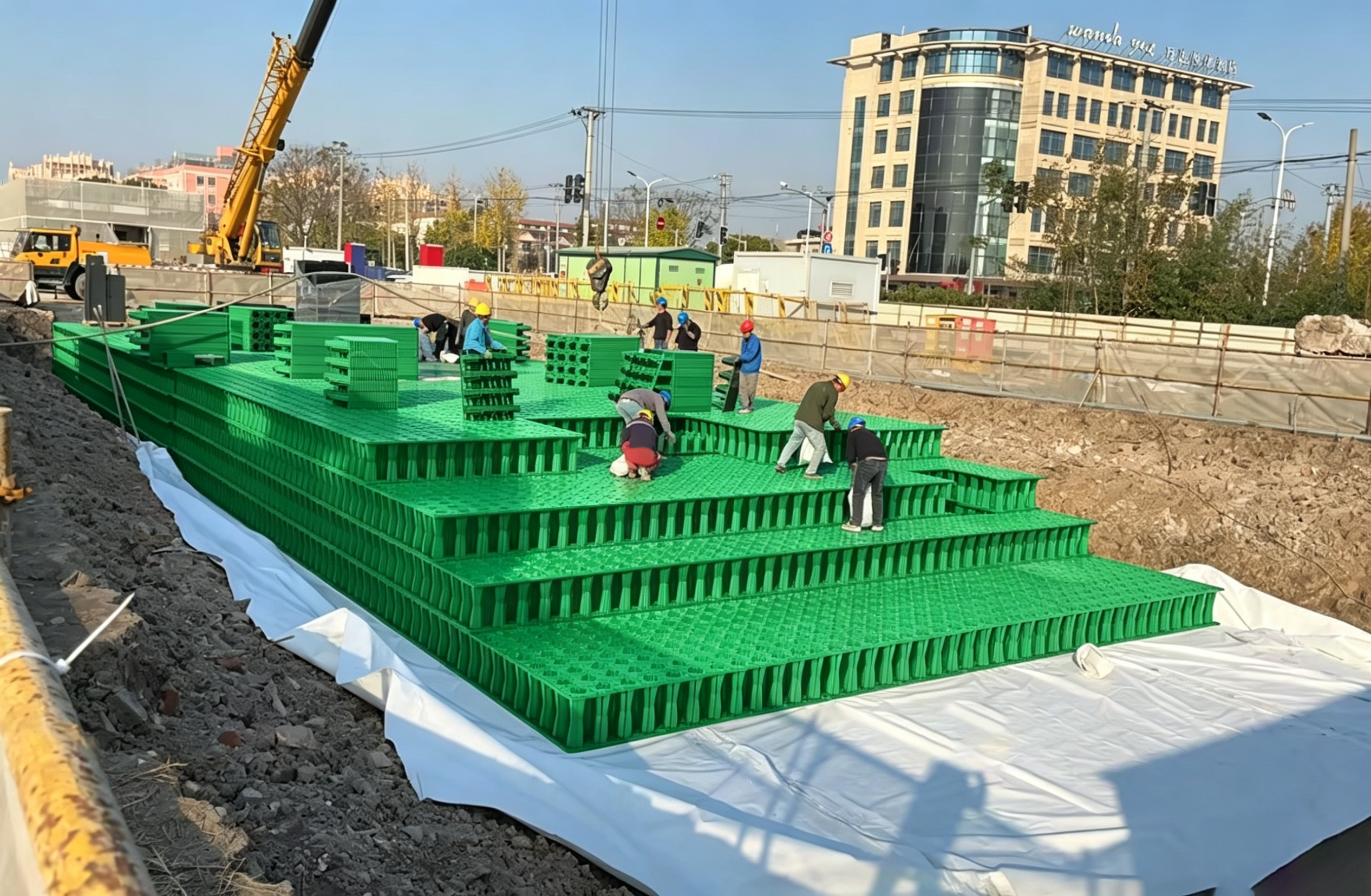
Yingyuan HD modular system: 200mm module height, 92% void, 8-column load path, no formwork, no cure, CCTV-inspectable via riser (no confined space). Construction duration 8-12 days for 500 m³ (4-person crew, no crane). Installed cost linear with depth -- approximately 25-43% of concrete cost at 5m burial. Carbon: 40-60 kg CO₂/m³. 2 million cycle fatigue validated. 50-year design life with projected settlement under 25mm.
FAQ
Frequently Asked Questions for
Heavy-Duty Stormwater Systems
 What is your main product?Do you provide customization services?