News


Above Ground vs Underground Rainwater Tanks: An 8-Factor Comparison
24 Jun 2026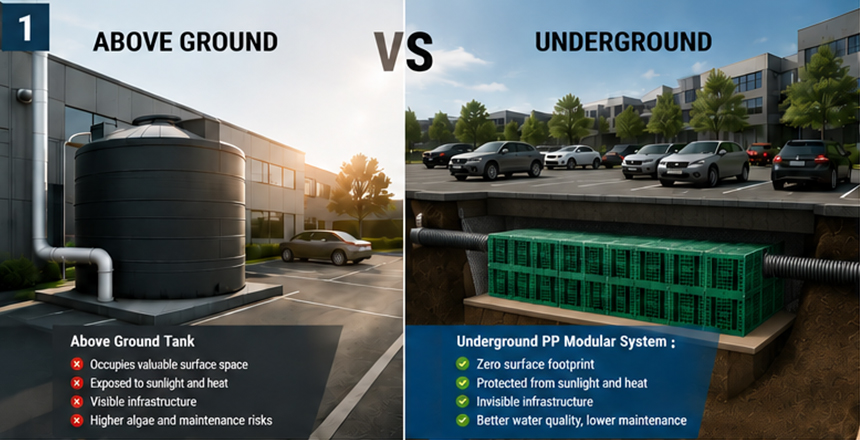
Choosing between an above ground tank and an underground storage system is one of the first decisions in any rainwater harvesting project. This choice affects capital cost, site layout, water quality, maintenance access, and long-term operational reliability. Below is a direct comparison across the eight factors that most frequently determine which option best fits your project.
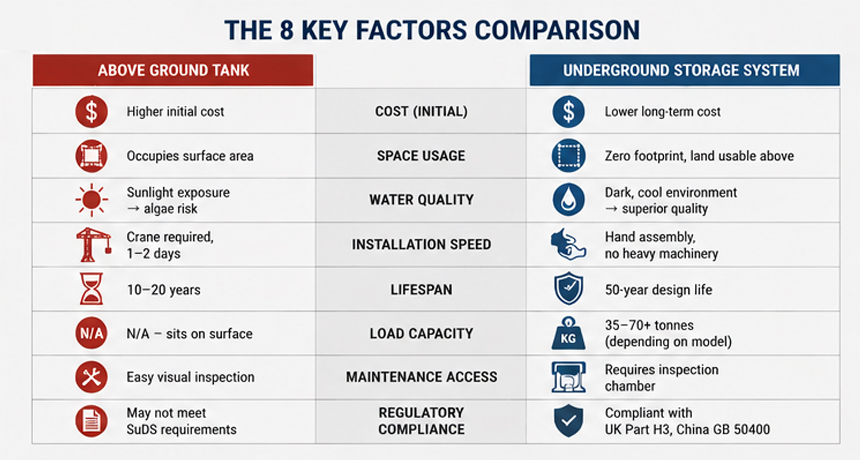
A few notes on the table. Initial cost clearly favours above ground tanks, but this comparison changes significantly when you account for the value of the surface land the tank occupies — a factor we examine in detail below. Water quality is not merely an aesthetic concern; algae growth in above ground tanks increases treatment costs and reduces pump life. Underground PP modules install faster than many engineers expect — they are hand-assembled on site without cranes or heavy machinery. And with a design life of 50 years versus 10-20 years for typical polyethylene tanks, underground systems often deliver lower total cost of ownership over a project's lifetime.
The Three Factors That Decide Most Projects
Of the eight dimensions above, three carry disproportionate weight in most commercial and municipal rainwater harvesting decisions.
1. Space Economics: Why Every Square Meter Counts
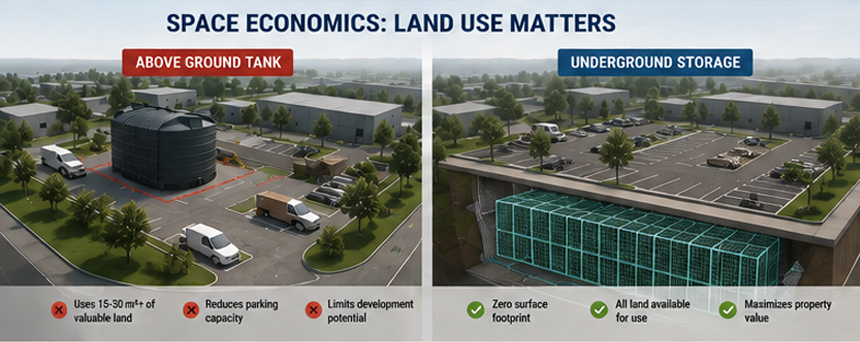
An above ground tank is a visible, permanent structure. A 10 m³ polyethylene tank typically occupies a footprint of 2-3 m². Scale that to the 50-100 m³ storage volumes common in commercial developments, and you are looking at 15-30 m² of surface area permanently removed from other use.
On a commercial site where land is valued at $2,000/m², that 30 m² of opportunity cost can reach $100,000.
Underground PP modular storage eliminates this trade-off entirely. The modules are buried below finished ground level, and the surface above remains available for parking, landscaping, pedestrian access, or additional building footprint. Application scenarios for underground systems range from commercial car parks to school playing fields to residential driveways, with the stored rainwater volume having zero impact on surface land use.
This is not a marginal consideration. In dense urban developments where every square metre of surface area has a designated purpose — parking bays, loading zones, fire access routes, landscaping setbacks — underground storage is often the only viable option. The modular nature of PP systems also means storage volume can be scaled precisely to match site runoff calculations, without the fixed-size constraints of pre-manufactured above ground tanks.
2. Water Quality Physics: Why Underground Water Stays Cleaner
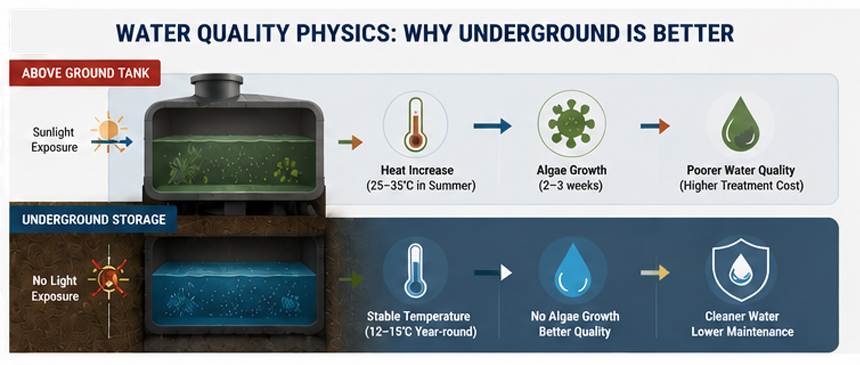
Above ground tanks are exposed to ambient temperature and, critically, to sunlight. Even opaque polyethylene tanks experience heat transfer through their walls, and any translucent sections, fittings, or inspection hatches admit light.
Here's what happens in practice. In summer, water temperatures inside an above ground tank can reach 25-35°C — conditions in which algae colonisation occurs within 2-3 weeks. Once established, algae produces organic acids that accelerate pH decline. It also generates biofilm on tank walls. And it creates particulate matter that overloads downstream filters and pumps. The result? Higher treatment costs and shorter pump life.
Underground PP modules operate in a fundamentally different environment. Buried below ground level, with typical cover depths up to 3.5 m, the stored water maintains a stable temperature of approximately 12-15°C year-round, regardless of surface conditions. This temperature range inhibits bacterial proliferation and prevents algae growth entirely — algae require both light and warmth to photosynthesise, and underground storage eliminates both. The result is measurably better water quality at the point of draw-off, with lower turbidity, lower bacterial counts, and reduced demand on post-storage filtration equipment.
The 92% void ratio of third-generation PP modules means the internal water volume circulates freely, preventing the stagnant dead zones that develop in single-chamber above ground tanks. In contrast, a large above ground tank often develops thermal stratification — warm water at the top, cool water at the bottom, with limited mixing between them. This encourages anaerobic conditions at depth, which can degrade water quality. PP module geometry promotes more uniform water movement, supporting better overall quality.
3. Structural Capability: More Than Just Water Storage
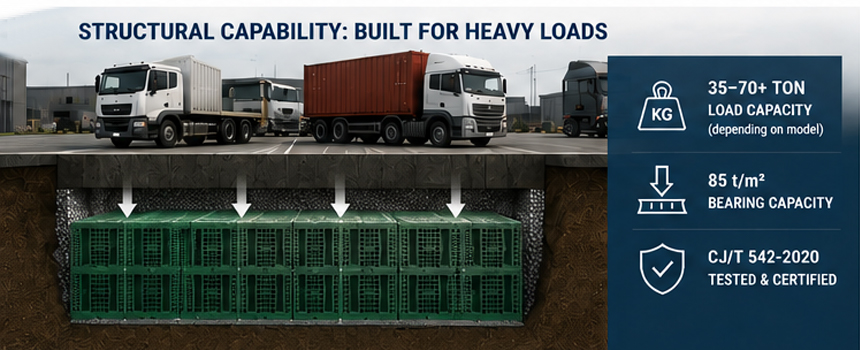
This is where the comparison becomes asymmetrical. An above ground tank has no structural function beyond containing water. It cannot support loads, carry traffic, or contribute to site engineering requirements.
Underground PP modules are engineered structural components. Depending on the model, they carry vertical loads of 45-85+ tonnes — equivalent to the weight of a fully loaded concrete truck. Third-generation PP modules achieve a bearing capacity of up to 85 t/m², sufficient for heavy truck traffic. This load rating is verified through testing to CJ/T 542-2020 heavy-duty standards, meaning they can be safely installed beneath car parks, driveways, and access roads without taking the surface out of service.
Understanding why load capacity matters requires looking at structural failure modes. Underground storage modules must resist:
• Vertical earth pressure from the soil above
• Lateral soil pressure from the sides
• Hydrostatic uplift (the upward force from groundwater) when the water table rises
• Dynamic loads from surface traffic
Insufficient load capacity leads to module deformation, joint separation, and ultimately collapse — failure modes that are catastrophic because they occur below ground and are invisible until surface subsidence appears. That's why modules designed for the highest load scenarios use reinforced internal geometry that distributes vertical forces across the full cross-section.
For agricultural reuse applications, the load capacity of underground modules allows storage to be placed beneath farm access roads and hardstanding areas, maximising usable land while keeping water storage protected from UV exposure and temperature extremes.
Compared to concrete underground tanks, PP modules offer several practical advantages:
• ✅ Approximately 1/30 the weight of concrete
• ✅ 60%+ faster installation time (no curing time required)
• ✅ Flexible sizing that adapts to irregular site geometry
• ✅ Simpler long-term maintenance — individual modules can be accessed and replaced without demolishing the entire structure
Quick Decision Guide: Above Ground or Underground?
Not sure which option fits your project? Use this simple 3-step flowchart to narrow it down.
Step 1: Check your budget
• Budget under $5,000 AND space is not tight → Above ground tank
• Budget over $8,000 (or flexible) → Proceed to Step 2
Step 2: Check your space
• Available surface area is limited or valuable → Underground PP module
• You have spare land and no visual concerns → Proceed to Step 3
Step 3: Check your end use
• Only garden irrigation / temporary use → Above ground tank
• Toilet flushing / cooling / washing / need high water quality → PP module
• Storage must sit under parking or traffic areas → PP module
• Need to meet SuDS or local stormwater regulations → PP module
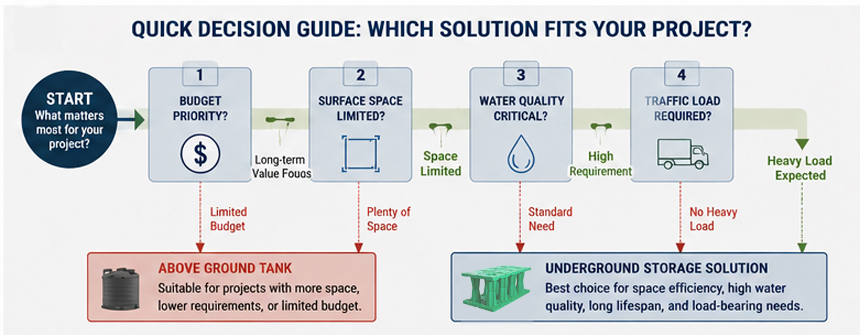
Not sure? If your project meets multiple conditions simultaneously (medium budget, limited space, and high water quality requirements), underground PP modules are worth considering — they offer advantages in long-term total cost and water quality assurance. Many engineers find that a free site assessment helps clarify the best option for specific conditions.
When to Choose Each Option
✅ Choose an Above Ground Tank When:
When budget is the primary constraint. For small-scale residential installations where a 5-10 m³ tank serves basic garden irrigation, an above ground polyethylene tank at $2-5K represents the lowest entry cost. Imagine setting it up over a weekend, connecting a hose, and starting to water your garden — no excavation, no heavy machinery, no complex engineering. This is a sound choice when surface space is not scarce and the installation is not subject to planning conditions that mandate integrated sustainable drainage.
When the installation is temporary. Construction site water management, event infrastructure, and seasonal agricultural operations sometimes need storage that can be deployed and removed within weeks. Above ground tanks, particularly those with standardised connections, suit these scenarios well. Need to move it? Disconnect, drain, and relocate — it's that simple.
When visual demonstration matters. Education centres, sustainability demonstration projects, and community gardens sometimes benefit from visible water storage that visitors can see and understand. An above ground tank makes the rainwater harvesting process tangible in a way that buried modules cannot. There's something compelling about watching rain flow from a downpipe into a visible tank — it tells a story that underground systems simply can't.
When small-scale irrigation is the only end use. When the harvested water feeds a garden hose or simple drip irrigation system, the water quality advantages of underground storage provide limited practical benefit, and the higher capital cost of underground systems is harder to justify. For this use case, an above ground tank delivers perfectly adequate water quality at a fraction of the cost.
Choose Underground PP Modules When:
When the project is a commercial or municipal development.
Office buildings, retail centres, schools, hospitals, and residential developments generate significant roof runoff volumes that require substantial storage — typically 50-500 m³. At this scale, the space economics of underground storage become decisive. The surface area saved can be used for parking, landscaping, or additional building footprint — uses that generate ongoing value.
When the storage must sit beneath a car park, driveway, or access road.
PP modules rated for 85+ tonnes vertical load are one of the few rainwater storage technologies that can perform this dual function. No above ground tank, and few alternative underground systems, can match this capability without significant additional engineering.
When sustainable drainage compliance is required.
In jurisdictions where SuDS, UK Part H3, China GB 50400, or equivalent regulations govern stormwater management on development sites, underground modular storage systems with certified load ratings and tested structural integrity are frequently specified as the compliant solution.
When water quality matters for the intended end use.
Toilet flushing, cooling tower makeup, and vehicle washing all demand cleaner water than basic garden irrigation. The dark, temperature-stable environment of underground PP storage reduces biological loading and eases the burden on downstream filtration — an advantage that compounds over the system's 50-year design life.
When long-term cost of ownership is the decision metric.
While the initial capital cost of underground PP modules is higher, the combination of zero surface land consumption, minimal maintenance requirements, superior water quality (reducing treatment costs), and a 50-year structural lifespan frequently results in lower total cost over 20-30 years compared to replacing above ground tanks two or three times in the same period.
Frequently Asked Questions
Can you install underground rainwater tanks in high water table areas?
Yes, but it requires specific design measures. When the water table rises above the base of the underground storage, hydrostatic uplift (the upward force from groundwater) acts on the empty or partially filled modules. The solution is to design adequate anti-flotation measures — typically a concrete base slab or geogrid anchoring system that provides sufficient dead weight to resist uplift forces. Third-generation PP modules are tested to withstand these conditions when properly anchored. The key is conducting a geotechnical survey before finalising the installation design, so the water table profile is known and the anti-flotation system can be sized accordingly.
What about concrete vs PP underground tanks?
Concrete underground tanks have been the traditional choice for large-volume rainwater storage, but PP modular systems have largely displaced them in new installations. The practical differences are substantial: PP modules weigh approximately 1/30 as much as equivalent concrete structures, install 60%+ faster because they require no curing time and no heavy lifting equipment, offer flexible sizing that adapts to irregular site shapes, and allow simpler maintenance since individual modules can be inspected and replaced independently. Concrete tanks also crack over time due to ground movement and chemical attack from stored water, while PP modules maintain structural integrity through their 50-year design life.
Can above-ground tanks be retrofitted underground?
Generally, no. Above ground polyethylene and steel tanks are not engineered to resist earth pressure, hydrostatic uplift, or vertical ground loads. Burying a tank designed for surface installation creates a high risk of structural collapse. The wall thickness, rib geometry, and material specification of an above ground tank are calibrated for internal water pressure only — they do not account for external soil pressure that can reach 35-70+ tonnes per square metre at depth. If underground storage is needed after an initial above ground installation, the correct approach is to install a purpose-designed underground system alongside or beneath the existing tank location.
What are the frost protection differences between above ground and underground tanks?
Above ground tanks in climates with freezing winters require active frost protection — trace heating elements, insulated jackets, or complete enclosure within a heated structure. Without these measures, water in an above ground tank will freeze solid when temperatures remain below 0°C for extended periods, potentially cracking the tank walls and damaging connected pipework.
Underground PP modules installed at cover depths up to 3.5 m sit below the frost line in most climates, meaning the stored water remains liquid year-round without any active heating. The thermal mass of surrounding soil maintains the water at approximately 12-15°C even during the coldest months. This passive frost protection eliminates energy costs for heating and removes a failure point from the system.
What's the total cost of ownership comparison — how many years to break even?
This is one of the most common questions, and the answer depends on your site conditions. Here's a simplified example based on a 50 m³ commercial installation:
| Cost Item | Above-Ground Tank | Underground PP Module |
| Initial Equipment + Installation | $8,000 - $12,000 | $20,000 - $30,000 |
| Land Opportunity Cost (30 m² @ $2,000/m²) | $60,000 (one-time) | $0 |
| Service Life | 10-15 years | 50 years (0 replacements) |
| Replacements in 50 Years | 3-4 times | 0 times |
| Total 50-Year Cost of Ownership (Estimated) | $80,000 - $120,000+ | $20,000 - $30,000 |
| Payback Period (vs. Above-Ground Solution) | / | Approx. 3-5 years (via land cost savings + avoided replacements) |
Key takeaway: Although the initial investment for underground PP modules is higher, considering land opportunity costs, a longer service life (50 years vs. 10-15 years), and lower water treatment maintenance requirements, most commercial projects can achieve a lower total cost than above-ground solutions within 3-5 years. In urban areas with high land value, the payback period is even faster.
Summary
The choice between above ground and underground rainwater storage depends on your specific site conditions, end use, and project economics. For projects where surface space is limited, long-term water quality matters, or the storage area must serve dual purposes (such as parking lots or access roads), underground PP modular storage offers a compelling solution. For smaller, budget-constrained installations where space is available and the end use is simple garden irrigation, above ground tanks remain a practical and cost-effective choice.
If you'd like to apply these factors to your specific site conditions, our engineering team offers a free initial assessment. We'll help you compare costs, evaluate space constraints, and determine the most cost-effective solution for your project.
Technical Resources & References
The following sources support the technical claims made in this article. For detailed specifications and test data, please refer to:
• Load capacity testing: Verified per CJ/T 542-2020 heavy-duty standards
• Material specifications: PP material properties (100% recycled, UV-stabilised, chemically resistant)
• Design life data: Based on accelerated aging tests and field performance tracking
• Installation guidelines: Modular assembly procedures for underground PP systems
• Regulatory compliance: UK Part H3, China GB 50400 standards
Editor: Zoey, Content Planning Department
Related Reading
The structural half of the five-factor comparison is covered in underground storage comparison in our system guide, underground PP modular attenuation tanks, rainwater collection system types and costs, rainwater harvesting tank size guide and Get a Quote.