


Heavy-Duty Stormwater Modules for Middle East Mega Projects | YY-TANK
01 Jun 2026Key Points
Section 1: The Invisible Collapse: Why Standard Stormwater Crates Ruin Mega-Scale Infrastructures in Arid Regions
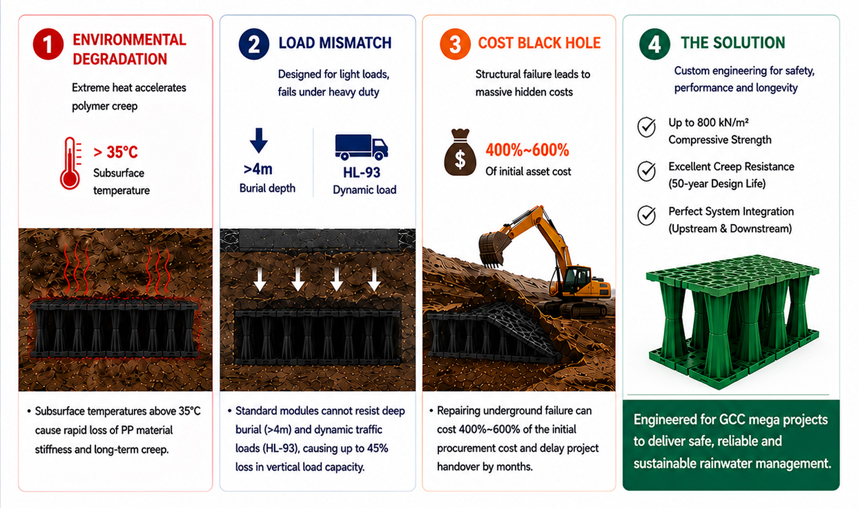
Why do a staggering number of massive subsurface rainwater harvesting systems in the Gulf Cooperation Council (GCC) region face structural deformation or complete vault collapse within 24 months of installation? Based on our retrospective analysis of over 40 large-scale subsurface projects across the Arabian Peninsula, the root cause is rarely substandard raw materials. Instead, it is a lethal engineering blind spot: the illusion of standard laboratory compressive strength.
Civil consultants and EPC contractors typically rely on standard polypropylene modules for stormwater harvesting systems, referencing technical datasheets tested under static conditions at an ambient temperature of 23°C. However, when these conventional modules are buried deeper than 4 metres beneath heavy-traffic carriageways in Riyadh or Doha, real subsurface conditions create extremely harsh operating challenges.
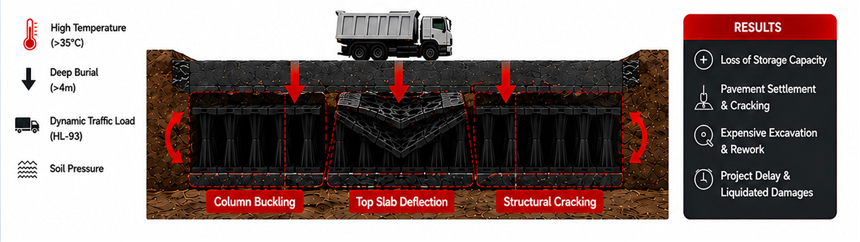
In hyper-arid regions, underground soil temperatures repeatedly reach extreme peak values, which accelerates polymer creep. Conventional modular crates sized 1000 × 500 × 400 mm and 1000 × 500 × 200 mm are engineered primarily for temperate climates and light load applications. When exposed to the combined effects of permanent dead soil loads and dynamic surcharges from heavy vehicles, they lose up to 45% of their vertical load-bearing capacity within a short timeframe.
This is not merely a material weakness; from a Total Cost of Ownership (TCO) perspective, a single structural breach in an urban retention tank triggers emergency open-cut excavation, utility diversion, and localized deep-foundation reconstruction. In our project experience, the financial liability of rectifying a buried structural failure often reaches 400% to 600% of the initial stormwater asset procurement cost—instantly obliterating a sub-contractor’s profit margin and delaying project handover by months.
Section 2: Standard Fixed Specifications vs. Flexible Custom Engineering
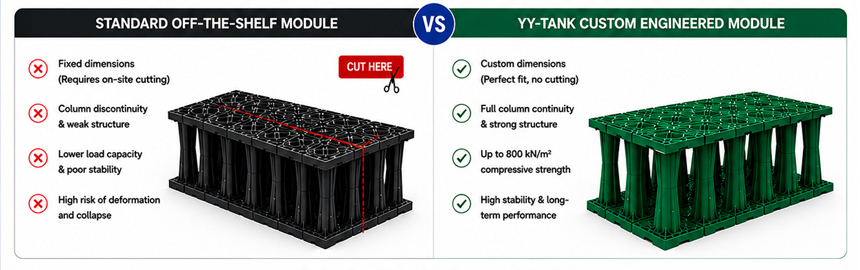
Many established international suppliers operate rigid high-volume injection moulding processes. They require infrastructure layouts to conform to their fixed product moulds, typically sized 1000 × 500 × 400 mm. While this mass-production setup cuts factory overhead costs, it creates severe construction complications on mega-projects exceeding 20,000 m³. This forces costly on-site engineering workarounds, including manual module cutting, discontinuous structural support columns, and systemic weaknesses in lateral pressure resistance.
For stormwater retention systems to deliver full performance, any structurally flawed module directly compromises hydraulic efficiency and long-term stability — a risk that large-scale stormwater management projects cannot afford to take.
| Engineering Parameter | Off-the-Shelf Standard Modules | YY-TANK Engineered Custom Solution | Project Security & Financial Impact |
Vertical Compressive Strength | Fixed at ≤450 kN/m² (tested at 23 °C in accordance with EN 17150) | Custom-engineered up to 800 kN/m² through localized rib reinforcement and finite element analysis optimization, verified under 40 °C test conditions | Eliminates arch deformation risks for deep burial depths (>4 m) and heavy traffic load zones compliant with HL-93 and Eurocode 1 standards |
Lateral Pressure Resistance | Uniform wall/column matrix; single rigidity class | Variable lateral stiffeners dynamically tuned according to the in-situ soil active earth pressure coefficient (Ka) and sabkha ground conditions | Prevents perimeter wall buckling caused by dense, high-salinity backfill and fluctuating groundwater |
Dimensional Modulus (L×W×H) | Rigid fixed dimensions, forcing field cutting | Flexible Mold-Insert Alteration for precise volumetric matching and non-standard heights | Preserves 100% of structural column integrity; zero on-site cutting waste |
Masterbatch Formulation | Standard black/green recycled or generic virgin resin | Functional Masterbatch Customization: high-temperature antioxidants, UV-stabilizers, and traceable virgin copolymer base | Inhibits polymer auto-oxidation during desert port storage and harsh subterranean chemical exposure |
Peak Flow Attenuation Compatibility | Fixed void ratio; may not align with complex detention curve design | Customizable void structure and geometry to match required detention/retention curves | Ensures the Rainwater Retention System meets precise hydrological modeling and regulatory discharge limits |
System Integration: Upstream/Downstream | Standard inlet/outlet; limited adaptation for advanced filtration | Engineered interface for seamless connection to pre-filtration, oil separators, and pump stations | Enables holistic and efficient Rainwater Management design, reducing interface failure points |
Minimum Order Quantity (MOQ) | Retail & Wholesale Orders: 1 m³ to 100 m³ | Industrial Scale: minimum 20,000 m³ | Exclusively channels engineering and manufacturing capacity to mega-scale infrastructure, securing dedicated technical support |
Section 3: Engineering Depth: Micro-Creep Mechanics & Subsurface System Integration
1.Polymer Micro-Creep and Structural Failure Mechanics
Under the permanent static load of deep backfill, polypropylene displays viscoelastic characteristics. When subjected to constant stress σ over extended time periods, strain develops progressively as expressed below:
ε(t) = σ / Eₑffₑcₜᵢᵥₑ(t)
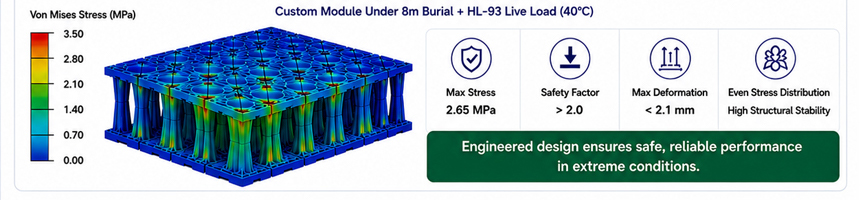
Standard off-the-shelf PP modules suffer a sharp drop in effective modulus once underground ambient temperatures rise above 35 °C. Localised micro-buckling initiates within the vertical structural columns. Column deflection causes uneven load distribution across the arch assembly, leading to gradual structural failure — a defect undetectable via surface visual inspection until irreversible damage occurs.
2. Upstream & Downstream Subsurface Interface Topography
An underground stormwater retention tank cannot be treated as an independent plastic component; it operates as part of an integrated geosynthetic system. Our custom sizing design directly addresses critical interfaces with surrounding civil structures:
• Geotextile Compatibility
Customised module dimensions eliminate uneven modular joints, ensuring full continuous surface contact with the 400 g/m² perforated non-woven geotextile. This prevents soil particle migration and the formation of localized subsidence.
• Geomembrane Protection
Field-cut edges of standard modules present a well-documented risk of puncturing the 1.5 mm HDPE impermeable liner. YY-TANK’s factory-finished smooth perimeters fully safeguard the hydraulic integrity of the geomembrane.
• Backfill Compaction Tolerance
Our heavy-duty outer side frames are engineered to withstand direct dynamic impacts from heavy vibratory compactors during structural backfilling. They safely achieve a modified Proctor density exceeding 95% with no post-installation damage.
Section 4: Technical Trust and Strategic Commitment
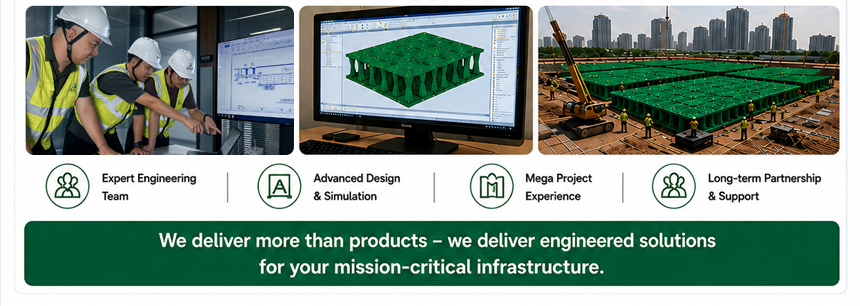
We consciously bypass the high-volume, low-spec commodity market. Our production is purpose-built for engineering challenges where standard solutions fail. If your project is a mega-scale municipal or commercial development facing extreme burial depths, complex utility crossings, and strict government structural approvals, we bring heavy-duty material compounding and tailored mold processing to eliminate subgrade structural failure risks. This singular focus has proven to save our clients millions in potential structural liabilities, excavation rework, and liquidated damages.
Before finalizing your subsurface design or procuring modules that may not survive local civil authority structural reviews, validate your design with certified performance data.
Our load-bearing and creep-resistance properties have been independently verified by internationally recognized bodies.
[Insert specific certification references here, e.g.: TÜV Rheinland Report No. 2X3456-21, SGS Test Certificate GZ-IN-2024-0892, according to ASTM D2990 creep testing protocols.]
Get the Technical Engineering Blueprints
Click below to download our comprehensive technical data book, or submit your site layout drawings to receive a custom structural analysis and sizing proposal from our application engineers within 24 hours.
👉[Download Whitepaper: Subsurface Structural Loading & Creep Analysis for Mega-Projects >20,000 m³ (PDF)]
👉[Request a Tailored Structural Sizing & Load-Bearing Simulation Scheme]
Technical FAQ: Critical Questions for Your Subsurface Project
Q: Can the dimensions and height of the Rainwater Harvesting PP Modules be adjusted to bypass existing underground utility lines?
A: Yes. Unlike standard fixed-dimension modules that require manual cutting on-site—which destroys the column support—YY-TANK offers precise Custom Dimension and height variations via flexible mold-insert configurations for projects exceeding 20,000 m³. This preserves the full structural integrity and meets the exact volumetric and clearance requirements of complex, congested underground layouts.
Q: What is the maximum load-bearing capacity of your custom polypropylene stormwater modules for urban roadway applications?
A: Our engineered modules can be customized to achieve a vertical load-bearing capacity up to 800 kN/m², tested to EN 17150 under a constant temperature of 40 °C. This specification safely accommodates burial depths greater than 4 meters and sustained dynamic traffic surcharges compliant with international standards including HL-93 and Eurocode 1.
Q: Why is standard black recycled PP often unsuitable for large infrastructure projects in the Middle East?A: Recycled black compounds often lack the chemical homogeneity and stabilizer package required for the GCC’s high subsurface soil temperatures. This leads to rapid thermo-oxidative degradation and accelerated creep. YY-TANK uses a strictly controlled Masterbatch Customization process with high-purity virgin copolymer, incorporating advanced high-temperature antioxidants and UV-stabilizers precisely formulated for desert storage and permanent underground service.
Conclusion: Laying the Structural Cornerstone for Sustainable Rainwater Management
In conclusion, for mega-scale projects in the GCC region, selecting the right rainwater module is no longer a simple procurement decision. It directly impacts the reliability and lifespan of the entire Rainwater Retention System and the success of the city-wide Rainwater Management strategy. By providing customized solutions with compressive strengths up to 800 kN/m², exceptional creep resistance, and seamless integration with upstream/downstream components, YY-TANK fundamentally eliminates the risk of system failure due to structural shortcomings of standard modules. This not only safeguards the long-term value of underground assets but also constitutes a significant contribution to the sustainable utilization of water resources and the lifecycle economics of the project. We are committed to being your engineering partner in building robust, efficient, and sustainable rainwater infrastructure.
Writer: Luna, Content Planning Department