




Heavy-Duty PP Stormwater Module Manufacturer | >800 kN/㎡ Strength
09 Jun 2026Static vs. Creep: The Wrong Strength Test Is Why 80% of Deep-Buried Attenuation Tanks Buckle Within 24 Months

Stop looking at perfect laboratory datasheets where a hydraulic press crushes a single plastic element in a split second. That static, instantaneous measurement has almost nothing to do with subsurface reality.
When thousands of polypropylene modules are buried 8 meters underground, submersed in fluctuating groundwater, and subjected to tens of thousands of tons of dead weight from soil overburden alongside continuous dynamic shear stresses from heavy-duty traffic, a silent engineering catastrophe begins.
According to multiple post-incident engineering audits, up to 80% of large-scale stormwater attenuation tanks installed under heavy-duty pavements exhibit significant structural deformation or catastrophic collapse within 12 to 24 months of completion—especially when the material specification overlooked long-term creep resistance. EPC contractors are routinely blindsided when post-handover site inspections reveal uneven ground settlement. Beneath the surface, the stormwater retention structure—frequently built from low-cost, unverified recycled plastics—has already yielded to lateral soil displacement, tilting, or localized crushing.
The Fatal Oversight: Misjudging Static Compressive Strength for Long-Term Subsurface Stability
During the procurement and material-control phase of major civil engineering projects, procurement officers almost universally fall into a catastrophic cognitive trap: evaluating quotes solely based on initial static vertical compressive strength per dollar.

To achieve competitive bidding margins, low-end suppliers flood the market with modules manufactured from generic, post-consumer recycled polypropylene (Recycled PP). These materials are heavily cross-contaminated with degraded polymers and fillers that look robust during a 60-second compression test but possess zero long-term molecular stability.
Under real-world conditions, these traditional, unrefined options fail completely against continuous earth pressure and localized shear stresses. Not only is this a narrow technical failure, but from a total cost of ownership (TCO) and geotechnical economics perspective, prioritizing cheap material single-unit costs guarantees an exponential multiplier on liability and remediation costs when the subsurface system breaches.
| Technical Specifications & Core Metrics | High-Performance Modified PP Module (1000×500×400) | Typical Unmodified Post-Consumer Recycled PP Modules | Geotechnical Significance & Failure Correlation |
| Base Material Composition | Premium Modified Polypropylene (Modified PP) | Unmodified mixed post-consumer recycled plastics (no anti-creep formulation) | Governs long-term macromolecular chain stability and resistance to chemical aging. |
| Constant Load Creep Strain | < 2.0% over a 50-year design life under 8m overburden | Rapidly exceeds 15% within 12–24 months under identical load | The ultimate hidden parameter. Determines whether the buried tank maintains structural integrity or collapses over decades. |
| Total Void Ratio (Porosity) | 92% (Engineered Optimization) | 82% – 88% (Relies on excessive wall thickness) / 82% - 88% | Directly impacts the total volume of earth excavation, hauling, and backfilling costs. |
| Ultimate Vertical Compressive Strength | > 800 kN/㎡ | 300 – 400 kN/㎡ (Drops drastically as temperature rises) / 300 - 400 kN/㎡ | Establishes the maximum allowable burial depth and heavy-duty traffic load ratings (e.g., HS-20). |
| Ultimate Lateral Compressive Strength | > 450 kN/㎡ | ≤ 60 kN/㎡ (Extremely vulnerable to lateral earth pressure) / ≤ 60 kN/㎡ | Crucial for resisting active horizontal earth pressures and maintaining shape retention during intense backfill compaction. |
The Physics of Subsurface Failure: Macromolecular Slip and Structural Buckling
To understand why a module with high initial static strength can fail in year two, one must look at polymer mechanics under constant load. Generic recycled polypropylene contains a chaotic mix of short-chain polymers, residual pigments, and organic impurities. Under a sustained, long-term dead load (such as 8 meters of compacted soil), these unaligned polymer chains experience irreversible macromolecular slipping.
This phenomenon, known as creep-induced progressive deformation, means the plastic material gradually deforms over time under a stress level far below its ultimate static tensile strength. While a static test machine may record a high yield point, the material under constant subsurface load undergoes micro-cracking and accumulated strain, eventually leading to sudden structural buckling.
Furthermore, if the installation lacks an integrated, multi-dimensional structural lock, it remains highly vulnerable to lateral forces. When standard modules are subjected to unbalanced horizontal earth pressures, their vertical columns begin to tilt. Without an engineered Interlocking Structure designed to distribute shear forces horizontally across adjacent units, the entire matrix suffers from multi-row cascading displacement, causing the top slab to fold inward.
Engineering Lesson : Mechanical performance under static laboratory conditions at 20°C is entirely irrelevant to an asset's structural survival under real-world viscoelastic deformation regimes. Civil engineers must mandate long-term creep testing data extrapolated to a 50-year baseline via ASTM D2990 or ISO 899-1 protocols before qualifying any polymer module for heavy-duty retention infrastructure.
Geotechnical System Integration: Moving Beyond the Single-Component Mindset
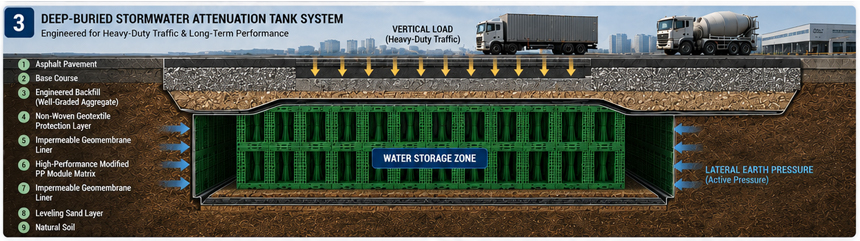
A heavy-duty stormwater attenuation tank is never just an isolated arrangement of plastic crates; it is a highly sensitive, interactive subterranean structural system consisting of the engineered modules, a specified Geotextile wrapping, a robust Geomembrane liner, and the precisely controlled Infill Compaction of the surrounding soil matrix.
When designing a deep-buried retention system (up to 8 meters depth), managing the lateral active earth pressure during the backfilling phase is a critical milestone. If the backfill material is dumped carelessly or unevenly, it exerts immense localized point loads on the side walls of the tank.
Our module's industry-leading lateral compressive strength of > 450 kN/㎡ is specifically engineered to withstand aggressive, multi-layered mechanical backfilling. It allows contractors to employ standard heavy vibratory plate compactors to achieve the mandatory 95% Modified Proctor Density in the surrounding soil without causing any internal deflection or structural warping of the polymer framework.
Additionally, the selection of the outer non-woven geotextile must be precisely matched to the local soil's hydraulic conductivity. Utilizing a sub-standard or generic fabric allows fine silt particles to migrate through the mesh, blinding the geotextile skin and filling the void space inside the tank. Over time, this decreases the operational water capacity well below the original 92% specification and creates localized voids in the adjacent soil, triggering sinkholes on the surface.
The Financial Reality: A Penetrating TCO Model for Infrastructure Asset Management

When evaluating the true cost of subsurface stormwater infrastructure, asset owners and EPC contractors must utilize a rigorous Total Cost of Ownership (TCO) calculation model rather than a simple upfront material purchasing invoice.
A realistic failure rectification cost typically breaks down as follows:
Total Failure Rectification Cost = Material Replacement Cost + Deep Excavation & Shoring (often ~150% of original material cost) + Contaminated Soil Disposal & Fresh Backfill (~120%) + Surface Infrastructure Reconstruction (~180%) + Contractual Liquidated Damages
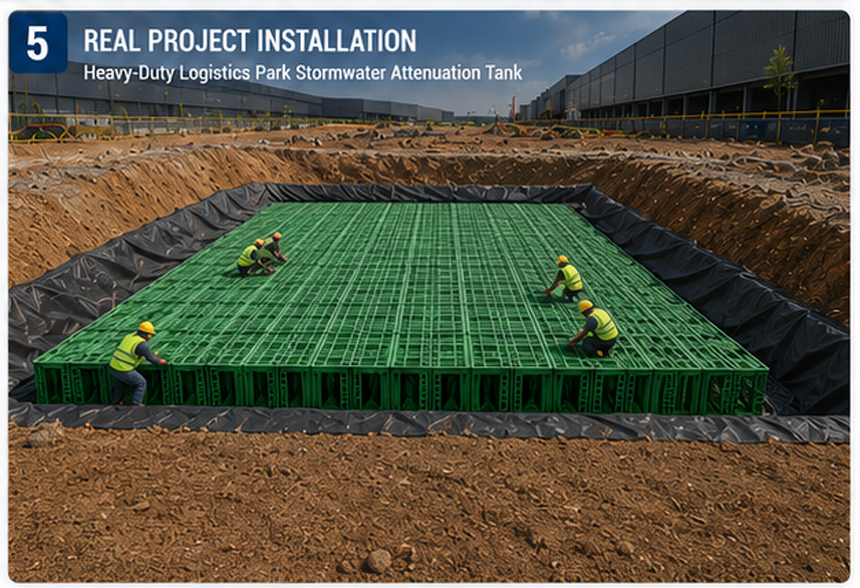
Let us review a practical engineering scenario: A major distribution center logistics park requires a 10,000 m³ underground stormwater attenuation facility beneath its primary heavy vehicle maneuvering area.
Choosing a low-end, recycled PP alternative might save approximately 12% on the initial Bill of Quantities (BOQ) for the plastic components. However, because those low-end modules only offer a lower void ratio (around 84%), the contractor is forced to excavate an additional 950 m³ of earth to achieve the exact same net water storage volume compared to our 92% high-porosity system. This instantly inflates the site's earthworks budget, off-site soil transportation fees, and protective geotextile square-meter usage.
If that lower-tier structural matrix suffers a creep-induced failure or lateral buckling under traffic load in year two, the financial consequences are catastrophic. The rectification cannot be performed via a localized patch. It requires completely shutting down logistics operations, implementing extensive deep structural shoring, executing massive open-cut excavation, disposing of the contaminated collapsed modules, and rebuilding the entire system from the foundation up. The cost of this structural failure typically scales to over 400% of the original total system procurement budget, completely obliterating the initial marginal savings.
Our Engineering Commitment: Transparent Parameter Trading
Let us be completely transparent: If your project is limited to shallow, non-load-bearing landscape irrigation or requires the absolute lowest per-unit baseline cost, our high-performance modified PP stormwater modules may not be the most cost-effective choice. We do not compromise on base material processing or structural safety margins to manufacture cheap, single-use plastic components.
However, if your scope of work involves high-stakes civil infrastructure—where the installation is buried up to 8 meters deep, placed under dynamic heavy-duty traffic loading, or located within challenging geological conditions with stringent long-term structural liabilities—we deliberately allocate investment into long-term structural integrity rather than minimal upfront pricing. This engineered trade-off sacrifices the absolute lowest price tier in exchange for an unyielding vertical strength exceeding 800 kN/㎡, a lateral resistance greater than 450 kN/㎡, an optimized 92% void ratio, and verified 50-year creep resistance performance. This engineering execution protects your project from catastrophic structural failure, ensures complete compliance with strict municipal regulations, and eliminates the risk of multi-million dollar subsurface rectification claims.
🛡️ISO9001Certificate No.:66724Q0879R0S
📜No.of Report:BETC-T3AC-2025-02701
Technical FAQ: Critical Questions for Your Subsurface Project
Q: What is the significance of >800 kN/㎡ vertical strength in a PP stormwater module?
A: A vertical compressive strength exceeding 800 kN/㎡ indicates that the module belongs to an elite, heavy-duty engineering class. It allows for extreme burial depths (up to 8 meters or more depending on soil conditions) and ensures the structural matrix can safely bear heavy-duty dynamic live loads, such as HS-20 truck traffic, container terminals, and airfield pavements, without structural deformation.
Q: Why does lateral compressive strength (>450 kN/㎡) matter as much as vertical strength for underground attenuation tanks?
A: Vertical strength prevents the tank from being crushed from above, but lateral strength (>450 kN/㎡) prevents it from buckling from the sides. Underground tanks are subject to intense horizontal earth pressures and active shear forces during backfill mechanical compaction. Insufficient lateral resistance leads to column tilting and cascading matrix failure, making high lateral strength vital for deep-buried installations.
Q: How does a 92% void ratio optimize the overall construction budget (TCO) of a retention system?
A: A 92% void ratio balances structural wall thickness with volumetric efficiency. It ensures maximal water retention space within a minimal structural footprint. Compared to lower-porosity modules (e.g., 80%-85%), it reduces the required volume of total soil excavation, off-site hauling, and premium backfill material, significantly lowering the overall civil engineering and labor costs.
Q: What is the typical lead time for a large-scale heavy-duty modified PP module project, and is customization supported?
A: For standard 1000×500×400mm dimensions with >800 kN/㎡ specifications, our automated production lines can deliver a capacity of up to 3,000 units/week with a standard international lead time of 21-28 days. We fully support customized port configurations and can tailor proprietary modified material masterbatch formulations according to the FEA load requirements of specific projects.
Editor: Luna, Content Planning Department