





Rainwater Collection & Harvesting Systems: Costs, Pros, Cons & How to Choose (2026 Guide)
24 Jun 2026Comparative Analysis of Five Rainwater Harvesting System Types
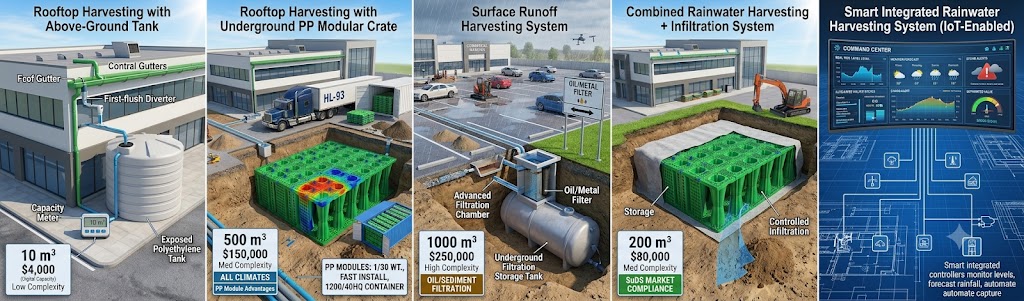
1. Rooftop Harvesting with Above-Ground Tank
The simplest commercially available configuration for rainwater harvesting. Rainwater flows from roof gutters through a first-flush diverter and pre-filter into a polyethylene or steel tank sitting on the ground surface.
• Capacity range: 1–20 m³
• Cost range: $1,500–$8,000
• Installation complexity: Low — no excavation required
• Best climate: Temperate regions with moderate rainfall and no frost risk
• Limitation: Consumes surface area, vulnerable to temperature extremes and UV degradation
2. Rooftop Harvesting with Underground PP Modular Crate
A common and widely adopted configuration for commercial and municipal rainwater harvesting projects.
Filtered rainwater enters an underground array of interlocking polypropylene modules with 92% void ratio. The modular design allows custom sizing from 5 m³ to 500+ m³.
•Capacity range: 5–500+ m³
•Cost range: $5,000–$150,000+
•Installation complexity: Medium — excavation and base preparation required
•Best climate: All climates (underground thermal stability)
•Limitation: Requires soil investigation and groundwater assessment
PP modules weigh 1/30th of an equivalent concrete tank and can install up to 60% faster.
Transport efficiency is a key cost factor: over 1,200 modules (in collapsible form) fit in a single 40HQ container.
3. Surface Runoff Harvesting System
Captures rainwater from parking lots, roads, and ground surfaces for harvesting. Offers larger volumes but lower water quality, necessitating aggressive pretreatment.
• Capacity range: 50–2,000+ m³
• Cost range: $20,000–$300,000+
• Installation complexity: High — requires civil engineering for channel drains and sediment traps
• Best climate: Areas with large paved surfaces and high rainfall intensity
• Limitation: Oil, heavy metals, and sediment require advanced filtration
4. Combined Rainwater Harvesting + Infiltration System
Dual-function system storing rainwater for reuse while allowing controlled infiltration via geotextile-wrapped modules. Meets both rainwater harvesting and SuDS (Sustainable Drainage Systems) compliance.
• Capacity range: 20–200 m³
• Cost range: $10,000–$80,000
• Installation complexity: Medium — similar to underground PP module installation
• Best climate: UK, Germany, Australia (markets with SuDS mandates)
• Limitation: Requires percolation test; unsuitable for clay soils with infiltration rate < 15 mm/hr
5. Smart Integrated Rainwater Harvesting System (IoT-Enabled)
Enhances any harvesting configuration above with IoT sensors, weather-linked controllers, and automated valves. Smart controllers monitor tank levels, forecast rainfall, and pre-emptively release stored water before storms to maximise capture.
• Capacity range: Any
• Cost premium: +$2,000–$10,000 for IoT components
• Installation complexity: Medium + electrical/commissioning
• Best climate: Regions with highly variable rainfall patterns
• Limitation: Requires reliable internet connectivity and ongoing software maintenance
Cost Comparison Across Rainwater Harvesting System Types
| System Type | Initial Investment (50 m³) | Annual Maintenance | 10-Year Total Cost | Water Savings |
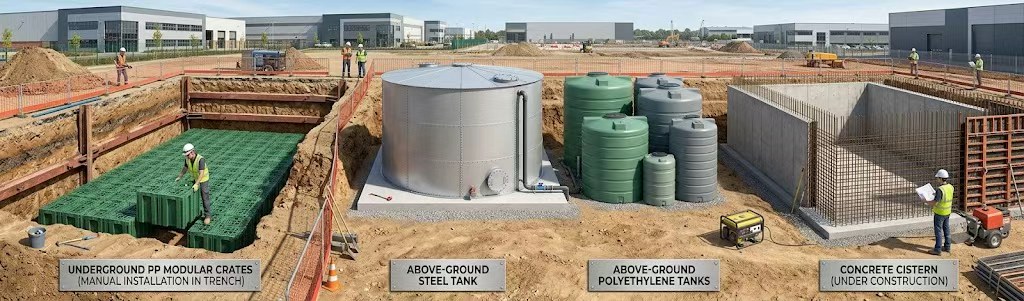
| PP modular underground | $18,000–$35,000 | $500–$1,200 | $23,000–$47,000 | 20–50% |
| Concrete cistern | $35,000–$55,000 | $800–$2,000 | $43,000–$75,000 | 20–50% |
| Above-ground steel tank | $15,000–$28,000 | $1,200–$2,500 | $27,000–$53,000 | 20–50% |
| Above-ground polyethylene | $8,000–$18,000 | $400–$800 | $12,000–$26,000 | 15–35% |
Note: Water savings represent the percentage of potable water replaced by harvested rainwater.
In most scenarios, PP modular harvesting systems exhibit lower 10-year total costs than concrete cisterns. This advantage stems from dramatically lower installation labor requirements: PP systems forgo the need for cranes or heavy machinery, relying instead on manual assembly by a small crew. The Nanjing Industrial Park case study demonstrates a 5–7 year payback period for a 500 m³ PP modular rainwater harvesting system when evaluated against local municipal water tariffs.
For a detailed, line-item cost breakdown across three common system sizes, consult our comprehensive rainwater harvesting system cost analysis.
Choosing the Right Rainwater Collection System
Choosing the right rainwater collection system requires matching four project parameters to the system types above.
Step 1: Assess Collection Area and Rainfall Data
Measure the horizontal roof footprint (m²) and obtain 10-year average annual rainfall for your location.
This determines the theoretical harvestable volume:
Annual Harvest (litres) = Area (m²) × Rainfall (mm) × 0.85 (efficiency factor)
A 400 m² roof in Berlin (570 mm/year) yields approximately 194,000 litres annually — enough for toilet flushing in a 40-person office.
Step 2: Define End-Use Requirements
Different uses demand different water quality standards:
• Irrigation: Basic pre-filtration is sufficient. No post-treatment needed.
• Toilet flushing: Pre-filter + UV sterilisation recommended.
• Industrial cooling: Pre-filter + chemical treatment for scale prevention.
• Potable supply: Full treatment chain including UV + chlorination + carbon filtration.
Step 3: Evaluate Site Constraints
Three factors determine which storage type is feasible:
• Available surface area: If surface area is limited, underground PP modules are often the most practical option.
• Soil conditions: Clay soils with low permeability favour sealed storage (geomembrane-wrapped). Sandy soils with good drainage allow infiltration-type systems.
• Groundwater level: The module base must sit at least 1 m above the seasonal high groundwater table.
Step 4: Match System Type to Project Parameters
| Project Profile | Recommended System | Why |
| Small office, temperate climate, ample land | Above-ground tank | Lower cost, simpler installation |
| Commercial building, space-constrained urban site | Underground PP modular | Zero footprint, scalable, 50-year life |
Industrial park, large paved area | Surface runoff + PP modular | Maximises collection area |
| UK/Germany new development | Combined harvest + infiltration | Meets SuDS compliance + water reuse |
| Data centre, hospital (critical supply) | Smart integrated system | Automated management, weather-linked control |
Frequently Asked Questions
What is the typical cost of a rainwater harvesting system?
Basic above-ground rainwater collection systems for residential use start around $1,500. For larger-scale applications, a commercial underground polypropylene (PP) modular rainwater harvesting system with a 50 cubic meter capacity typically costs between $18,000 and $35,000 for a fully installed solution. Key cost drivers are the excavation scope and any required post-treatment components.
Which rainwater harvesting system is recommended for a large building?
For buildings with a roof area exceeding 500 m², an underground PP modular rainwater storage tank paired with rooftop collection is highly recommended. This rainwater collection solution offers an optimal balance of capacity, durability, and cost efficiency. Its modular design allows scaling from 10 m³ to over 500 m³ without custom fabrication, and the 95% void ratio maximizes water storage per cubic meter of excavation.
Can I DIY my own rainwater harvesting setup?
Small, above-ground rainwater collection systems (1–5 m³) are feasible for a competent DIY installer. However, installing an underground modular rainwater harvesting system requires professional expertise for excavation, base preparation, and proper wrapping with geotextile or geomembrane. Our comprehensive step-by-step guide to installing a rainwater harvesting system details the entire process.
How much rainwater can I collect from my roof?
Use the standard rainwater harvesting calculation formula: Roof Area (m²) × Annual Rainfall (mm) × 0.85 (runoff coefficient) = Harvestable Litres per year. For example, a 250 m² roof in Sydney (1,200 mm/year annual rainfall) can harvest approximately 255,000 litres annually—sufficient for garden irrigation and toilet flushing in a medium-sized commercial building.
This article is part of our comprehensive guide to rainwater harvesting systems. For detailed specifications on individual parts, refer to our guide on rainwater harvesting system components. For high-capacity storage solutions, explore our Large 1200 modular collection crate.Integrating a well-planned rainwater harvesting system is a key step towards sustainable water management, offering significant long-term savings and resilience.