





Rainwater Harvesting System: The Complete Guide to Collection, Storage and Reuse
30 Jun 2026Water scarcity now affects over 2 billion people worldwide, and the global rainwater harvesting market reflects the urgency: sales reached $951 million in 2024, with projections showing sustained 6–7% annual growth through 2031. Governments from London to Beijing have stopped treating rainwater collection as optional—Building Regulations Part H3 in the UK, China‘s GB 50400, and the US EPA’s Green Infrastructure programme all mandate or strongly incentivise on-site rainwater management. In the U.S., most states now permit and even encourage rainwater harvesting, with Texas exempting rainwater equipment from sales tax and California embedding rainwater systems in its building code . In the UK, using harvested rainwater for non-potable purposes such as toilet flushing and gardening is widely promoted to reduce mains water demand .
A rainwater harvesting system is an engineered setup that captures rainwater from collection surfaces such as rooftops or paved areas, channels it through filtration components, stores it in underground or above-ground tanks, and makes it available for non-potable uses including irrigation, toilet flushing, and industrial processes. Jiangsu Yingyuan Sponge City Technology Co., Ltd. manufactures PP (polypropylene) modular storage units that sit at the core of these systems, with an annual production capacity of 150,000 m³ serving projects across 30+ countries.
This guide covers system types, core components, sizing methodology, ROI data, installation workflows, and the regulatory landscape across six key markets.
Table of Contents
• What Is a Rainwater Harvesting System?
• Types of Rainwater Harvesting Systems
• Core Components & PP Modular Technology
• How to Size Your System
• ROI & Cost Analysis
• Installation Overview
• Global Regulations & Standards
• Why Choose PP Modular Systems
• FAQ
What Is a Rainwater Harvesting System?
A rainwater harvesting system collects, filters, stores, and distributes rainwater from roofs and surfaces for non-potable or potable reuse. Unlike simple barrel-and-gutter setups used in residential gardening, modern commercial-scale systems involve four engineered stages that work in sequence to deliver clean, pressurised water to the point of use.
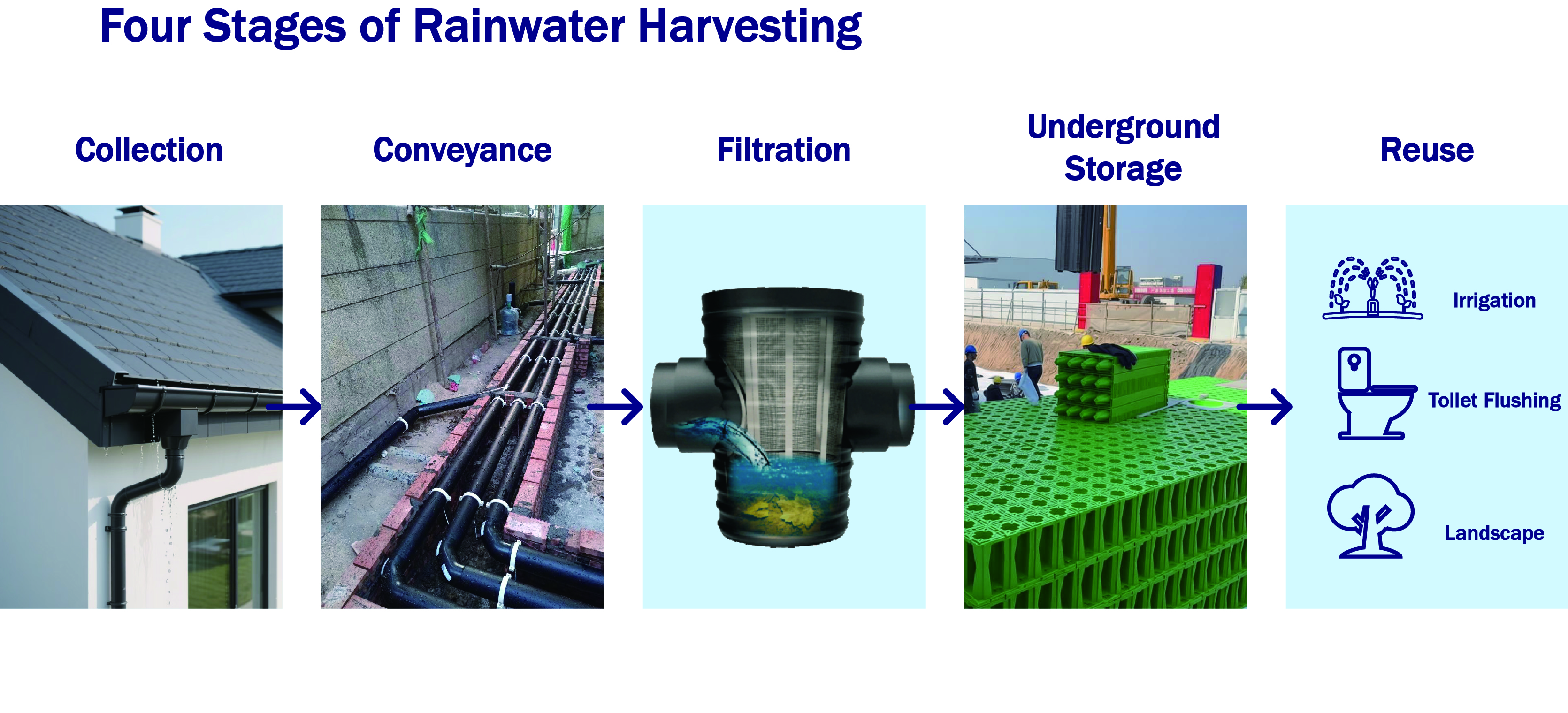
The four core stages:
Collection — Rainfall lands on a rooftop or paved surface. Rooftop collection efficiency varies by material: metal roofs can achieve up to 95% efficiency, while asphalt shingles typically reach about 85% . Clay and concrete tiles offer around 90% .
Conveyance — Gutters and downpipes channel water toward the storage area. A proper slope of at least 1/16 inch per foot is recommended to prevent standing water . Gutters should be cleaned quarterly, as clogged gutters are the No. 1 cause of system failure .
Filtration — A first-flush diverter discards the initial flow from each rain event, which carries the highest concentration of dust, bird droppings, pollen, and roof debris. A common guideline is to divert 1 gallon of water per 100 sq ft of roof area (roughly equivalent to 1 litre per 10 m²). After the first flush, water passes through a mesh or vortex pre-filter before entering the storage module .
Storage & Distribution — Filtered water enters the underground PP modular tank, where it is held at a void ratio of 92%—meaning nearly the entire internal volume is available for water storage. A pump station delivers stored water to the point of use on demand. Tanks must be opaque or UV-resistant to prevent algae growth .
PP modular storage represents the third generation of rainwater tank technology. First-generation units were simple hollow plastic boxes with 60–70% void ratio and limited load capacity (<10 tonnes/m²). Second-generation designs introduced ribbed reinforcement, raising void ratios to 85–90% and load ratings to 20–40 tonnes/m². Today‘s third-generation modules—exemplified by the Polystorm Xtra benchmark—achieve 92%+ void ratio and 80 tonnes/m² compressive strength. Yingyuan’s Hurricane HD series matches this tier with 85 tonnes/m² certified load capacity.
The evolution matters because it directly affects how much water you can store per cubic metre of excavation. A modern PP module stores roughly 950 litres per cubic metre of installed volume, compared to 300–400 litres for gravel-filled systems and 1,000 litres for a single-walled concrete tank that occupies far more space per unit of storage.
Types of Rainwater Harvesting Systems
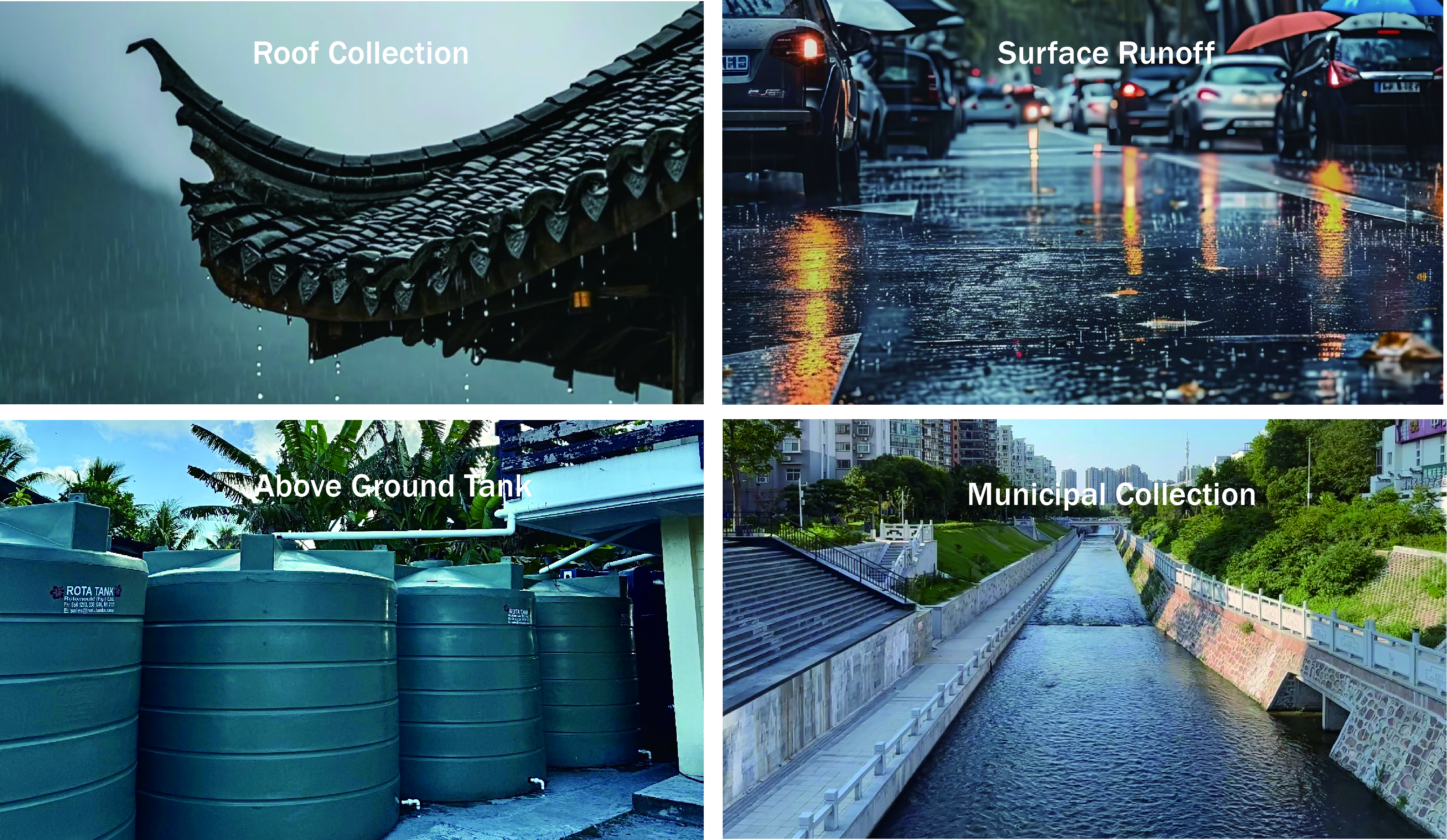
Rainwater harvesting systems can be classified along four dimensions—collection surface, storage type, end use, and scale—each influencing cost, complexity, and suitability for a given project.
By collection surface:
• Rooftop collection delivers the highest water quality and collection efficiency (85–95% depending on material) , making it ideal for residential and commercial buildings.
• Surface runoff collection captures rainwater from parking lots, roads, and ground surfaces. Lower water quality requires more aggressive filtration, but the volumes available from large paved areas can justify the treatment investment.
By storage type:
• Underground modular PP tank offers zero surface footprint, thermal stability, and 92% void ratio. Best for space-constrained commercial and municipal projects.
• Above-ground tank (steel, fibreglass, or polyethylene) is simpler to install but consumes surface area and is vulnerable to temperature extremes. Polyethylene tanks are a popular choice due to their affordability, light weight, and UV resistance .
• Concrete cistern provides 100% void ratio but weighs 30× more per unit volume, takes longer to install, and is prone to cracking.
By end use:
• Direct-use systems pump stored water directly to irrigation sprinklers, toilet cisterns, or wash-down hoses.
• Gravity-fed systems rely on elevation head, eliminating pump costs but requiring the tank to sit above the point of use.
• Integrated attenuation + reuse systems combine stormwater detention with rainwater harvesting, releasing stored water at a controlled rate while retaining a reserve for reuse.
By scale:
| Scale | Typical Capacity | Best For | Cost Range (USD) | Key Advantage |
| Residential | < 10 m³ | Garden irrigation, toilet flushing | $3,000–8,000 | Low upfront cost |
| Commercial | 10–100 m³ | Office buildings, schools, hotels | $20,000–60,000 | Measurable ROI within 3–7 years |
| Municipal | 100+ m³ | Parks, highways, public buildings | $100,000–500,000+ | Regulatory compliance + ESG reporting |
For a deeper comparison of system types and their cost implications, see our guide on rainwater collection system types and costs. If you are comparing underground storage options, our underground rainwater storage module vs tank comparison breaks down the engineering trade-offs.
Core Components & PP Modular Technology
Every rainwater harvesting system comprises eight functional components. Understanding each one—and how they interact—is the difference between a system that delivers reliable water savings and one that underperforms or fails prematurely.
1. Collection surface — The roof or paved area where rainfall is captured. Calculate the effective collection area as the horizontal footprint (not the sloped surface area). A 500 m² flat roof in London (600 mm annual rainfall) can theoretically harvest 300,000 litres per year before efficiency losses.
2. Leaf screen / debris interceptor — A mesh screen fitted at the gutter outlet to block leaves, twigs, and insects. Stainless steel mesh with 2–3 mm aperture is the standard for commercial systems. Fine mesh (1/16 inch or smaller) also prevents mosquitoes .
3. First-flush diverter — Discards the initial 2–5 mm of rainfall (or about 1 gallon per 100 sq ft of roof) , which carries the bulk of particulates, bird droppings, and dissolved pollutants. Vortex-type diverters are preferred for commercial installations because they have no moving parts and self-clean after each event.
4. Pre-storage filter — Removes particles down to 280 microns before water enters the tank. Options include mesh filters (lower cost, more frequent cleaning) and vortex filters (higher cost, self-cleaning). For potable use, a 5-micron sediment filter and 3-micron carbon filter may be needed .
5. PP modular storage crate — The system‘s core. Yingyuan modules are manufactured from PP (block copolymer polypropylene), an engineering-grade plastic with high impact resistance and a 50-year design life. The interlocking column-and-rib structure achieves 92% void ratio while supporting compressive loads from 35 to 85+ tonnes/m² depending on the model. Modules snap together without heavy machinery—two or three workers can assemble 10 m³ per day using hand tools.
6. Pump station — Submersible pumps sit inside the module array; external pumps sit in a separate chamber. Sizing depends on delivery head (depth of tank + height to point of use) and flow rate requirements. A pressure tank can provide consistent flow for indoor use .
7. Post-storage treatment — For non-potable use, UV sterilisation (25 mJ/cm² dose) is usually sufficient . Potable-grade applications require additional chlorination or carbon filtration. Ozonation and reverse osmosis are advanced options .
8. Smart controller — IoT-enabled controllers monitor tank level, weather forecasts, and pump status in real time, automatically adjusting operation to maximise water savings.
A complete buyer‘s guide to each component, with specification tips and compatibility notes, is available in our rainwater harvesting system components guide.
How to Size Your System
Undersizing a system wastes rainfall that could have been captured. Oversizing inflates capital costs without proportional water savings. The following five-step method, adapted from BS 8515:2009 and BRE Digest 365, produces a practical tank size for most projects.
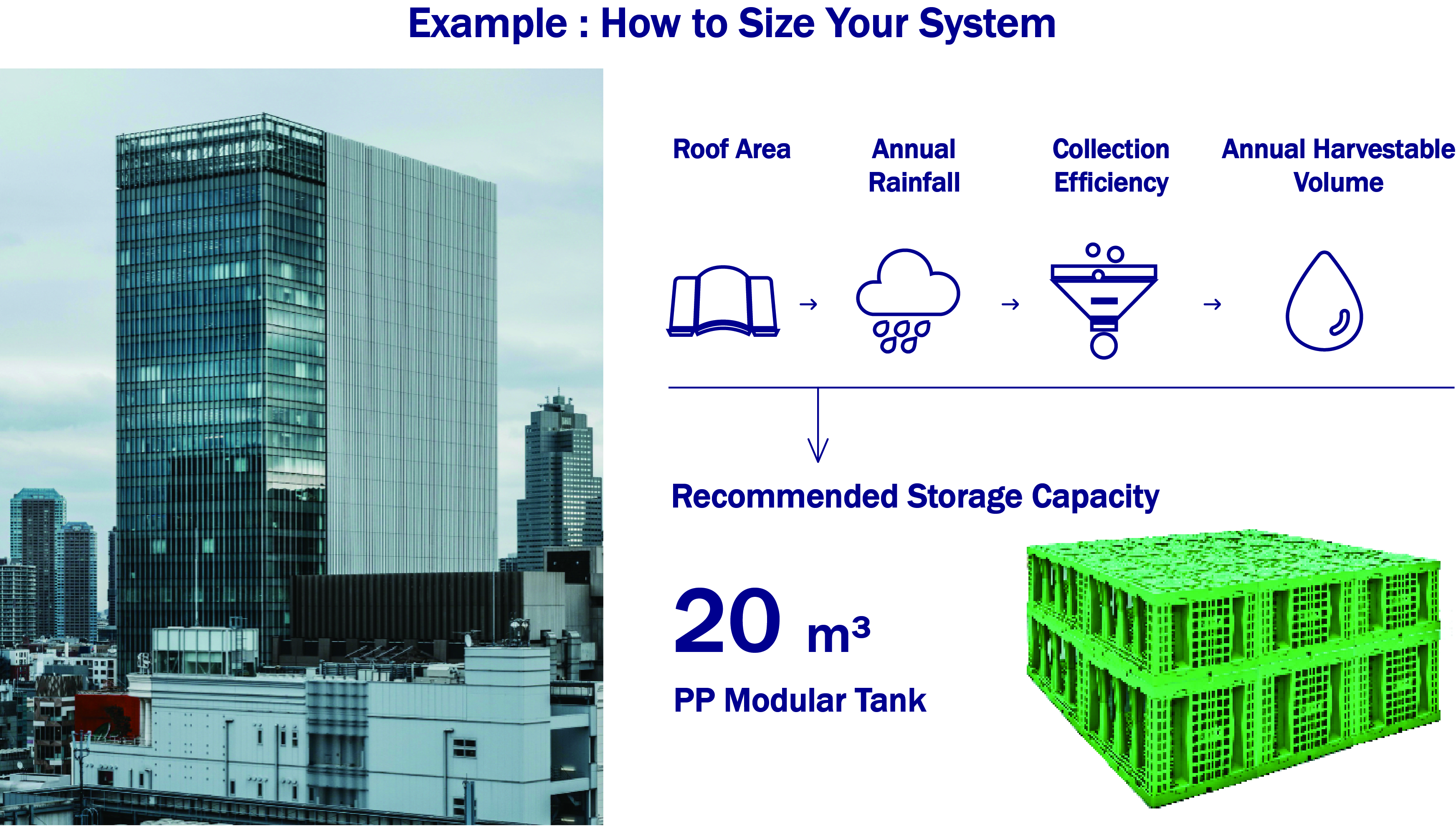
Step 1: Calculate collection area.
Measure the horizontal roof footprint in m². For a 500 m² commercial building, the collection area is 500 m².
Step 2: Determine annual rainfall for your location.
| City | Annual Rainfall |
| London | 600 mm |
| Sydney | 1,200 mm |
| Dubai | 100 mm |
| Berlin | 570 mm |
| Singapore | 2,340 mm |
| New York | 1,200 mm |
Step 3: Apply collection efficiency factor.
Rooftop efficiency typically ranges from 0.80 to 0.95 depending on the material. Use 0.85 for asphalt, 0.90 for tile, and 0.95 for metal as default values .
Step 4: Calculate demand.
Estimate daily non-potable water consumption (litres/day) and multiply by the desired days of autonomy (typically 14–21 days for temperate climates, 7–10 for tropical climates with frequent rainfall).
Step 5: Select tank size.
The basic formula for collection volume is:
Gallons = Roof Area (sq ft) × Rainfall (inches) × 0.623 × Efficiency %
For metric users: Litres = Roof Area (m²) × Rainfall (mm) × 0.85 (efficiency) × 0.001 (approximately, before demand adjustment). For monthly storage requirements, divide the annual total by 12 and apply a demand factor.
Worked example—500 m² commercial roof in London (600 mm rain, 85% efficiency):
Annual harvestable volume = 500 × 0.600 × 0.85 = 255 m³/year ≈ 21.25 m³/month
Recommended storage: 15–20 m³ PP modular tank (enough to bridge a dry month while capturing most wet-month surplus).
Yingyuan’s modular design allows starting with a 10 m³ array and expanding by adding modules as demand grows.
For detailed volume calculations, see our guide on how to calculate rainwater storage volume. Tank sizing guidance is covered in our rainwater tank sizes guide.
ROI & Cost Analysis
For procurement managers and project developers, the financial case often matters more than the environmental one. A well-designed commercial rainwater harvesting system reduces water bills by 20–50% annually, and the payback period typically falls between 3 and 7 years depending on local water tariffs and system scale.
Typical cost breakdown for a 50 m³ commercial system:
| Component | Share of Total |
| PP modular storage | 40–50% |
| Excavation & civil works | 15–20% |
| Pump station & distribution | 8–12% |
| Pretreatment (filter + first-flush) | 5–10% |
| Geotextile & PE membrane | 5–8% |
| Post-treatment (UV, carbon) | 5–8% |
| Piping & electrical | 5–8% |
| Smart controller & sensors | 3–5% |
Overall, storage tank costs vary widely: polyethylene tanks typically range from $0.50 to $2.00 per gallon, with installed costs averaging $1.50–$7.00 per gallon depending on material and complexity .
PP modular systems carry a structural cost advantage over concrete cisterns: they weigh 1/30th as much, install 60% faster, and ship efficiently—over 1,200 modules fit in a single 40HQ container, whereas a concrete tank requires dedicated flatbed transport per unit.
Case study: Nanjing Industrial Park
A 500 m³ system installed at a Nanjing industrial facility cost RMB 350,000 and harvests 1,200 tonnes of rainwater annually for landscaping, road washing, and fire-reserve topping. Treatment cost runs RMB 0.8 per tonne (electricity + consumables), yielding a payback period of 5–7 years against the municipal water tariff.
25-year total cost of ownership comparison:
| Metric | PP Modular | Concrete Tank | Above-Ground Steel |
| Capital cost (per m³) | Medium | High | Medium |
| Installation labour | Low | High | Medium |
| Maintenance (25 yr) | Low—annual inspection | Medium—crack repair, relining | High—corrosion treatment |
| Transport cost | Low (container-stackable) | Very high | Medium |
| Total cost of ownership | Lowest | Highest | Medium |
Beyond direct water savings, rainwater harvesting systems earn credits under BREEAM, LEED, and China‘s Green Building Evaluation Standard, adding measurable value to commercial property portfolios. A detailed ROI analysis with case studies from multiple markets is available in our commercial rainwater harvesting ROI guide.
Installation Overview
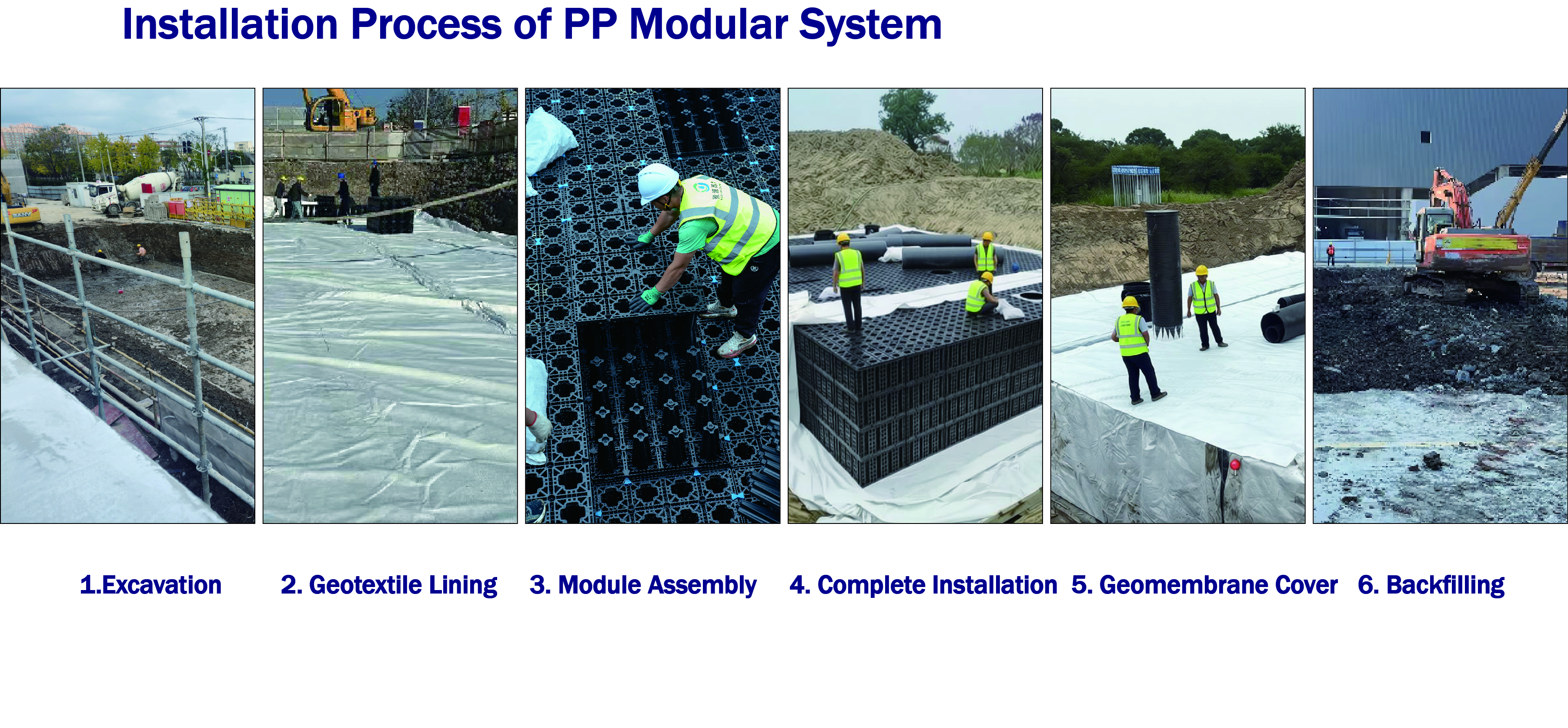
Installing an underground PP modular rainwater system follows a structured workflow that most civil contractors can execute without specialist training. The eight steps below apply to both infiltration (geotextile-wrapped) and sealed storage (geomembrane-lined) configurations.
1. Site survey & design — Soil investigation, groundwater level check, utility mapping. Confirm the burial depth accommodates module height plus 200 mm base slab plus 150 mm top cover.
2. Excavation — Dig to the required depth, typically 1.5–3 m. Maintain 200 mm clearance on each side for working space.
3. Base preparation — Lay a 100–150 mm compacted sand or C20 concrete slab, levelled to ±10 mm tolerance.
4. Geotextile / membrane layer — For infiltration systems, wrap with non-woven geotextile (200 g/m²). For sealed storage, use 0.5 mm PE geomembrane.
5. Module assembly — Snap-fit interlocking PP modules. No heavy machinery is required for module assembly—modules weigh 5–12 kg each and connect by hand. Two to three workers can assemble 10 m³ per day.
6. Pipe connections — Install inlet, outlet, overflow, and ventilation pipes using HDPE fittings. All pipes should have a minimum decline of 1% toward the tank to facilitate gravity flow .
7. Top wrap & seal — Complete the geotextile or membrane envelope, overlapping seams by 300 mm minimum.
8. Backfilling & commissioning — Backfill symmetrically in 200 mm layers with compaction. Round-grained gravel is recommended for backfill, compacted in 30 cm layers while simultaneously raising the water level inside the tank to balance pressure . Perform a fill test, leak check, and pump activation.
Yingyuan modules ship pre-assembled in 40HQ containers (1,200+ units per container), reducing on-site assembly time compared to systems that require field fabrication. For the complete step-by-step installation guide with tools checklist and soil-type guidance, see our rainwater harvesting installation guide.
Global Regulations & Standards
Rainwater harvesting is regulated differently in every market. The table below summarises the key frameworks across Yingyuan‘s six target regions.
| Country / Region | Regulation / Standard | Key Requirement |
| UK | Building Regulations Part H3, BS 8515:2009, FWMA 2010 Schedule 3 | SuDS mandatory for major developments (10+ dwellings or 1,000 m²+ commercial). Sustainable drainage hierarchy: reuse > infiltrate > watercourse > sewer. Rainwater harvesting is promoted for reducing mains demand . |
| US | EPA Green Infrastructure, NPDES permit, state-level LID mandates | Rainwater harvesting classified as a core Green Infrastructure practice. Most states permit collection; Texas exempts equipment from sales tax; California’s building code includes provisions for rainwater systems . Some states restrict residential storage (e.g., Colorado limits combined storage to 110 gallons; Utah allows up to 2,500 gallons with registration) . |
| China | GB 50400, Sponge City Programme (2026 full enforcement) | New buildings must include rainwater collection and reuse. Sponge City requirements now mandatory for all new, renovated, and expanded projects. |
| Australia | WSUD requirements, AS/NZS 3500, state mandates | Water Sensitive Urban Design principles mandated in major developments. Melbourne leads with source-control requirements for volume and quality. |
| Germany | DIN 1986-100, DIN EN 752 | New-build property owners must manage rainwater on-site. Discharge to public sewer is prohibited except in defined circumstances. |
| Middle East | Dubai Municipality SuDS Strategy (2025), Abu Dhabi Estidama | Growing adoption driven by extreme water scarcity. Regional market growing 20%+ annually. |
The regulatory trend is unambiguous: jurisdictions worldwide are moving from voluntary guidelines to mandatory requirements. Early adopters of rainwater harvesting infrastructure position themselves ahead of compliance deadlines while capturing immediate water cost savings. For a country-by-country regulatory deep dive, see our rainwater harvesting regulations guide.
Why Choose PP Modular Systems
PP modular storage occupies a distinct position between traditional concrete tanks and above-ground steel or polyethylene tanks. The comparison below highlights why modular PP has captured an estimated 35–40% of the global modular rainwater storage market, according to industry estimates,growing faster than concrete or metal alternatives.
PP Modular vs Concrete Tank:
PP modules weigh 1/30th of an equivalent concrete tank, install 60% faster, and offer a 50-year design life with minimal risk of cracking or rebar corrosion in the main structure (external wrapping quality should be ensured during installation). Concrete provides 100% void ratio versus 92% for modules, but the weight differential means concrete requires crane access and dedicated transport—adding cost and scheduling risk on congested urban sites.
PP Modular vs Above-Ground Steel Tank:
Underground PP modules occupy zero surface footprint, eliminating the above-ground opportunity cost of land in commercial developments. They maintain stable water temperature year-round (10–15°C underground vs ambient for above-ground), reducing bacterial growth. Steel tanks require periodic anti-corrosion treatment and have shorter service lives (15–25 years vs 50+).
PP Modular vs HDPE Modules:
PP (polypropylene) offers higher stiffness and better creep resistance than HDPE (high-density polyethylene) under sustained load. Yingyuan’s CNAS-accredited lab testing confirms module integrity under sustained loads per CJ/T 542-2020 heavy-duty requirements. The material withstands temperature ranges from –20°C to +60°C without structural degradation.
Yingyuan differentiators:
• CNAS-accredited laboratory testing with traceable report numbers
• Hurricane HD: 85 tonnes/m² compressive strength, D400 load class
• Annual production capacity: 150,000 m³
• Distribution network serving 30+ countries
• AAA credit enterprise rating(certified by a recognized credit rating agency)
Frequently Asked Questions
How much does a rainwater harvesting system cost?
A residential system (5–10 m³) typically costs between $3,000 and $8,000 installed. Commercial systems (50–200 m³) range from $20,000 to $120,000 depending on scope. Installed tank costs alone range from $1.50 to $7.00 per gallon depending on material and size . PP modular storage accounts for 40–50% of the total system cost, with excavation and civil works comprising the next largest share at 15–20%. Detailed line-item pricing for three system sizes is available in our complete system cost breakdown.
Is rainwater harvesting legal?
Not only legal—it is mandated in many jurisdictions. UK Part H3 requires sustainable drainage for new developments . China‘s GB 50400 mandates rainwater collection for all new buildings from 2026. In the U.S., most states permit and encourage rainwater harvesting, though some have specific limits—for example, Colorado caps residential storage at 110 gallons combined, and Utah allows up to 2,500 gallons with registration for larger systems .
How long does a rainwater harvesting system last?
PP modular tanks carry a 50-year design life when properly installed and backfilled. Above-ground polyethylene tanks typically last 15–25 years; steel tanks 15–30 years with maintenance. The key longevity factor is installation quality—correct geotextile wrapping and symmetric backfilling prevent uneven loading. Opaque tanks and regular cleaning further extend service life by preventing algae and sediment buildup .
Can rainwater harvesting save money?
Commercial buildings typically see 20–50% reduction in water bills. A well-sized system can pay for itself within 3–7 years through lower water bills, reduced stormwater fees, and possible tax incentives or rebates offered in some U.S. states . Rainwater used for toilet flushing and irrigation can replace 30–60% of a building’s potable water consumption.
Which type of rainwater tank is right for my project?
Underground PP modular tanks offer a strong combination of durability (50-year design life), space efficiency (zero surface footprint), load capacity (up to 85 tonnes/m² for heavy-duty models), and transport efficiency (1,200+ modules per 40HQ container). Above-ground polyethylene tanks are a cost-effective alternative for smaller installations where land is available. The right choice depends on project scale, budget, and site conditions. For a full comparison of storage options, see our underground storage module vs tank guide.
How do I maintain a rainwater harvesting system?
Annual inspection of filters, tank inlet/outlet, and pump is the baseline. First-flush diverters should be checked quarterly and cleaned after major storms. Gutters should be cleaned at least before and after the rainy season . Geotextile wrapping should be inspected every 3–5 years via the inspection well. Tanks should be emptied and cleaned of sediment every few years to maintain water quality . A complete maintenance checklist is available in our rainwater system maintenance guide.
How much rainwater can I collect from my roof?
Use the formula: Collection Area (sq ft) × Rainfall (inches) × 0.623 × Efficiency = Gallons . For metric: Area (m²) × Rainfall (mm) × 0.85 (efficiency) ÷ 1000 = m³. A 200 m² roof in Sydney (1,200 mm/year) can harvest approximately 204,000 litres annually—enough to supply toilet flushing and garden irrigation for a medium-sized office building year-round.
Yingyuan's PP modular rainwater systems are engineered for commercial, municipal, and residential projects worldwide. With CNAS-accredited testing, 150,000 m³ annual capacity, and a distribution network spanning 30+ countries, we support projects from initial design through commissioning.
[Request a free system design consultation and quotation] | [Download the Rainwater Harvesting Specification Guide]
References
: Offgrid Collective – Rainwater Harvesting Basics
: Home Depot Eco Actions – How to Set Up a Home Rainwater Collection System
: Jojo Tanks – Steps to Set Up a Rainwater Harvesting System
: My Rain Plan – Rainwater Harvesting 101 [2026]
: NC State Extension – Rainwater Harvesting: Guidance for Homeowners
: Travis Perkins – Rainwater Harvesting Advice
: Tank Systems – Rainwater Harvesting Manual
: FilterSmart – Rainwater Harvesting: A Comprehensive Guide
: GRAF UK – How to Install a Rainwater Harvesting System
Cici —Content Planning Department