





What Is a Rainwater Harvesting System and How Does It Work?
24 Jun 2026A rainwater harvesting system is an engineered arrangement that captures rainfall from rooftops or paved surfaces, filters out debris and contaminants, stores the clean water in underground or above-ground tanks, and delivers it on demand for non-potable uses such as irrigation, toilet flushing, and industrial cooling.
The Four Types of Rainwater Harvesting Systems
Not all rainwater harvesting systems work the same way. The right configuration depends on your collection surface, storage preference, site constraints, and water demand.
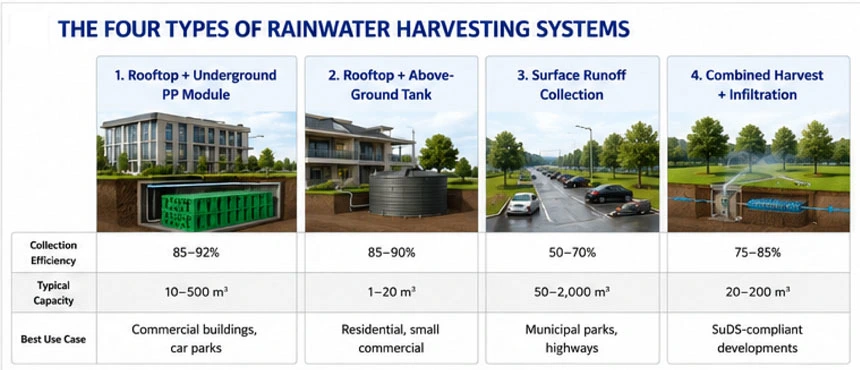
| Type | Collection Efficiency | Typical Capacity | Best Use Case |
| Rooftop + underground PP module | 85–92% | 10–500 m³ | Commercial buildings, car parks |
| Rooftop + above-ground tank | 85–90% | 1–20 m³ | Residential, small commercial |
| Surface runoff collection | 50–70% | 50–2,000 m³ | Municipal parks, highways |
| Combined harvest + infiltration | 75–85% | 20–200 m³ | SuDS-compliant developments |
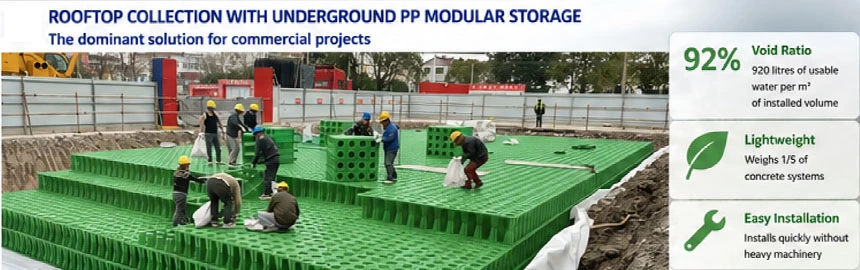
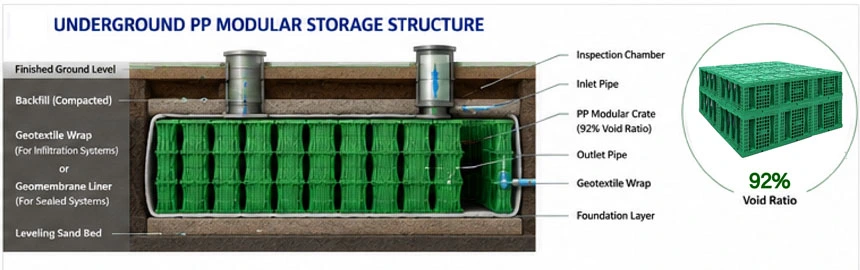
Rooftop collection with underground PP modular storage is the dominant configuration for commercial projects. The PP (polypropylene) modules achieve a 92% void ratio — meaning 920 litres of usable water per cubic metre of installed volume. They weigh a fraction of concrete alternatives and install without heavy machinery.
Surface runoff systems sacrifice water quality for volume. Parking lots and roads produce more total runoff than rooftops, but the water carries oil, heavy metals, and sediment that demand more aggressive pretreatment. These systems are common in municipal infrastructure projects and large industrial sites.
For a detailed comparison of system types with cost data, see our guide on types of rainwater collection systems.
Six Core Advantages of Rainwater Harvesting
Commercial building owners adopt rainwater harvesting for measurable financial and regulatory reasons, not just environmental goodwill.
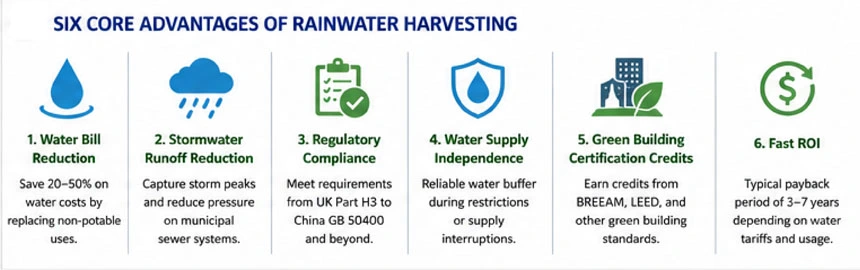
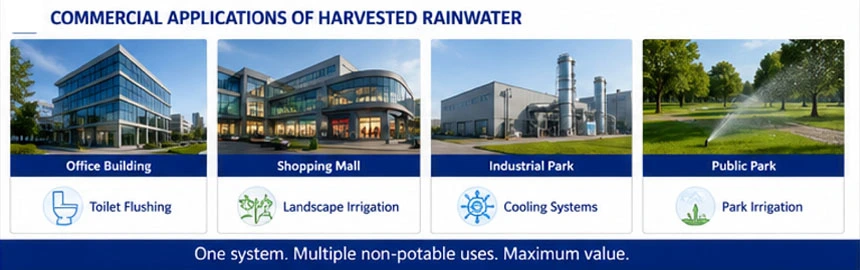
1. Water bill reduction of 20–50%. Non-potable uses — toilet flushing, irrigation, cooling tower makeup, wash-down — typically account for 60–70% of a commercial building's water consumption. Harvested rainwater displaces municipal supply for these applications, producing immediate cost savings.
2. Stormwater runoff reduction. A 500 m³ underground storage array captures storm peaks that would otherwise overwhelm municipal sewers. This is particularly relevant in the UK, where SuDS compliance is mandatory for developments of 10+ dwellings or 1,000 m²+ commercial space under the Flood and Water Management Act 2010 Schedule 3.
3. Regulatory compliance. From UK Part H3 to China's GB 50400 (mandatory from 2026) to the US EPA Green Infrastructure programme, jurisdictions worldwide are requiring on-site rainwater management.
4. Independence from municipal supply. In regions with unreliable water infrastructure or seasonal restrictions, stored rainwater provides a buffer that keeps operations running during supply interruptions.
5. Green building certification credits. BREEAM, LEED, and China's Green Building Evaluation Standard all award credits for on-site rainwater harvesting, contributing to higher property valuations and tenant appeal.
6. ROI timeline of 3–7 years. The US 4-city study by Rostad et al. demonstrated that rooftop rainwater used for toilet flushing replaced 30–60% of potable water consumption, with payback periods varying by local water tariffs. For a full financial analysis, see our commercial rainwater harvesting ROI guide.
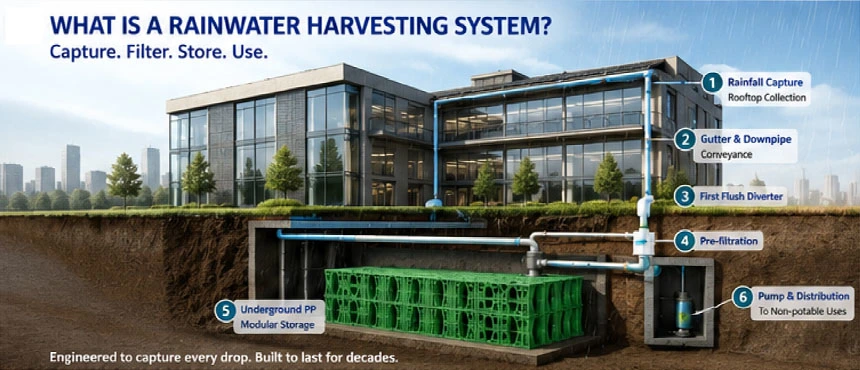
How a Rainwater Harvesting System Works — Step by Step
Understanding the water journey from sky to tap clarifies why each component matters and what happens when one is missing.
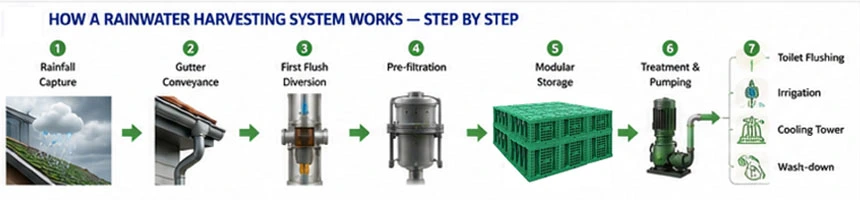
Step 1: Rainfall capture. Rain lands on the collection surface (rooftop or paved area). The effective collection area equals the horizontal footprint — not the sloped surface — of the roof.
Step 2: Gutter conveyance. Gutters and downpipes channel water toward the storage location. Undersized gutters cause overflow during peak events; the standard commercial specification is 150 mm half-round or 125 mm box gutter per 50 m² of roof.
Step 3: First-flush diversion. The first 2–5 mm of rainfall carries the highest pollutant load — bird droppings, dust, pollen, dissolved organics. A vortex-type first-flush diverter automatically discards this initial volume without moving parts.
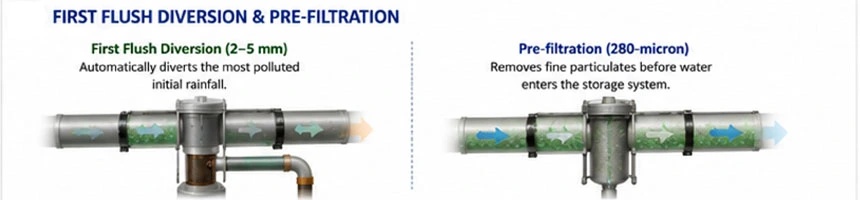
Step 4: Pre-filtration. Water passes through a mesh or vortex filter (280-micron rating typical) that removes fine particulates before they reach the storage module.
Step 5: Modular storage. Filtered water enters the PP modular tank. Yingyuan modules use interlocking PP (block copolymer polypropylene) columns that snap together by hand. The assembled array sits underground, wrapped in geotextile for infiltration or geomembrane for sealed storage, with a 50-year design life.
Step 6: Treatment and distribution. A submersible pump draws water from the module array and delivers it through post-filtration (UV sterilisation for non-potable use) to the point of consumption. Smart controllers can integrate weather forecasts to pre-emptively release stored water before a predicted storm, maximising capture capacity.
A complete guide to selecting and specifying each component is available in ourrainwater harvesting system components buyer's guide.
Frequently Asked Questions
Is rainwater harvesting legal everywhere?
Yes — and increasingly mandated. UK Part H3, China GB 50400, the US EPA Green Infrastructure programme, and Australia's WSUD frameworks all require or incentivise on-site rainwater collection. Some US municipalities offer tax credits or stormwater fee reductions for installed systems.
How much water can a rainwater harvesting system collect?
The formula is: Collection Area (m²) × Annual Rainfall (mm) × Efficiency (0.85) = Harvestable Litres per year. A 300 m² commercial roof in London (600 mm rainfall) harvests approximately 153,000 litres annually — enough to supply toilet flushing for a 50-person office.
What is the difference between rainwater harvesting and rainwater collection?
"Rainwater collection" refers broadly to any method of capturing rainfall — from a simple barrel under a downpipe to a fully engineered system. "Rainwater harvesting" specifically implies a complete system with filtration, storage, treatment, and distribution components working together.
How long does a rainwater harvesting system last?
Underground PP modular tanks carry a 50-year design life when installed with correct geotextile wrapping and symmetric backfill. Pumps typically last 8–12 years before replacement. Filters require annual cleaning and periodic element replacement (every 2–5 years depending on debris load).
This article is part of our complete rainwater harvesting system guide. For installation instructions, see our step-by-step installation guide. For product specifications, explore the Hurricane HD modular storage crate.
Editor: Cici, Content Planning Department