News


What Is Stormwater Management? Systems, Benefits & Compliance | YY Tank
24 Oct 2026What Is Stormwater Management?
Stormwater management refers to the strategies, systems, and practices used to collect, convey, store, treat, and reuse runoff. Rain and snowmelt generate that runoff as they wash over land and impervious surfaces like roads, rooftops, and parking lots. It handles two problems at once: the quantity of water a storm builds up, and the quality of what that water picks up. This guide explains how the systems work, what United States regulations require, and where load-rated underground storage fits into a site plan.
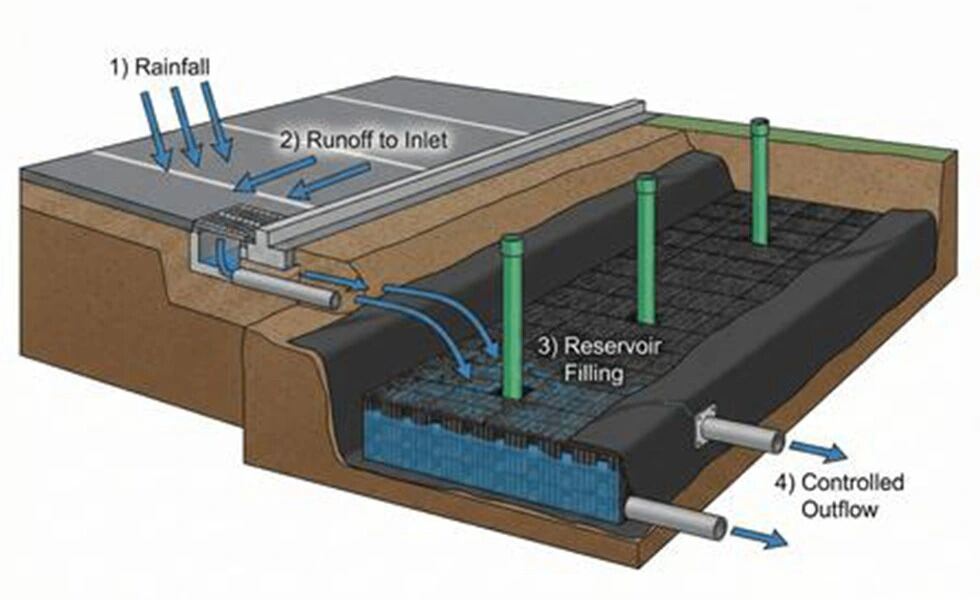
Overview of Stormwater Management
The discipline pursues six objectives: flood mitigation, water quality protection, erosion and sediment control, infrastructure protection, regulatory compliance, and groundwater recharge. Every component on a site — from a curb inlet to a buried tank — serves at least one of them. The US Environmental Protection Agency defines stormwater runoff as rain and snowmelt that flows over land or impervious surfaces. It runs off rather than soaking into the ground, which is why heavily paved sites produce far more of it.
Key Components of Stormwater Management
Conveyance and drainage networks. Storm drains, culverts, pipes, and graded swales that move runoff off streets and parcels to a lawful outlet.
Detention and retention basins. A detention basin stores the peak of a storm and releases it at a controlled rate; a retention basin holds a permanent pool. Both can now sit fully underground — stormwater detention modules keep the surface in use while meeting discharge limits.
Green infrastructure. Rain gardens, bioswales, permeable pavement, and tree pits that let soil and roots absorb runoff where it falls.
Rainwater harvesting. Roof capture piped into a rainwater harvesting tank for irrigation, flushing, or process water — the reuse arm of rainwater management.
Underground infiltration and storage modules. Geocellular arrays that detain, infiltrate, or store large volumes beneath lawns and parking lots. Where space is tight, modular attenuation tanks do the heaviest lifting — literally.
The Importance of Stormwater Management
Five outcomes justify the engineering budget. Four are physical; the fifth is legal, and it stops projects when missed.
1. Flood Risk Reduction
Impervious coverage turns rain into runoff within minutes. When storage and conveyance are sized to the design storm, streets stay passable, ground floors stay dry, and the peak load on municipal drains drops.
2. Water Quality Protection
Runoff collects heavy metals, oil, nutrients, and sediment as it crosses pavement. Settling and filtration before discharge keep those pollutants out of rivers, lakes, and coastal waters.
3. Soil and Slope Stabilization
Uncontrolled discharge scours channels, undermines foundations, and slides slopes. Slowing water at the source and releasing it gently protects both natural and built ground.
4. Climate Resilience and Urban Heat Mitigation
Green components add canopy and evapotranspiration, cooling hard urban districts while absorbing the increasingly intense cloudbursts that fixed pipe networks were never sized for.
5. Regulatory and Development Compliance
Regulators now require stormwater plans before ground breaks, and approval has become a scheduling input, not paperwork. The next section breaks down what US compliance actually requires.
Regulatory and Development Compliance: What US Projects Must Meet
In the United States, stormwater regulation starts with the Clean Water Act. Under the National Pollutant Discharge Elimination System (NPDES), most stormwater discharges are point sources that need permit coverage before leaving a site. EPA's stormwater program concentrates on three source categories: municipal separate storm sewer systems (MS4s), construction activity, and industrial activity. The MS4s are the public storm water management systems that drain streets.
The construction trigger catches the most projects: an NPDES permit is required for any activity disturbing one acre or more. It also covers smaller sites that are part of a larger common plan of development or sale. In practice, a phased subdivision counts as one plan, not several. Permit coverage rides on a stormwater pollution prevention plan (SWPPP) documenting erosion controls and the post-construction treatment train.
Below the federal floor, cities and counties write their own design manuals — the documents civil engineers actually design to. Portland, Oregon's Stormwater Management Manual, for instance, sets pollution reduction, flow control, and infiltration requirements. It applies to development and redevelopment that alters impervious area, public or private. Manuals of this type usually translate into three duties on a private site. Limit peak discharge to pre-development rates, treat the water quality storm, and infiltrate where soils allow.
So who needs a stormwater management plan? They include land developers and general contractors disturbing soil; industrial operators with outdoor material exposure; and municipalities operating MS4s. So do commercial owners re-paving or expanding impervious area in cities that require it.
| Project type | What typically applies | Storage duty on site |
|---|---|---|
| Commercial redevelopment, new parking | Local manual flow control + water quality (e.g., Portland SWMM) | Underground detention sized to the permitted discharge |
| Land disturbance ≥1 acre, or part of a larger common plan | NPDES construction permit + SWPPP | Erosion control during works; post-construction detention or retention |
| Industrial facility with outdoor exposure | NPDES industrial stormwater permit + BMPs | Pre-treatment and controlled discharge |
| Municipal MS4 operator | MS4 permit obligations | Regional basins, green infrastructure programs, maintenance |
Non-compliance stops work and draws penalties for illegal discharge. Compliance, by contrast, is a design input. Settle the storage volume, discharge rate, and treatment train early, and the rest of the site design flows around them.
How Does Stormwater Management Help?
Stripped to mechanics, a system collects runoff, slows it, cleans it, and releases or reuses it on a schedule the downstream network can absorb. Those four actions compound into the benefits below.
Key Benefits of Stormwater Management
Well-engineered stormwater management systems earn their footprint six ways:
Flood prevention. Peak shaving is the core mechanic. Detention storage absorbs the first surge and meters it out after the peak passes. Pipes and culverts then see the average instead of the spike. That is what keeps underpasses, parking lots, and ground-floor tenants dry in cloudbursts. The volumes are real. A 400 m² roof sheds roughly 272 m³ of runoff a year at 800 mm of rainfall. That water either becomes someone's flood or a managed asset.
Cleaner receiving waters. Settling and filtration strip sediment, metals, and nutrients before discharge. The dirtiest water arrives first — the first flush carries most of the load — so pre-treatment sized to it protects the stream and the storage downstream.
Erosion and streambank control. Controlled release protects channels downstream; velocity control on site protects your own soil, pavement edges, and slopes. Erosion damage compounds quietly: a scoured channel becomes a permit violation, and an undermined edge becomes a rebuild.
Infrastructure longevity. Water that enters the ground network slowly does not burst, back up, or wash out pipes. The same logic applies underground — a tank that sees filtered, moderate flows keeps maintenance visits short and rare.
Water supply resilience. Storage built for storm duty doubles as supply — rainwater catchment systems feed irrigation and process water. This extends rainfall management from the parcel scale to the district scale.
Permit approval and community resilience. A compliant design clears the regulatory gate faster because reviewers can check its inflow, storage, and discharge numbers quickly. It also feeds the city-level flood reduction targets behind it. That is the difference between a site that merely drains and a district that weathers the storm.
Each of these benefits can be estimated at design time from the same three numbers — volume, burial depth, surface load. That is what makes stormwater engineering a planning discipline rather than a repair one.
How to Choose a Stormwater Management System
Selection is sequential — each decision narrows the hardware options before you commit to one:
| Step | Determine | Key inputs | Points to |
|---|---|---|---|
| 1 | Required storage volume | Catchment area × rainfall depth × runoff coefficient; permitted discharge rate | Tank size in m³ |
| 2 | Discharge or infiltrate | Soil infiltration rate, groundwater table | Sealed attenuation duty vs an open infiltration system |
| 3 | Surface load class | Traffic, parking, fire lanes, burial depth | Module rating: >45 / >70 / >85 T/m² vertical |
| 4 | Reuse demand | Irrigation or process water needs | Harvesting kit: filter, pump, sealed liner |
| 5 | Maintenance strategy | Upstream sediment load | Pre-treatment: leaf screens, first-flush diverters, hydrodynamic separators |
Two hardware notes. Geocellular crates have largely replaced cast-in-place concrete for buried storage because they ship nested and assemble by hand. And where the volume simply has to disappear beneath a usable surface, underground water storage tanks hold it there. The void ratio is ≥92% — about 920 liters of storage in every cubic meter of matrix.
How YY Tank Helps
YY Tank manufactures the storage core of these systems: the YYRH-MR series of modular PP tanks. It is one platform configured for attenuation, detention, infiltration, or harvesting duty. As modular water storage tanks, the modules interlock to spread multi-directional soil stress. Fitted with a flow-control outlet, they run attenuation duty, as detailed in our stormwater attenuation tanks guide. Sealed with a geomembrane liner, they hold reusable water.
Every rating is third-party verified: CABR-BETC full-scale testing backs the load figures, and long-term creep testing extrapolates a 50-year service life to EN 17152-1. Engineers size the array from three inputs — target volume, burial depth, surface load — and return a module layout within 24 hours, free of charge.
| Module | Dimensions (L×W×H) | Vertical load | Lateral load | Void ratio | Best suited to |
|---|---|---|---|---|---|
| YYRH-MR1000-EW | 1000×500×200 mm | >70 T/m² | >30 T/m² | ≥92% | Commercial landscaping, harvesting; ≈6.7 kg plates assemble by hand |
| YYRH-MR1000-HD | 1000×500×200 mm | >85 T/m² | >45 T/m² | ≥92% | Airfield pavements, container ports |
| YYRH-MR1200-EW | 1200×600×300 mm | >45 T/m² | >15 T/m² | ≥92% | Light-duty residential and park detention |
| YYRH-MR1200-SD | 1200×600×300 mm | >85 T/m² | >30 T/m² | 95–97% | Deep burial to 8 m; fewer units per m³ |
Series baseline: ≥92% void ratio = 920 L net storage per m³; load ratings verified by CABR-BETC full-scale testing.
Frequently Asked Questions
What is stormwater?
Stormwater is rain and snowmelt that flows over the ground and across hard surfaces — roads, roofs, parking lots — instead of soaking into the soil. As it travels it picks up sediment, oil, metals, and nutrients, which is why cities treat it as both a flooding and a pollution problem.
Why is stormwater management important?
Because paved land sheds water fast, runoff volume and peak flow rise with every added square meter of impervious surface. The runoff floods streets and carries pollutants straight to streams. Management slows, stores, treats, and reuses that water — cutting flood damage, protecting water quality, and keeping projects on the right side of permits.
Who needs a stormwater management plan?
The list includes developers and contractors disturbing one acre or more. The rule also covers a smaller lot that is part of a larger common plan of development. So do industrial operators with outdoor exposure and municipalities that run MS4 drains. Commercial owners adding impervious area in cities with local stormwater manuals round out the list. When in doubt, confirm with the local drainage authority.
What is one of the biggest problems with stormwater runoff?
Volume and speed. Hard surfaces turn a slow-soaking rain into a fast surge that overwhelms pipes in minutes — and that surge scrubs pollutants off pavement as it goes. The result: flooded underpasses downstream and contaminated receiving waters.
How to prevent stormwater runoff?
You rarely prevent it entirely — the goal is to shrink and slow it. Keep rain where it falls with permeable paving, rain gardens, and tree pits. Infiltrate what the soil can take and store the rest underground. Harvest roof water for reuse, and detain the remainder for controlled release.
What are the four types of drainage systems?
Commonly: surface drainage (graded swales and channels) and subsurface drainage (buried pipes and storage). The other two are slope drainage (pipelines that carry water down gradients) and gutter-and-downspout systems that clear roof water. On engineered sites, subsurface storage ties the other three together — everything conveys to it, and it decides how fast water leaves.
What does SWMM stand for?
Storm Water Management Model — the EPA's simulation software for urban runoff quantity and quality, used worldwide since 1971. Engineers run design storms through it before construction. Its two-word spelling is also why "storm water management system" and "stormwater management system" appear interchangeably in the field.
Start Your Stormwater Management Design with YY Tank
Stormwater management decides whether a site opens on schedule or stalls at permitting. YY Tank supplies factory-direct modular stormwater management solutions rated up to >85 T/m², backed by third-party test reports and free engineering layouts. Contact YY Tank with your target volume, burial depth, and surface load — a sized module layout comes back within 24 hours.