News


Drainage Crates: Types, Specs, and Where Crate Systems Fit
20 Nov 2026Drainage Crates: Types, Specs, and Where Crate Systems Fit
Drainage crates are load-bearing, interlocking polypropylene modules that assemble into underground voids for stormwater. One crate system handles storage, attenuation, or infiltration — the wrap and the fittings decide which. The plastic lattice carries the earth load, so a crate array keeps its void for the life of the installation. Loose fill cannot make that promise. This page maps the crate family, sets out the specs that matter at tender, and shows where each type earns its keep.
The Crate System Family
The same structural lattice travels under several names, and the label usually names the duty.
| Family name | Duty | Wrap / fittings | Typical surface above |
|---|---|---|---|
| Drainage crates (also sold as drainage cages) | General stormwater storage and soak-away | Geotextile, open base | Lawns, gardens, light drives |
| Attenuation crates | Hold and release slowly | Geomembrane + flow-control outlet | Parking, yards |
| Soakaway crates | UK term for the soak-in duty | Geotextile | Gardens, driveways |
| Geocellular crates | The umbrella term for the module class | Either, by configuration | Anything load-rated |
The UK term deserves one bridge, no more. A soakaway crate system is the same hardware aimed at letting water soak into the ground. The dedicated UK guidance lives on the soakaway crates page. North American drainage projects meet the same modules under the geocellular name — the geocellular crates page carries the full class definition, including the geocell distinction that spec sheets routinely blur.
Every family member shares the structural core: molded PP plates that interlock column-to-column and spread load across the array. The 1000-series plate measures 1000×500×200 mm and weighs about 6.7 kg, so two workers assemble an array without a crane. The 1200-series plate measures 1200×600×300 mm for higher volume per unit. Arrays form L, T, U, or rectangular footprints and stack vertically for deeper installs. New sections join later through standard pipe couplings, so the array grows when the site grows.
Specs That Matter in a Crate System
Tenders are won and lost on four numbers, and all four should come from test evidence rather than brochure text.
| Property | Verified value |
|---|---|
| Void ratio | ≥92% (95–97% deep-burial variant) — 920 liters net storage per m³ |
| Vertical load rating | >45 / >70 / >85 T/m² by model |
| Cover depth | Typical 3.5 m; deep-burial variants to 8 m |
| Long-term performance | 50-year service life (EN 17152-1 creep basis); CABR 50-year creep at 25% of failure load, zero collapse |
Against cast concrete, a modular crate system weighs roughly 1/30 as much for the same storage. It installs 60%+ faster because nothing cures, and it needs more than 30% less excavation than a gravel bed. Manufacturing standards and third-party verification (CJ/T 542-2020, CABR-BETC full-scale testing, TEPPFA verified list) are the paper trail to ask for. A 10-year limited warranty sits on top; the creep evidence sits under it.
Procurement follows the paper trail to a quotation. Price is project-configured from three inputs — storage volume, loading class, and ground conditions — so no honest price list exists. What a buyer can compare today is everything around the price: verified ratings, test reports, and the freight economics of nestable plates. A single 40' HQ container carries over 5,000 of the 1200-EW units, and factory-direct supply at up to 150,000 m³ of annual module capacity removes the distribution margin.
Installing a Crate System: Key Points
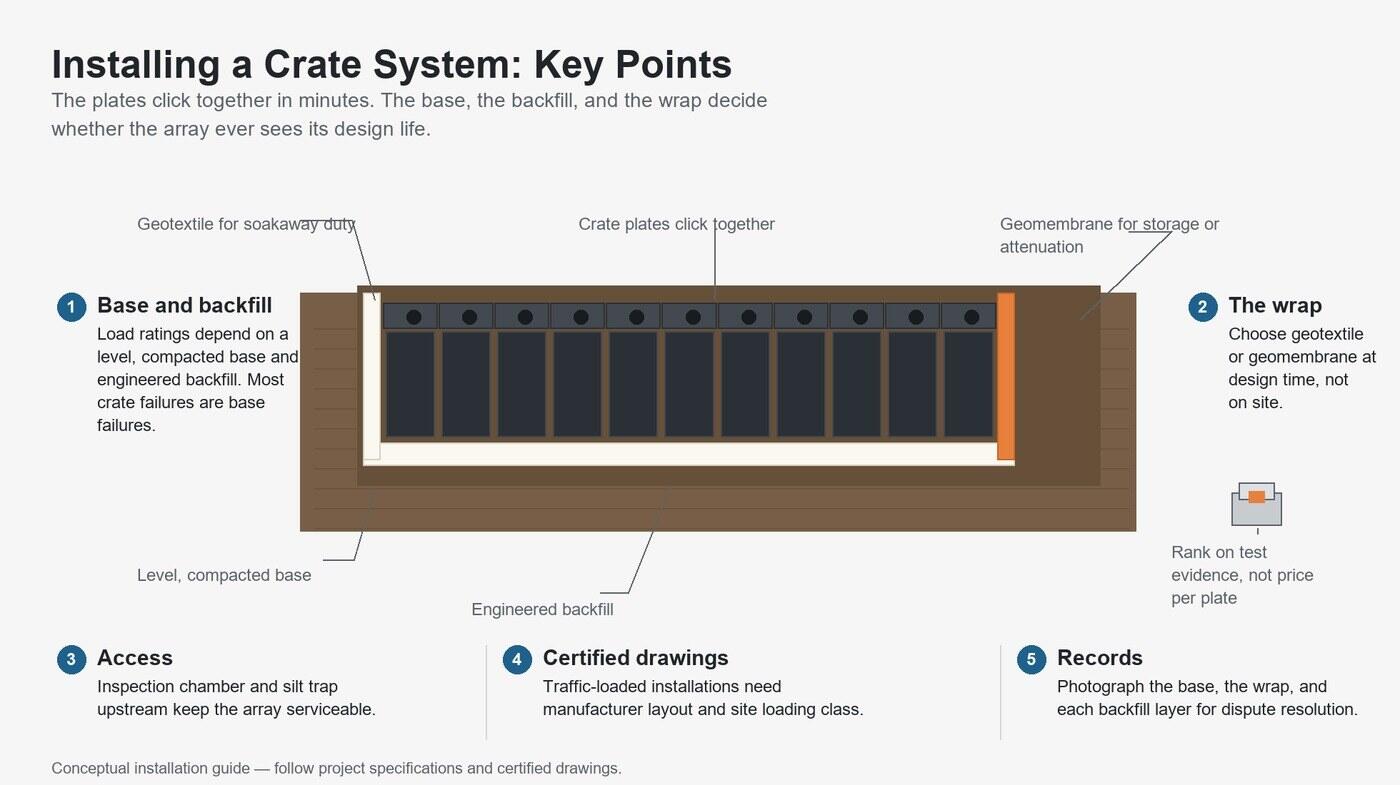
The full sequence belongs to the installation guides; four checkpoints decide the outcome at this page's altitude. Crate installation is forgiving in the plate-stacking stage and unforgiving in the groundworks around it. The plates click together in minutes. The base, the backfill, and the wrap decide whether the array ever sees its design life.
• Base and backfill. A level, compacted base and engineered backfill are what let the load ratings be real. Most "crate failures" are base failures.
• The wrap. Geotextile for soak-away duty, geomembrane for storage or attenuation — chosen at design time, not discovered on site.
• Access. An inspection chamber and a silt trap upstream keep the array serviceable for decades.
• Certified drawings. DIY suits small garden arrays; anything under traffic needs the manufacturer's layout against the site's loading class. The same rule ranks the best drainage crates on test evidence, not on price per plate.
• Records. Photographs of the base, the wrap, and each backfill layer cost minutes on the day. They settle any dispute about what actually went into the ground.
Where Drainage Crates Fit
The scenario matrix is short to state and long in service.
| Scenario | Duty | What the array does |
|---|---|---|
| Yard and garden drainage | Soak-away | Holds the surge, releases it into native soil |
| Parking and driveways | Storage or attenuation | Rated plates carry traffic; wrap decides the duty |
| Basement and retaining walls | Relief drainage | Perf-wrapped crates relieve hydrostatic pressure — the geocellular-for-basements pattern |
| Commercial stormwater trains | Attenuation stage | The array holds the peak between pre-treatment and the permitted outlet |
The matrix reads in two directions. Pick the scenario first and the duty narrows the wrap, the rating, and the fittings. Or pick the crate system first and the table tells you which surfaces it can legally live under. Either way, the scenario row decides the loading class — and the loading class decides the model long before price enters.
In the wider drainage path, crates are the structural stage: upstream sit the pipes and channels, downstream sits the outlet. The division of labor between the drainage line and the crate stage is mapped on the rainwater drainage system page. Where treatment joins the train, the modular wetland system page covers the planted stage that pairs with crate storage — and the stormwater attenuation tanks page carries the attenuation duty end to end.
Ownership, finally, is where crate systems repay their spec sheet. The lattice void does not compact, so capacity does not quietly disappear the way loose backfill does. Inspection happens through a chamber, not with an excavator. And when a section does take damage, single modules can be lifted and replaced without opening the whole array. Buried hardware should be boring for decades; that is the design brief this product family was written against.
Frequently Asked Questions
How deep should a soakaway be in clay soil?
Clay drinks slowly enough that depth will not save the design. A soak-away crate array needs soil that absorbs. In clay the honest options are a larger array with a long drain-down, or a change of duty to a lined storage-and-release system. Depth then follows the approved design, not a rule of thumb. A percolation test decides which path the plot takes before anything is bought.
How does a geocellular system work for basements?
Around basements and retaining walls, geocellular crates act as a relief-drainage layer. Perf-wrapped crates sit against the wall or behind the slab, collecting groundwater and percolation before pressure can build. The water runs through the voids to a sump or a lawful outlet, so the structure sees less hydrostatic load. The lattice holds the drainage gap open where loose gravel would eventually choke with fines.
How do you choose a modular stormwater detention system?
Choose from three inputs, in this order. Storage volume comes from the catchment calculation and the permitted discharge. Loading class comes from what drives or parks above the array — light duty, traffic, or heavy loads map to different rated models. Ground conditions come from the survey: water table, bearing, and cover. Match those three to published, third-party-verified ratings and the shortlist writes itself.
How do you install drainage crates?
The short sequence is dig, line, stack, wrap, backfill — with a silt trap on the inlet and an inspection chamber over the array. Depth, distance from buildings, and the soak test follow your local rules, so this page stays at sequence level. The dedicated UK installation guide carries each step; commercial and traffic-loaded arrays belong to a designed installation either way.
What's the difference between a soakaway and a septic tank?
A soakaway receives clean rainwater from roofs and paving and returns it to the soil. A septic tank receives foul wastewater and treats it by settlement before any outflow reaches a drainage field. The two never connect — different water, different rules, different hardware. Confusing them on a drawing is the fastest way to fail an inspection.
Request a crate layout sized to your volume, load class, and ground — contact YY Tank.