News


Modular Wetland Systems: Modular Stormwater Treatment
20 Nov 2026Modular Wetland Systems: Modular Stormwater Treatment
A modular wetland system is a prefabricated unit that cleans stormwater the way a natural wetland does — slowly, biologically, and without chemicals. Runoff moves through a planted, soil-like filter medium inside an engineered cell. What leaves the unit carries far less sediment, nutrient, and metal than what entered. The word "modular" describes the housing. Treatment cells are built in a factory, shipped to the site, and set in line like any other piece of drainage equipment. This page explains the treatment mechanism, the siting logic, and how treatment pairs with storage downstream.
How a Modular Wetland Treats Stormwater
The cleaning happens in stages, and each stage has its own job.
1. Pre-treatment. A separator chamber drops the heavy fraction first: grit, sediment, litter, and floating oil. This stage protects everything downstream from clogging.
2. Biofiltration. The pre-treated flow spreads across a planted filter medium. Roots and microbial communities take up nutrients. The medium strains fine particles, and metals bind to its surfaces. This is the biological heart of the unit.
3. Discharge or transfer. Treated flow leaves through an outlet to a pipe, a storage array, or the receiving water — at whatever rate the permit allows.
The mechanism is biological, which separates it from mechanical filtration. A filter cartridge fills up and gets swapped. A planted medium matures and keeps working, season after season. The trade is footprint and patience. Biofiltration needs room, and it needs a growing season to reach full performance.
Maintenance follows the same split. The pre-treatment stage needs periodic cleaning on a schedule the vendor states. The planted stage needs seasonal care — the kind any landscape crew can learn. Ask for both intervals in writing before purchase, because they are the real cost of ownership.
What the medium actually removes is worth naming, because it explains the siting. Sediment is strained mechanically and settles in the pre-treatment chamber. Nutrients — nitrogen and phosphorus from fertilizers and organic matter — are taken up by plants and consumed by microbes. Metals from roofing and traffic bind to the media surfaces. Oil and hydrocarbons separate in the pre-treatment stage and degrade slowly in the medium. Each removal path has a capacity limit, which is why the pre-treatment stage and its service schedule carry so much weight in the specification.
Where Treatment Wetlands Fit a Site
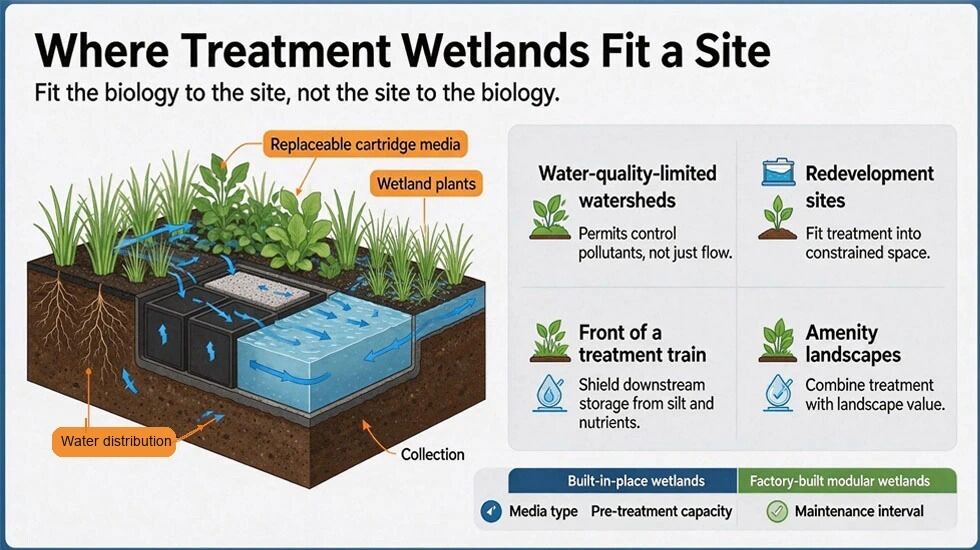
Treatment wetlands earn their place wherever water quality, not water volume, is the binding constraint.
• Water-quality-limited watersheds, where discharge permits name the pollutants and not just the flow rate.
• Redevelopment sites, where stormwater treatment systems must retrofit into a landscape that is already built.
• The front of a treatment train, where a modular wetland protects storage and infiltration assets downstream from silt and nutrient loading.
• Amenity landscapes, where a planted treatment cell reads as landscaping while it works.
The category includes both built-in-place wetlands and factory-built modular units. The modular versions compress the same biology into a replaceable cartridge-and-planting format. American buyers meet this format most often through cartridge-media modular wetland products — a category pioneered by brand-name suppliers and offered today by several manufacturers. The brand name matters less than the specification sheet: media type, pre-treatment capacity, and the maintenance interval. Those three lines separate a working modular wetland from an expensive planter.
One pattern runs under all four siting cases. A water quality duty is meeting a landscape that cannot give up more room. Treatment wetlands answer exactly that squeeze: the cleaning happens in a footprint the site chooses, above or below the surface it wants to keep. Where a basin would sterilize an acre, a modular cell folds the same biology into a corner.
Combining Treatment with Modular Storage
Treatment and storage solve different problems. The strongest site plans run them in series. Runoff arrives at the treatment stage first, where sediment and nutrients are stripped. The cleaned flow then continues to a storage or attenuation stage sized for volume. Treatment first protects the storage; storage downstream protects the receiving water.
The structural modules behind that storage stage are the same geocellular lattice described on the geocellular crates page. A modular treatment unit can connect directly to a modular storage matrix, which is why the two stages specify well together.
YY Tank manufactures the storage side of that pairing. Modular crate systems take treated water and hold it for reuse or controlled release — the duty described under stormwater attenuation tanks. Where the ground can drink instead, an infiltration system turns treatment plus storage into treatment plus recharge. The drainage crates page maps the crate stage of that same train.
A concrete site sequence makes the pairing legible. A parking lot sheds a storm into a separator, which drops the grit. The flow crosses a planted treatment cell, which strips nutrients and metals. The cleaned water then drops into a buried crate matrix, which either meters it out after the peak or keeps it for irrigation. Three pieces, each doing one job — and each replaceable without redesigning the others.
Choosing and Costing a Modular Wetland
Selection runs on four questions. Which pollutants does the permit name? Which water quality storm must the site treat? How much land can the footprint take? And which maintenance regime will the owner actually fund? A unit sized for the wrong pollutant is an expensive planter. A unit sized for the wrong storm is a permit problem.
Cost is project-configured, and the honest breakdown has four lines. The treatment unit itself. The pre-treatment stage. The earthworks and planting. And the maintenance contract over the life of the system. For-sale listings and catalogue prices mean little at this scale — treatment wetlands are specified, not shelved. Cartridge media are replaced on a cycle the vendor states, and planted media need seasonal care on top. Ask for both numbers in writing before comparing suppliers.
Frequently Asked Questions
What is a bioretention basin?
A bioretention basin is a shallow, planted depression that receives runoff and cleans it through soil, mulch, and root systems. The water then soaks away or drains onward. It is the built-in-place cousin of the modular wetland: same biology, different construction. Bioretention suits landscapes with room to grade; modular units suit sites that need treatment delivered as equipment.
What is the definition of a constructed wetland?
A constructed wetland is an engineered water body built to treat runoff or wastewater through natural wetland processes. Those processes are sedimentation, filtration, plant uptake, and microbial breakdown. It replicates the cleaning work of a natural marsh in a controlled footprint. A modular wetland system is that principle prefabricated — the same processes in a factory-built cell that arrives on a truck.
Do wetlands increase property value?
Planted water features generally work in a property's favor. They read as amenity space, they signal environmental compliance, and they can turn a required drainage feature into usable landscape. The effect is site-specific and depends on design quality and maintenance. What a treatment wetland reliably adds is regulatory headroom: the site meets its water-quality duties while the surface stays presentable.
Ask which stage your site is missing — treatment or storage — and contact YY Tank for the storage half of the train.