News


Soakaway Crates: Modular Geocellular Soakaway Systems
13 Nov 2026Soakaway Crates: Modular Geocellular Soakaway Systems
A garden that lakes after every downpour and a driveway that floods at its lowest corner share one fix: a soakaway. A parking bay that sheds water toward the neighbor's fence needs the same thing buried at its edge. Modern soakaway crates are interlocking plastic modules that assemble into a buried void. Roof and surface runoff fills that void, then soaks away into the soil around it through a permeable wrap. This page explains how the crate system works, where it beats an old rubble pit, and how to size and choose one. It is the overview for the whole soakaway system; each sub-topic has its own in-depth guide below.
What Are Soakaway Crates and How Do They Work?
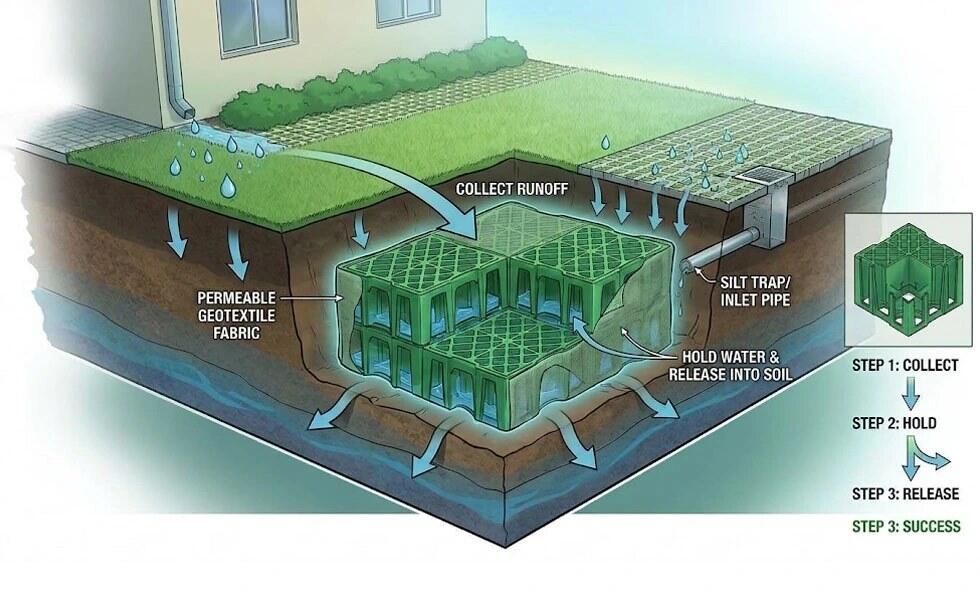
Soakaway crates work in three moves: collect, hold, release into the ground. An inlet pipe or channel drain brings runoff into the buried array. The crates hold that water in the open space between their lattice walls. From there the water passes through the geotextile wrap and into the soil over hours, not minutes.
The module itself is a load-rated plastic lattice. Plates interlock column-to-column, so an array behaves like a single structural block. Rated models carry verified vertical loads from >45 to >85 T/m², which is why arrays sit under driveways and parking bays and not only under lawns. Each cubic meter of crate matrix nets about 920 liters of storage. That is close to three times the useful volume of the same hole filled with loose rubble.
Installation asks for ordinary groundworks skill rather than special plant. The excavation is dug, a geotextile jacket is laid, and plates are clicked together by hand at roughly 6.7 kg each. No concrete pour, no curing window, no crane. The array is closed with the same fabric, and the surface above goes back to lawn, gravel, or paving.
The polymer matters as much as the shape. Soakaway crates are molded from structural polypropylene (PP), and the engineering evidence sits behind two documents. EN 17152-1 covers long-term creep performance for thermoplastic storage modules, and third-party full-scale testing backs the load ratings a supplier prints. Buyers comparing quotations should ask for the test evidence, not the brochure.
The same crate line serves a second duty with one change of fitting. Wrapped in geotextile, it soaks water away. Wrapped in an impermeable geomembrane and fitted with a flow-control outlet, it holds and meters water instead. That is the attenuation configuration, covered under stormwater attenuation tanks. If your drainage plan says "the water must leave slowly", the crate stays; only the wrap changes.
Soakaway Crates vs Soakaway Pits and Gravel Pits
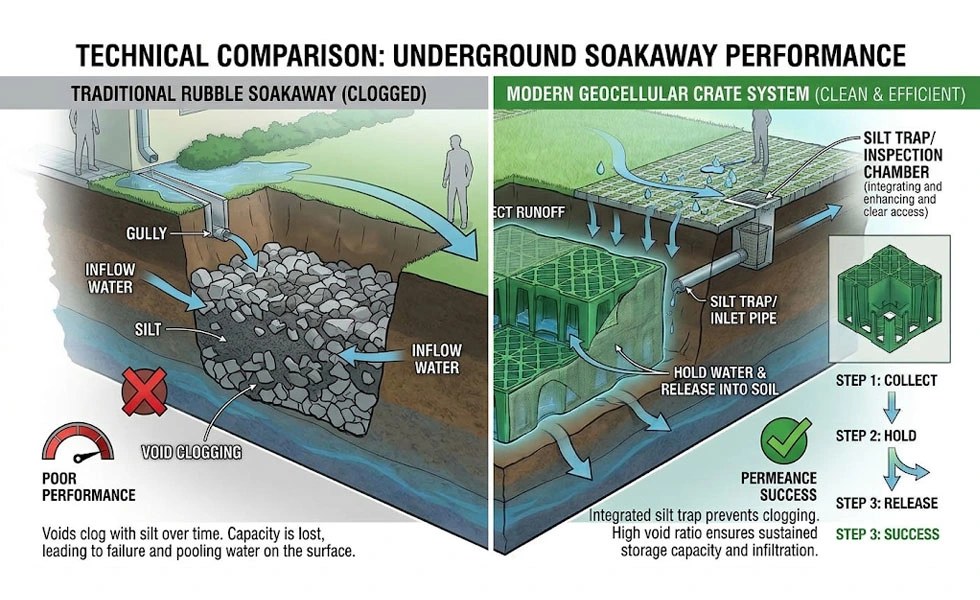
The traditional soakaway is a hole backfilled with gravel or rubble. It works — until silt finds its way in. A silted rubble pit loses its voids, and a lost void is a lost soakaway.
Crates fix that failure mode. The lattice keeps its voids open because the plastic, not the gravel, carries the earth load. A silt trap upstream catches the fines before they enter the array. Inspection and jetting happen through a chamber, not by re-digging the pit.
| Rubble pit | Crate array | |
|---|---|---|
| Storage per m³ of hole | Roughly 30% | ≈95% of excavation (920 L/m³ net) |
| Load capacity | None by design | Verified >45–>85 T/m² vertical |
| Silt behavior | Voids clog silently | Silt trap + inspection chamber |
| Excavation for same volume | Much larger hole | Smaller, shallower footprint |
| Lifespan of the void | Falls as fines wash in | Holds for the design life |
The comparison is not anti-pit. A small rubble soakaway under a single downspout can serve for years on sandy ground. The crate array earns its price wherever the surface carries weight, the ground drains reluctantly, or the volume is too large for trial and error.
How Big Should a Crate Soakaway Be?
Walk the calculation before you walk the timber yard. Add up the roof and paved area that drains toward the array. Take the local design rainfall, and apply a runoff coefficient of roughly one for hard surfaces. That gives the water the system must swallow in one storm. Subtract what the percolation test says the soil can absorb during the storm. The remainder is the void volume to buy in crates.
One planning anchor keeps the numbers honest: a 400 m² catchment at 800 mm of annual rainfall sheds about 272 m³ of runoff across a year. A single storm is a fraction of that, but the fraction decides the dig. Divide the required volume by 0.92 and you have the matrix volume to excavate. Crates make the arithmetic visible — each plate is a known number of liters, so the array size falls out of the sum directly.
Where Soakaway Crates Fit
Crates are the default under any surface that must stay flat, dry, and in use.
• Gardens and lawns — roof and surface water that would otherwise pool. A small array under the border takes a lawn back from standing water.
• Driveways and parking bays — rated arrays carry vehicles. A permeable block surface above them finishes the job.
• Front-of-property drainage — channel drains and downspouts routed to a lawful point of soak, instead of the pavement outside.
• Commercial yards and estates — larger arrays serve estates where council approval expects a designed, load-rated soakaway. Phased expansion matters here: new crates connect to the existing array through standard pipe couplings as the site grows.
Underground module systems are known by several names in different markets. North American specifications call the same load-rated lattice geocellular crates; the UK trade calls it the soakaway crate. One hardware family, two naming conventions — worth knowing when you compare quotations.
Choosing a Soakaway Crate System
Size the system from three numbers: how much water arrives, how fast the soil drinks, and what sits above the array. The arrival side comes from the roof and paved area feeding the inlet. The soil side comes from a simple percolation test — sandy ground drinks fast, clay barely. The surface side decides the load rating.
| Input | What to check | Points to |
|---|---|---|
| Inflow | Roof + paved area, local rainfall | Required void volume |
| Soil | Percolation test result | Soak-away feasibility; lined duty if ground is tight |
| Surface load | Lawn, driveway, HGV route | Crate rating: >45 / >70 / >85 T/m² vertical |
| Cover | Depth from grade to array | Standard cover vs deep-burial variants |
| Maintenance | Silt load upstream | Silt trap + inspection chamber position |
As a planning anchor, the runoff rule of thumb is volume = area × rainfall × runoff coefficient. A 400 m² catchment at 800 mm of annual rain sheds about 272 m³ a year. The design-storm slice of that, less what the ground can take, is the volume your crates must hold.
Three mistakes account for most failed installations. The array is undersized for a paved area added later. The silt trap is skipped to save a morning's work. Or a crate built for a lawn is set under a vehicle path it was never rated for. All three are cheap to avoid on paper and expensive to fix in the ground.
Installing and Looking After a Crate Soakaway
The site sequence runs dig, line, stack, wrap, backfill. Each step has its own details, covered in the installation guide below. Two habits keep the array honest for decades: keep the silt trap serviceable, and keep wash-down water and landscaping runoff out of the inlet. Blocked-soakaway symptoms almost always begin upstream, not in the crates themselves.
Explore the Soakaway System in Depth
Each sub-topic below goes deep on one question.
What is a soakaway — the plain-English definition, where the term comes from, and how a full system reads on a drawing. Start here if the terminology is new.
Soakaway pit — the dug-and-lined form behind the crate revolution: how pits are sized, how deep they go, and when a crate array simply drops into a pit excavation.
Soakaway drain — the pipes, channels, and gullies that carry water to the soakaway, and the problems that start upstream of the pit.
Soakaway design — turning inflow, soil, and load data into an array layout that satisfies building control the first time.
Soakaway installation — the groundworks sequence from excavation to backfill, with the checks inspectors ask about.
Blocked soakaway — symptoms, causes, and the fix order for an array that stopped draining; most blockages start at the silt trap.
Flat pack soakaway crates — the shipped-flat product variant: what a kit contains and how it cuts freight on small orders.
Rainwater soakaway — domestic scenarios from downspout-only systems to whole-garden layouts.
Soakaway vs attenuation tank — the UK term against the US term for the same hardware, and why the wrap decides the duty.
Frequently Asked Questions
what is a soakaway?
A soakaway is a buried structure that collects surface and roof water and lets it soak back into the soil. Old soakaways were pits filled with rubble. Modern ones are crate arrays: interlocking plastic modules that hold the water in an open void while it drains into the ground over hours.
what is a soakaway in a garden?
In a garden, a soakaway is the quiet end of the drainage line. Downspouts, channel drains, or a low spot in the lawn feed it. Water that would otherwise pool on the grass soaks away underground instead. A garden soakaway is usually a small crate array under the lawn or border. It is wrapped in geotextile and covered with a shallow layer of soil, so the surface stays green.
how to install a soakaway?
The short sequence: dig, line, stack, wrap, backfill. Excavate to the sized footprint, lay the geotextile, assemble the crates, fit the inlet and silt trap, then fold the wrap and backfill. Depth, distance from buildings, and the percolation results come from your local rules — the detailed installation guide covers each step. For engineered layouts on commercial jobs, ask the manufacturer.
What is a soakaway and how does it work?
A soakaway is a holding void below grade that releases water into the soil rather than to a sewer. It works by buffering the flow. A burst of roof or surface runoff fills the void quickly, and the ground draws it out slowly through the permeable wrap. Because the crate lattice carries the load, the void stays open for decades instead of silting shut like loose backfill.
What does a crate look like?
A crate is a rectangular plastic lattice block. The 1000-series plate measures 1000×500×200 mm and weighs about 6.7 kg, light enough to place by hand. The walls form an open cellular structure, so water fills the block itself. Plates interlock on assembly, turning a pallet of loose blocks into one structural array.
Request a sized soakaway layout — send inflow area, soil type, and surface load to YY Tank.