News


What Is a Soakaway? Meaning and How the System Works
13 Nov 2026What Is a Soakaway? Meaning and How the System Works
A soakaway is a buried structure that collects rainwater from roofs and hard surfaces and lets it soak away into the soil below. That is the whole meaning in one line: a holding void in the ground that returns water to the earth instead of a sewer. The word belongs to UK and Irish building vocabulary. This page unpacks what the system contains, how the water moves through it, and what keeps it working year after year.
Soakaway Meaning and Where the Term Comes From
"Soak away" describes what the structure does — the water soaks away into the ground — and the noun stuck. You will see it written as soakaway, as two words, or mangled into "soakway" by hurried keyboards. All of them name the same buried thing. Spoken aloud, the stress falls on the first syllable, and nobody in the trade pauses over the spelling.
The term is UK and Irish usage. North American codes assign the same duty to "infiltration" systems and dry wells, where the hardware is often a rated geocellular array. More on that family below.
In trade documents the word behaves like any other specification term. Drawings label it "soakaway" or "soakaway system", quotations price it per void volume, and building control wants to see the percolation evidence behind the size. Knowing that the two-word verb and the single-word noun mean the same thing saves a loop of emails with a surveyor.
What a Soakaway System Looks Like
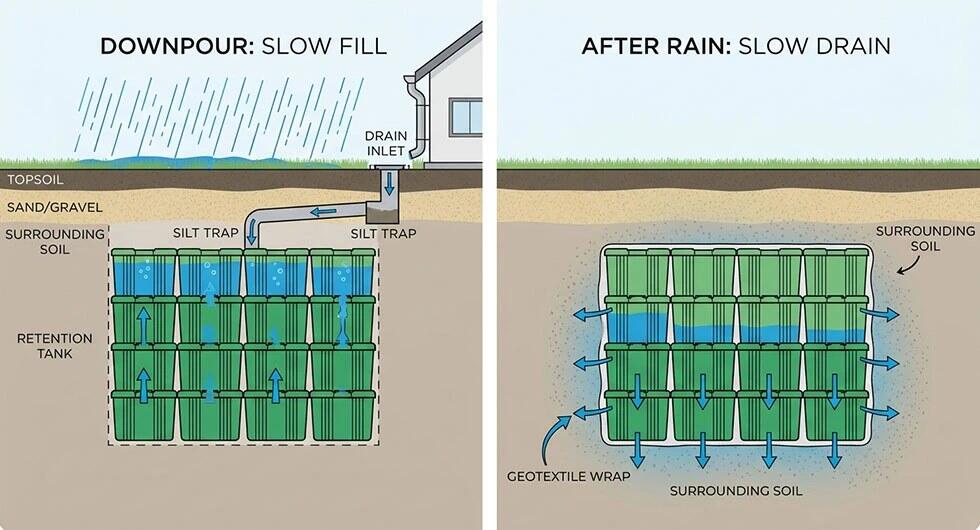
A full soakaway system has five parts in a line, and a text diagram reads it from roof to soil:
1. Inlet — the downspout or channel drain that brings water in from the roof or paving, usually through an underground pipe.
2. Silt trap — a small chamber that catches grit, leaves, and building fines before they reach the store. It is the sacrificial part of the system.
3. The soakaway itself — either a rubble-filled pit or, in modern builds, a stack of interlocking plastic crates forming an open void.
4. The wrap — a geotextile jacket around the store. It lets water pass while keeping surrounding soil out of the void.
5. The soil — the final layer that receives the water and draws it away over hours.
Pictured in cross-section, the assembly is simple. A rectangular hole in the ground is lined in fabric and packed with black lattice crates. The same fabric caps the stack, and a shallow layer of soil closes the profile. Above it sits whatever the site needs — lawn, border, gravel, or a rated drive surface. That is the entire geometry. No pump, no power, and no moving parts are involved.
How the System Lets Water Soak Away
The cycle is slow fill, slow drain. During a downpour, runoff arrives faster than soil can drink, so the void fills first. Over the following hours, water seeps through the geotextile into the ground around the array. By the next shower the store is empty and ready to buffer again.
Two boundaries decide whether the idea works on a plot. Tight clay drinks too slowly, so the store refills before it empties and the system backs up. A high water table leaves nowhere for the water to go. Where either applies, the plan usually switches from soak-away duty to a lined storage-and-release arrangement instead.
Burial gives the store one quiet advantage over anything above ground. Water held below grade sits at a steadier temperature, around 12–15°C in buried storage. It also stays out of the sunlight that turns an open water butt green. For a soak-away duty the point is smaller but still real. The fabric and crates work the same in January as in June. There are no frost-heave parts and nothing to drain down before winter.
What a Soakaway Is Not
Three neighbors get confused with the soakaway, and the differences matter. A septic tank treats foul wastewater, not clean rainwater — the two are never connected. A French drain is a shallow gravel line that moves water along a trench; a soakaway ends the line by sending it down. And an attenuation tank holds water in a sealed liner to release it slowly, where a soakaway has no liner and no outlet at all. If the water leaves through a pipe, it is not soaking away.
Crates, Pits, and the Modern System
The soakaway system most contractors install today is a crate array, not a rubble pit. Crates hold their voids open under load, and driveway-rated models carry a verified rating above 45 T/m². Each cubic meter of crate matrix nets about 920 liters of storage, so a sized array replaces a much larger hole. Arrays also stack vertically where the design needs more volume in the same footprint. The same lattice, sold in North America as geocellular crates, is described in full on the geocellular crates page.
The soakaway pit form — sizing, depth, and the crate-in-pit layout — has its own guide on soakaway pits. The full product and system overview lives on the soakaway crates pillar page. For the installation sequence itself, see soakaway installation; this page stays at the concept level on purpose.
Frequently Asked Questions
How do you maintain a soakaway?
Keep the upstream path clean and the soakaway mostly maintains itself. Clear gutters and channel drains each autumn. Empty the silt trap once a year, and lift the inspection lid after heavy storms to confirm water drains freely. Avoid pointing landscape wash-down water at the inlet, since silt is the only enemy a soakaway really has. A crate array with a working trap can hold its void for decades.
What happens when soakaway is full?
When the void is full, incoming water has nowhere to go and backs up toward the inlet. A standing puddle over the soakaway is the usual first sign. A healthy system empties within a day or so as the soil draws the water out. If it stands longer after ordinary rain, the ground around it is saturated or the void has silted up. Either way the drainage line needs attention rather than the soakaway alone.
What is the difference between a soakaway and a septic tank?
A soakaway handles clean rainwater from roofs and paving; a septic tank handles foul wastewater from toilets and drains. The septic tank settles and partially treats effluent. Only its clarified outflow ever reaches a drainage field, and the two systems are never joined. Same family of buried hardware, completely different jobs.