News


Rainwater Catchment System: Components & Sizing | YY Tank
30 Oct 2026Rainwater Catchment System: Components, Sizing & Design
A rainwater catchment system captures rain where it lands and moves it through four linked stages — catchment surface, conveyance, storage, and treatment. The water travels until it reaches the tap, hose, or process line that uses it. The storage stage is where projects succeed or fail. A 400 m² roof in an 800 mm rainfall zone delivers roughly 272 m³ of runoff a year. The storage has to be engineered to hold that rhythm through dry spells, not just catch the first storm. This page breaks down the four stages and the catchment math that sizes them.
The Four Stages of a Catchment System
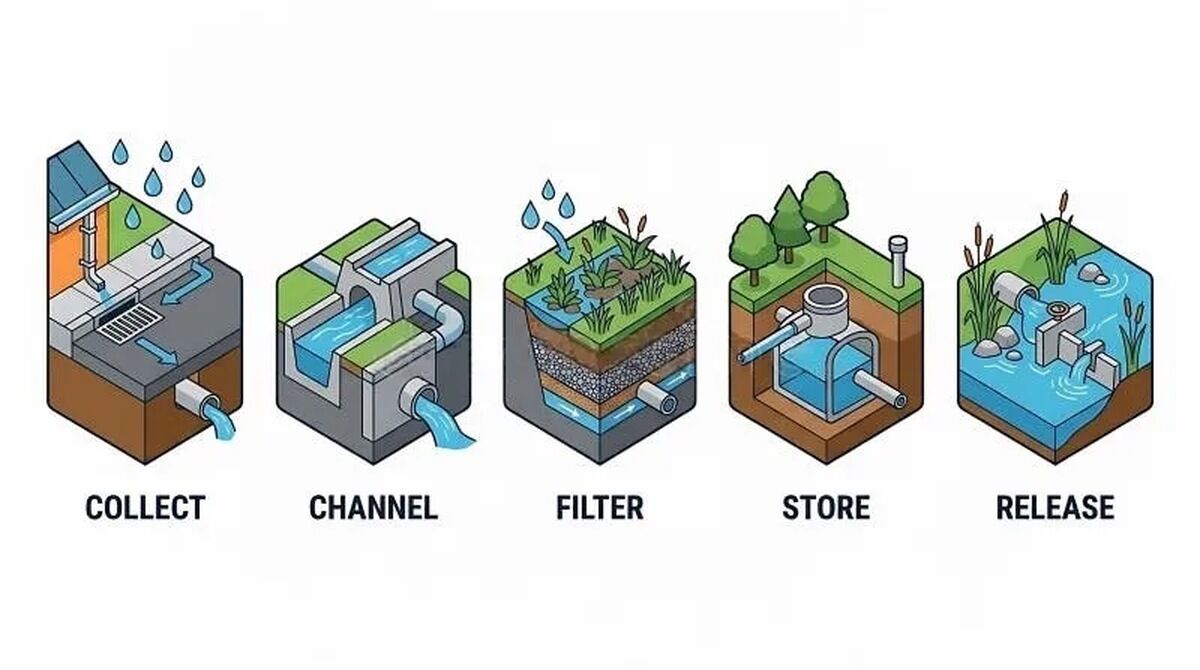
1. Catchment surface. Every impervious surface the rain hits — roofs first (cleanest water, metal and membrane at a 0.85–0.90 runoff coefficient), then paved yards and roads (0.70). The surface is measured in plan view, and its area and coefficient open every sizing calculation.
2. Conveyance. Gutters, downpipes, and sealed pipework move the water from surface to storage. At industrial scale this becomes zoned collection. A 10,000 m² complex runs separate pre-treatment chains per roof or yard zone, so cleaning one zone's filter never takes the whole plant offline.
3. Storage. The tank or module matrix that buffers supply against demand. Above-ground cisterns serve small residential duty. For commercial volumes, underground modular matrices store 920 liters of net water per m³ of modules.
The surface above stays in use — parking, landscaping, or traffic. A 500 m³ array under a landscaped courtyard in Nanjing collects runoff from about 8,000 m² of warehouse roofing. It returns roughly 1,200 tonnes of water a year for landscaping and road washing.
4. Treatment and distribution. Leaf screens and first-flush diverters at the inlet, filtration before the pump, and pressurization to the point of use. Occupied buildings add redundancy: twin pumps with automatic failover above 100 m³ of storage, and N+1 triple-pump sets for hospitals and data centers. Above 500 m³, SCADA monitoring replaces walkthrough inspection — level sensors, flow meters, and pump status on one dashboard.
How to Calculate a Catchment Area (and the Volume It Yields)
Catchment area is the horizontal footprint of every surface draining into the system. Measure it in plan view — the length times width of the building, not the slope surface of a pitched roof. For irregular sites, break the catchment into rectangles and triangles, calculate each, and add them up.
The volume that catchment yields follows the standard formula:
V = A (m²) × P (m) × C
For the 400 m² roof at 800 mm of annual rainfall used throughout our sizing guides: 400 × 0.800 × 0.85 ≈ 272 m³ per year. At published water values of up to $4.60 per kiloliter, full reuse of that yield offsets about $1,250 of mains water annually. Tank size then follows the supply-demand balance. It is the larger of demand during the longest dry spell and single-event capture (A × C × P_event at the 90th-percentile storm depth).
Rain Water Catchment System or Rainwater Catchment System?
Both spellings — the one-word and the spaced "rain water catchment system" — describe the same infrastructure, and US literature uses both interchangeably. The same is true of the wider family of water catchment systems. Catchment is the physics, storage is the engineering, and the duty splits into two. Reuse duty (harvesting) seals the storage and treats the water for irrigation, flushing, or process use. Flow-control duty releases the water back to the environment at a managed rate — that is the attenuation role. The same modular hardware serves both with different fittings.
From Catchment to Compliance
Rainwater catchment sits inside a wider regulatory picture. The same storage that feeds irrigation can double as peak-flow control, and many jurisdictions now expect both in one underground asset. The compliance framing — and where catchment storage fits it — is laid out in what is stormwater management. For the full cost stack around the storage stage, see rainwater harvesting system cost. For a full system walkthrough of large-scale architecture, see our rain water collection system briefing. Send catchment area, demand profile, and local rainfall to YY Tank for a sized storage layout within 24 hours.
Frequently Asked Questions
What is a rain catchment system? A rain catchment system is the full assembly that turns rainfall into usable water. It combines a catchment surface that collects runoff, gutters and pipes that convey it, and storage that buffers it against demand. Treatment and pumping deliver the water to the point of use.
Roofs are the standard catchment surface; storage ranges from a household rain barrel to commercial modular matrices holding hundreds of cubic meters beneath active ground. Sized with V = A × P × C, the same architecture scales from a garden hose to an industrial process line.
Can you describe a rainwater harvesting system? Picture a 400 m² warehouse roof in an 800 mm rainfall zone. Rain lands on the metal roof (runoff coefficient 0.85–0.90) and runs through gutters and a leaf screen. It then passes a first-flush diverter that sheds the dirtiest first minutes and fills an underground modular matrix storing about 272 m³ a year.
A pump pressurizes the stored water to irrigation points and toilet cisterns; an overflow passes storms the tank cannot hold to the storm drain. That is the complete loop — capture, convey, store, treat, deliver — with the storage stage sized by the supply-demand balance rather than guesswork.
What is the cheapest way to collect rainwater? A rain barrel on a downpipe is the cheapest working collection. Rain barrel installations run $300–$1,200 installed, a 137-gallon barrel lists at $214.95, and a bare 200-liter barrel sits in the low hundreds of dollars. The cheaper the hardware, the smaller the buffer — barrels handle garden convenience, not dry-season supply.
When the duty grows to toilet flushing or irrigation resilience, storage volume sets the budget. Underground modular storage usually wins on kept-in-service land versus its footprint cost above ground.
How do I calculate a catchment area? Measure the plan-view footprint of every surface that drains to the system. That means building length × width for the roof (not the pitched surface), plus paved areas draining toward the inlets. Split irregular shapes into rectangles and triangles, calculate each in m², and sum.
Multiply the total by annual rainfall in meters and the surface's runoff coefficient (roofs 0.85–0.90, paving 0.70) to get the annual harvestable volume in m³. A 400 m² roof at 800 mm of rain with a 0.85 coefficient yields about 272 m³ a year.