News


Underground Water Storage Tanks: Types, Design & Selection | YY Tank
02 Nov 2026Underground Water Storage Tanks: Types, Design & Selection
An underground water storage tank is a watertight storage structure installed below finished grade. It holds rainwater, stormwater, or process water while the surface above stays in active use. The family covers molded cisterns, buried single-shell tanks, and modular geocellular matrices assembled from load-rated PP modules. The choice among them follows the same three questions: how much water, under what surface, and at what depth.
How Does Underground Water Storage Work?

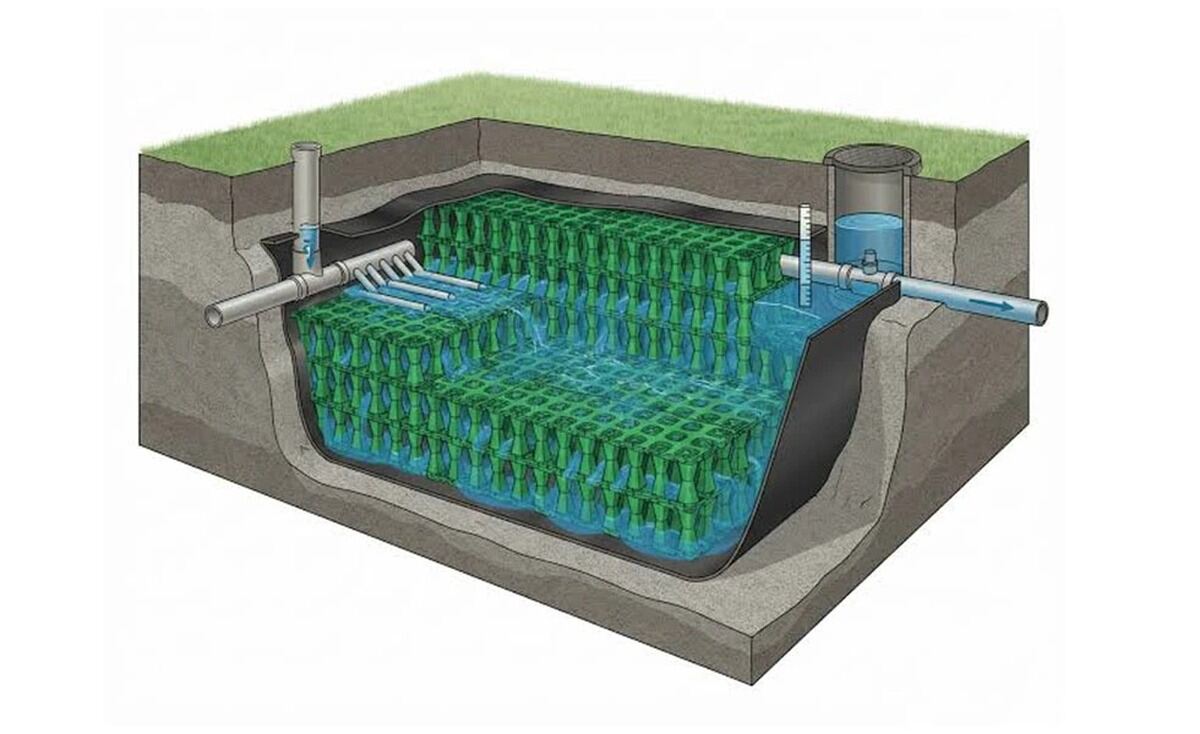
Burial changes what the storage structure has to do. The excavation is prepared with a level base. The tank or module array is set on it. A geomembrane liner seals the storage void, or the base is left open where the duty is infiltration rather than storage. Engineered backfill plus the structural cover close the system. From there the water cycle is simple. Inlets fill the void, and the stored water holds at a stable underground temperature. Either a pump sends it to the point of use, or a flow-control outlet meters it out.
Modular geocellular systems changed the economics of this category. Modules interlock into a structural matrix with a ≥92% void ratio — 920 liters of net storage per cubic meter. Typical cover depths run up to 3.5 m, with deep-burial variants rated to 8 m. The matrix itself carries load, with verified ratings from >45 to >85 T/m² vertical. The storage can therefore sit beneath parking lots, driveways, and access roads rather than beside them.
The Types Compared
| Type | Structure | Where it wins | Watch-outs |
|---|---|---|---|
| Molded cistern (poly/steel) | Single shell, factory-molded | Household and light-commercial volumes; lowest entry cost | Fixed sizes; surface footprint grows with volume |
| Cast-in-place concrete | Reinforced poured structure | Very large fixed volumes; municipal works | Longest schedule (excavation, formwork, cure); ~70–80% effective volume |
| Modular geocellular matrix | Interlocking PP modules + geomembrane | Flexible footprints (L/T/U layouts); traffic loads above; phased expansion; 92–95% verified void | Requires competent base and correct backfill specification |
Against concrete, modular PP systems weigh roughly 1/30 as much and install 60%+ faster (no curing time, no heavy lifting). They also allow individual module inspection and replacement without demolishing the structure.
The Disadvantages to Plan For
Underground storage trades surface land for engineering, and the honest list is short but real. Excavation and shoring dominate the budget. Geotechnical investigation comes first: a high water table brings hydrostatic uplift. Anti-flotation measures (a concrete base slab or geogrid anchoring sized from the survey) must therefore be designed in. Inspection means access chambers rather than opening a lid. Roofed or traffic-loaded designs need verified load ratings, not assumptions.
When Underground Fits
Underground is the default once volume grows past what the site can spare on the surface. Commercial and municipal duties range from tens to hundreds of cubic meters. The regulatory framing it serves, and the wider site water plan, are set out in what is stormwater management. Full specifications for the modular line sit on the modular water storage tanks product page. Pricing is project-based — see rainwater harvesting system cost for the cost stack. A sized layout comes from YY Tank within 24 hours of your volume, depth, and load inputs.
Frequently Asked Questions
What is the purpose of an underground water tank? The purpose is to store water without spending surface land. The tank holds rainwater for reuse, buffers stormwater for controlled release, or both. The ground above remains a parking lot, lawn, or building footprint. Burial also protects water quality. Stable underground temperatures around 12–15°C and total darkness stop the algae growth that sunlight-driven above-ground tanks fight. Load-rated designs add structural duty, carrying traffic instead of displacing it.
What are the disadvantages of underground water tanks? Four disadvantages deserve planning, not avoidance: the excavation and shoring line is the biggest cost item. A geotechnical survey is mandatory before design: a high water table creates hydrostatic uplift that requires anti-flotation anchoring.
Inspection and maintenance happen through access chambers, not by opening a lid; and traffic-loaded designs must show verified load ratings. Above-ground tanks stay cheaper and simpler at small scale — underground wins when volume grows or surface space is valuable.
How does underground water storage work? A buried tank or module matrix sits in a prepared excavation, sealed by a geomembrane liner. Water enters through inlets and fills the void. In a modular matrix, that void is the space between interlocking load-rated modules (920 liters of net storage per m³ of matrix). From there the duty decides the exit: a pump pressurizes stored water for reuse, or a flow-control outlet releases it slowly after the storm peak. The structure's job is to hold that water against earth pressure, groundwater uplift, and surface loads for decades.
What is an underground cistern? An underground cistern is a watertight vessel buried below grade to store water — historically masonry or concrete, today usually molded polyethylene, steel, or modular matrices. It is fed by roof or surface runoff and drawn down through a pump. It is the oldest form of underground water storage: the same buried, sealed, covered principle, now engineered with verified void ratios and load ratings. In practice "underground cistern" and "underground water storage tank" describe the same hardware at household scale. At commercial scale, the modular matrix has largely taken the role.