News


Geocellular Crates: Specs, Standards & Selection | YY Tank
02 Nov 2026Geocellular Crates: Specification, Standards & Selection
Geocellular crates are load-bearing, interlocking polypropylene modules that assemble into underground structural voids — the standard hardware for subsurface stormwater storage and infiltration. Stacked into a matrix and wrapped in a geomembrane, a crate array stores stormwater beneath lawns, parking lots, and access roads. Left unlined, the same array lets water soak into the ground. They are not the same product as "geocell" — the distinction matters when you specify, and it is the first thing this page settles.
Geocellular Crates vs Geocell: The Terminology, Set Straight
Geocellular crates (also sold as drainage crates, attenuation crates, or stormwater crates) are rigid, column-structured blocks that interlock into a three-dimensional storage matrix. The crate, not the surrounding soil, carries the load — which is why verified ratings run from >45 to >85 T/m² vertical.
Geocell is a different product: a three-dimensional, expandable honeycomb of HDPE strips laid on the ground and filled with aggregate to confine soil. It is used for slope and channel erosion control and load support over weak subgrades. Geocell confines soil; geocellular crates store water. Spec sheets and tenders conflate the two often enough that buyers should confirm which one a drawing actually calls for.
How Geocellular Crates Are Built and Tested
Each crate is a molded PP block. A 1000-series plate measures 1000×500×200 mm and weighs ≈6.7 kg, assembling by hand through a groove-and-rib column interlock with no crane, welding, or specialist tools. Arrays form L, T, U, or rectangular footprints beneath parking, landscapes, and buildings. They stack vertically for deeper installations (typical cover to 3.5 m; deep-burial variants to 8 m) and support phased expansion. New blocks connect to the existing array through standard pipe couplings.
The specification numbers that matter at tender:
| Property | Verified value |
|---|---|
| Void ratio | ≥92% (95–97% on deep-burial variant) — 920 liters net storage per m³ |
| Vertical load rating | >45 / >70 / >85 T/m² by model |
| Lateral load rating | >15 / >30 / >45 T/m² by model |
| Short-term compressive strength (EU practice) | ≥400 kN/m² at 5% deformation, tested to CIRIA C680 or equivalent |
| Long-term performance | 50-year service life (EN 17152-1 creep extrapolation); CABR 50-year creep test at 25% of failure load, zero collapse |
| Manufacturing standard | CJ/T 542-2020, third-party verified (CABR-BETC full-scale testing) |
| Warranty | 10-year limited, exclusions stated |
Against concrete tanks, the same storage volume lands in a smaller excavation, with verified void ratios of 92–95% against roughly 70–80% for concrete. It also installs in a fraction of the time because nothing cures.
Where Geocellular Crates Fit in a Stormwater System
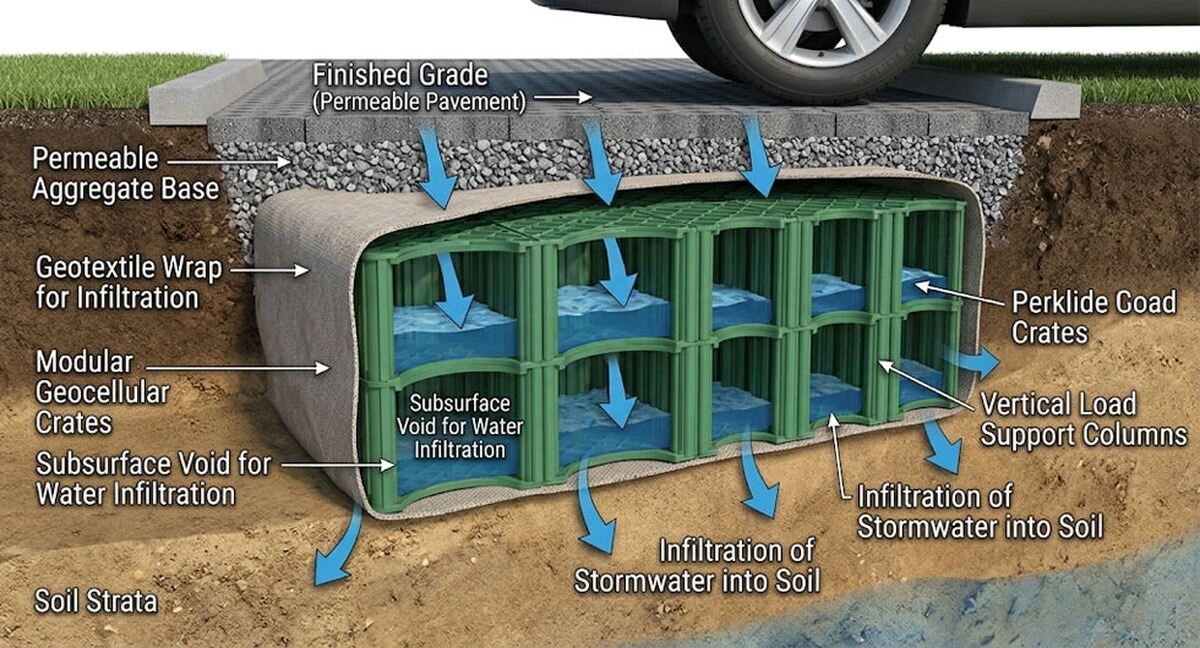
One crate line serves three duties with different fittings. Sealed with an impermeable geomembrane and fitted with a flow-control outlet, the array attenuates. This is the configuration behind the attenuation crates designation in specifications. Sealed and pressurized, it stores reuse water for rainwater harvesting. Left open to the soil with a geotextile wrap, it infiltrates, letting runoff recharge the ground. Upstream, leaf screens and first-flush separators keep the matrix clean for its 50-year design life. The full site-level picture is covered in what is stormwater management.
Specifying and Buying Geocellular Crates
Buy from manufacturers who publish test evidence, not brochure numbers. YY Tank produces geocellular modules at source (150,000 m³ of module capacity per year) and ships nestable, stackable units worldwide. Container loading density runs 60–100% above conventional modules, and a single 40' HQ container carries over 5,000 of the 1200-EW units. For European procurement, the industry association TEPPFA maintains a verified list of PP module systems. Send target volume, burial depth, and surface load to YY Tank: engineering responds within 4 working hours and a source-factory quotation follows within 24 hours.
Frequently Asked Questions
What is geocell used for? Geocell — a three-dimensional expandable honeycomb of HDPE strips — is used to confine soil and aggregate. Laid on slopes and channels, it controls erosion; filled over weak subgrades, it spreads load for access roads and working platforms. It is a ground-stabilization product. If the duty is storing stormwater underground, the product you need is geocellular crates — rigid interlocking PP modules that form a structural storage matrix. They are rated from >45 to >85 T/m² vertical.
Where can I buy geocell? If you need geocell proper (soil confinement), buy from geosynthetics suppliers and civil-materials distributors. If you actually need underground stormwater storage — the intent behind most searches that land here — buy geocellular crates factory-direct from module manufacturers. YY Tank supplies geocellular modules from source, with a sized layout returned within 24 hours of your volume, depth, and load inputs. For EU procurement, TEPPFA maintains a verified list of PP module systems. Buyers should always compare against third-party test reports rather than catalogue pages.
What is the cost of geocell per square meter? Geocell is priced per square meter of ground coverage and swings with cell depth, polymer, and install scope — there is no meaningful single number. Geocellular crates price differently: per cubic meter of verified storage volume, quoted per project from three inputs (volume, loading class, ground conditions). As procurement context, modular crates need more than 30% less excavation than a gravel attenuation bed for the same storage. Factory-direct supply also removes the distribution margin. Submit the three inputs and the quote reflects your project, not an average.
How long do geocells last? Service life depends on the polymer, the load, and above all UV exposure. Buried and covered geosynthetics outlast exposed installations many times over — which is why exposure limits appear on every spec sheet. For geocellular crates, the engineered benchmark is a 50-year service life based on EN 17152-1 long-term creep extrapolation. It is evidenced by a CABR 50-year creep test at 25% of failure load with zero collapse and backed by a 10-year limited warranty. Ask any supplier for the creep evidence, not just the warranty card.