News


Above Ground Rainwater Tanks: Types, Costs & Selection | YY Tank
30 Oct 2026Above Ground Rainwater Tanks: Types, Costs & Selection
Above ground rainwater tanks store harvested rainwater at surface level. The family covers rain barrels, slimline polyethylene tanks, and larger cisterns installed beside or behind a building. They are the fastest and cheapest way to start collecting rainwater: no excavation, no engineered foundation, most setups complete in a weekend.
Where they give ground is space and scale — and that is exactly the trade-off this page quantifies. The choice between above ground and underground is made on numbers, not habit.
Types and Costs Compared
| Type | Typical size | Observed cost band (Oct 2026) | Best for |
|---|---|---|---|
| Rain barrel | 50–300 gal | $300–$1,200 installed; 137-gal barrel lists at $214.95 | Garden irrigation, entry-level collection |
| Slimline / molded poly tank | 500–5,000 gal | $2,500–$15,000 as a system; 500-gal tank alone $800–$1,200 | Household partial reuse (toilet flushing, laundry) |
| Above-ground collection kit | ≈1,550 gal (≈5.9 m³) | $5,656 + freight; complete retail packages $8,160–$21,500 | Small-commercial and school packages |
| Underground modular matrix | 30–500+ m³ | Quoted per project (volume × loading class × ground conditions) | Commercial volumes, tight sites, traffic areas |
Budget guidance from our comparison practice: under $5,000 with space to spare, an above-ground tank is the right call. Past roughly $8,000 — or wherever space is tight — underground modular storage enters the comparison.
When an Above Ground Tank Is the Right Choice
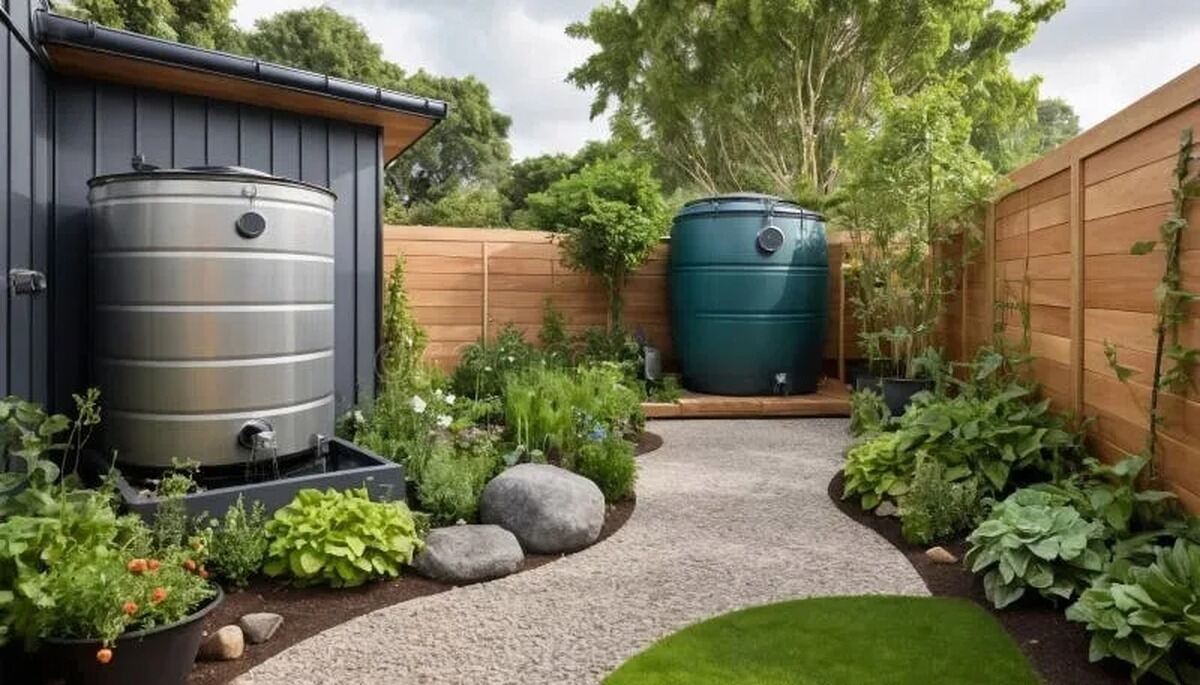
• Budget leads, and space doesn't bind. A 5–10 m³ polyethylene tank at $2,000–$5,000 serves a household's garden irrigation at the lowest entry cost — connect a hose and water.
• The installation is temporary. Construction sites, events, and seasonal agricultural duty need storage that deploys and relocates in weeks; disconnect, drain, move.
• Visibility is the point. Education centres and demonstration gardens use visible storage to make the harvesting loop tangible.
• Irrigation is the only end use. Where water quality demands are low, the advantages of underground storage don't justify their capital premium.
When Underground Modular Storage Wins
Space economics. A 10 m³ poly tank occupies 2–3 m² of surface; scale to the 50–100 m³ typical of commercial developments and 15–30 m² leaves active use permanently. At $2,000/m² land value, 30 m² of surface is a $60,000 trade-off — burial eliminates it, and the ground above stays a parking lot, lawn, or building footprint.
Water quality physics. Summer sun drives above-ground water to 25–35°C — algae colonises within 2–3 weeks, loading filters and shortening pump life. Buried storage holds a stable 12–15°C year-round: no light, no heat, no algae.
Structural duty. An above-ground tank only holds water. Load-rated modular modules (>45–85 T/m² vertical) carry traffic — the storage sits under the parking lot instead of next to it.
Service life. Polyethylene tanks serve 10–20 years. Engineered underground modules are built to a 50-year service life (EN 17152-1 creep extrapolation). That is why total cost of ownership over 20–30 years often reverses the capital-cost ranking.
The full factor-by-factor breakdown lives in our above ground vs underground comparison; the storage-duty and sizing math either way starts from what is stormwater management.
Sizing Applies Either Way
Whether the tank sits above or below ground, the same math sizes it. Harvestable supply = catchment area × rainfall × runoff coefficient (a 400 m² roof at 800 mm yields ≈272 m³/year). Tank volume = the larger of dry-period demand and single-event capture.
Household anchors: 2–5 m³ for garden-only duty, 5–10 m³ with toilet flushing; commercial floors start at 10 m³.
If the underground route fits the site, send the three inputs — volume, burial depth, surface load — to YY Tank for a sized module layout. Engineering responses run within 4 working hours.
Frequently Asked Questions
What are some ideas for storing rainwater? The main options, smallest to largest: a rain barrel on a downpipe (50–300 gallons, $300–$1,200 installed). A slimline polyethylene tank or cistern beside the house (500–5,000 gallons, $2,500–$15,000 as a system).
A buried modular matrix beneath a lawn or parking lot for commercial volumes. A pond or open reservoir where land is cheap and treatment duty is low.
Match storage to the demand math first. A barrel that overflows every storm is decoration, and a reservoir for garden duty is a budget mistake in the other direction.
What are the different methods of rainwater harvesting? The methods split by collection surface and duty.
Rooftop harvesting collects roof runoff through gutters into barrels, tanks, or cisterns for reuse. Ground catchment harvesting collects surface runoff from paved and landscaped areas, usually with heavier filtration. Stormwater harvesting captures runoff in engineered storage to control flooding as well as to reuse it.
The storage underneath can be above ground, a buried single tank, or a modular matrix. The sizing method (V = A × P × C) is the same across all of them.
What are rain barrels? A rain barrel is a drum-sized container, typically 50–300 gallons, that connects to a downpipe and stores roof runoff for garden use. A working setup adds a diverter with an overflow, a screen to keep debris and mosquitoes out, a tap, and a stand for gravity pressure.
Current retail anchors: a 137-gallon barrel lists at $214.95, and installed rain barrel setups run $300–$1,200. Barrels are the entry point of rainwater harvesting — cheap, visible, and sized for convenience irrigation rather than supply resilience.
What is the easiest way to collect rainwater? The easiest working setup is a rain barrel under the downpipe closest to the garden.
Cut the downpipe or fit a diverter. Seat the barrel on a level stand. Add the overflow back to the drain, and you are collecting in under an hour.
A 137-gallon barrel lists at $214.95 before fittings. For household reuse beyond the garden, the next step up is a slimline tank at 500 gallons ($800–$1,200 for the tank alone). Past that scale, collection stops being a weekend job and becomes a designed system.