News


Infiltration System: How It Works, Design & Sizing | YY Tank
30 Oct 2026What Is an Infiltration System? Design, Sizing & Standards
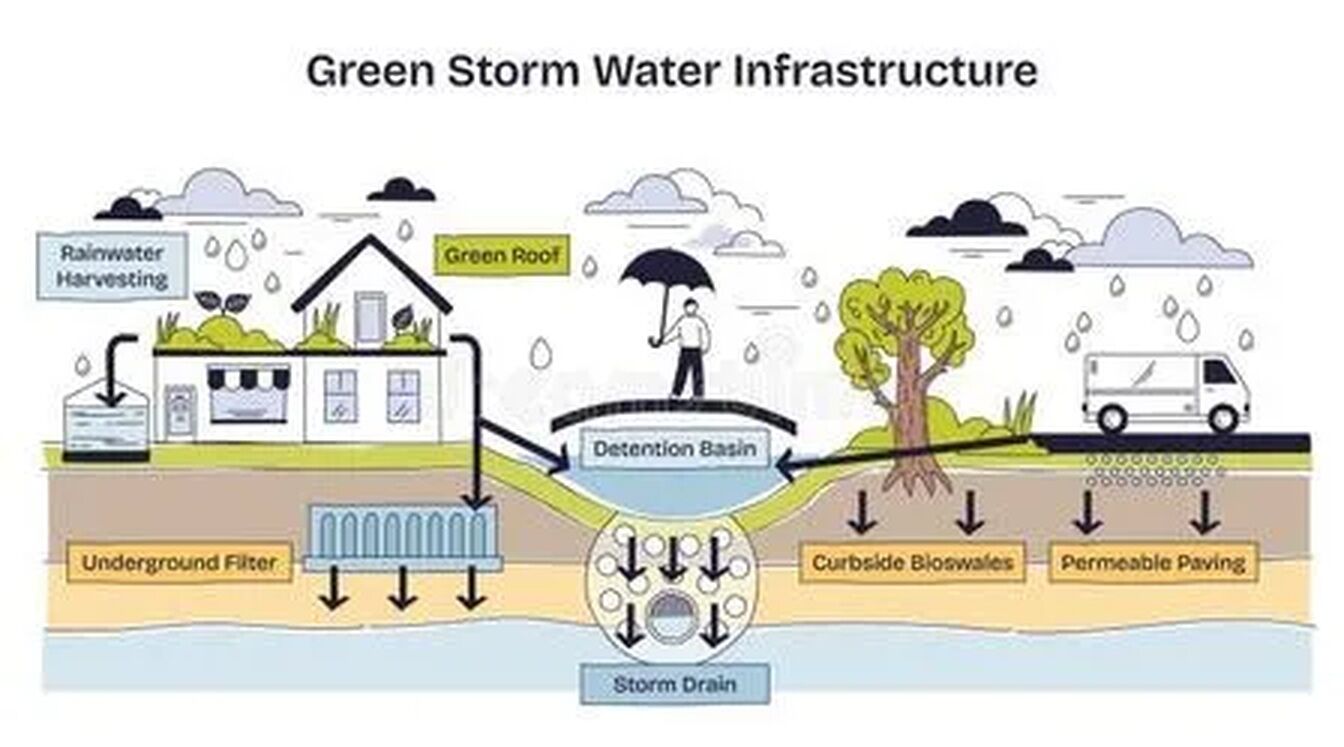
An infiltration system is a stormwater management structure. It captures runoff, filters it through aggregate or engineered media, and releases it into the surrounding native soil. It recharges groundwater instead of discharging to a piped network. Because the soil itself does the work, everything in the design hangs on two questions. How fast does your soil accept water, and can it keep accepting it storm after storm? This page covers how the systems work, the sizing math, and where US regulations draw the line.
How an Infiltration System Works, Step by Step
Step 1 — Capture. Runoff enters from roofs, paved areas, or a lined conveyance through inlets and pipes routed to the system.
Step 2 — Pre-treatment. Sediment, leaves, and hydrocarbons are removed before storage — leaf screens, first-flush separators, and vortex filters (in European SuDS practice rated to 280 micron or better). Clogging, not structural failure, is what kills infiltration systems. Once the soil surface seals with fine sediment, permeability does not come back without excavation.
Step 3 — Storage in the void. Water fills the open volume of an aggregate trench or a geocellular module matrix. Modular PP units store 92–95% of their gross volume, against roughly 70–80% for concrete structures. A given storage volume therefore fits in a noticeably smaller excavation.
Step 4 — Infiltration and drawdown. Water percolates through the open bottom and sides into native soil, recharging the shallow groundwater table. Design practice targets full drawdown within 24–48 hours after the storm. Indiana's stormwater manual, for example, sets a 12-hour minimum, a 72-hour maximum, and a 24–48 hour recommended drawdown. California vector-control districts expect standing water gone within about 72 hours to break the mosquito breeding cycle.
Step 5 — Overflow bypass. Flows beyond the design storm exit through an overflow to a receiving drainage or watercourse, protecting the site when capacity is exceeded.
The Sizing Math: Storage Volume and Infiltration Rate
Infiltration sizing is a race between inflow and soak-in. The standard method:
1. Runoff volume to store:
V_in = C × P × A
(catchment area A, design storm depth P, runoff coefficient C — the same supply formula used for rainwater harvesting tanks)
2. Volume the soil can absorb during drawdown:
V_soil = k_design × A_base × T
where k_design is the design infiltration rate (the field-tested rate reduced by the factor of safety your local manual requires). A_base is the infiltrative bottom area, and T is the allowable drawdown time (commonly 24–48 hours).
3. Required storage volume:
V_storage = V_in − V_soil
In words: store what arrives minus what soaks away during the storm. Rearranged, the formula also tells you the bottom area needed for a given storage depth. On slow soils, that area can grow quickly — which is why infiltration feasibility testing comes before layout, not after.
Design infiltration rate k is measured, not assumed. Field tests (double-ring infiltrometer or percolation pits) at the elevation of the proposed system base set the value. Compacted fill, clay-rich soils, and high water tables can cut the rate by an order of magnitude between test pits a few meters apart.
US Regulatory Context: Testing Before You Dig
US practice is converging on "prove infiltration first." The City of Portland's 2025 Stormwater Management Manual (effective March 1, 2025) requires infiltration feasibility investigation. It lists defined areas where infiltration is generally prohibited and testing is not required. Its Performance and Analysis Component reviews whether a design meets water quality, infiltration, and flow-control requirements before approval. Many US state and municipal manuals follow the same logic: test the rate, apply the safety factor, and demonstrate the drawdown time. EPA's national guidance likewise stresses drain-down requirements (typically 24–48 hours) as a core design check.
For an underground infiltration system, two further specifications matter at tender. One is verified short-term compressive strength: European practice targets ≥400 kN/m² at 5% deformation, tested to CIRIA C680 or the equivalent EU standard. The other is 50-year creep performance. Ask for the test report, not the brochure numbers.
When Infiltration Doesn't Work: Attenuate Instead
Infiltration is the right answer only where the soil cooperates. It is off the table — or heavily restricted — where soils are tight clays. It is also restricted where the seasonal high water table sits near the base or the site sits on contamination or karst. The local manual can prohibit it too, as Portland's 2025 manual now codifies for defined areas. There, the same geocellular hardware serves a different duty. Sealed with an impermeable geomembrane and fitted with a flow-control outlet, the matrix becomes an attenuation tank that stores peak flow and meters it out. It works in any soil. YYRH-MR modules are rated from >45 T/m² to >85 T/m² vertical with a ≥92% void ratio (920 liters of net storage per m³). The ratings are verified by CABR-BETC full-scale testing.
The two duties also chain together: an upstream stormwater management plan frequently pairs infiltration for water-quality volume with attenuation for peak-flow control. For the regulatory framing behind that pairing, see our EU SuDS market briefing on stormwater infiltration. Then send soil infiltration test results plus catchment data to YY Tank for a duty-matched module layout.
Frequently Asked Questions
What is water infiltration? Water infiltration is the process by which water on the ground surface enters the soil. It moves downward through pores and cracks into the soil profile and, eventually, the groundwater table. In stormwater design, engineered infiltration systems deliberately route runoff into permeable ground so the soil can absorb, filter, and slow it. This reduces runoff volume at the source instead of piping it away.
What is the simplest definition of infiltration? Infiltration is water soaking into the ground. That single process — surface water crossing into the soil — is the entire working principle behind infiltration trenches, basins, permeable pavement, and every other infiltration BMP. The engineering is only about making it happen fast enough, in enough volume, and keeping the entry surface from clogging.
What are infiltration trenches? An infiltration trench is a shallow excavated trench, backfilled with coarse aggregate or filled with geocellular modules. It stores runoff in its void space and lets it percolate through the trench walls and bottom into the surrounding soil. Runoff enters after pre-treatment, drains down over 24–48 hours, and an overflow passes extreme flows downstream. Trenches suit linear sites — road edges, parking perimeters, landscape strips — where a shallow, narrow footprint beats a large basin.
What is water infiltration in soil? Infiltration in soil is governed by soil texture, structure, and condition. Sands and gravels accept water quickly (high infiltration rate), clays accept it slowly, and compaction or sediment sealing can slow any soil dramatically. The rate is measured in the field — commonly inches or millimeters per hour. Design manuals require testing at the actual depth of the proposed system. The soil that matters is the soil at the invert, not the topsoil someone sampled last year.
How long should a detention pond hold water? A dry detention pond should empty within roughly 24–48 hours after the design storm. That window is the recommended drawdown in most US manuals. Indiana's, for instance, allows 12 hours minimum to 72 hours maximum, recommending 24–48. Holding much longer than 72 hours invites mosquito breeding and misses capacity for the next storm; draining too fast defeats the peak-shaving purpose. Wet ponds hold a permanent pool by design, so only the temporary detention volume above it needs to draw down.