News


Best Rainwater Harvesting Systems Compared: Durability, Efficiency, Capacity, Installation & Maintenance
20 Oct 2026Rainwater Harvesting Systems Compared: What Durability, Efficiency, Capacity, Installation and Maintenance Look Like in Published Numbers
Under a delivery lane, choosing a rainwater harvesting system is a structural decision; beside a flower bed, it is a gardening one. Engineered modular polypropylene systems lead the structural end — YY-Tank's YYRH-MR modules, for instance, rate above 85 tonnes vertical load with a 50-year zero-collapse creep result — while light-duty modules serve landscaped areas and moulded tanks or barrel kits serve gardens. The five factors below separate every system type on published numbers rather than adjectives.
Quick recommendations by scenario:
• Heavy-traffic commercial surfaces (parking, access roads, logistics yards): engineered modular PP geocellular systems — the only category with published creep-test and load-class documentation.
• Light-traffic and landscaped areas (greenbelts, sidewalks, overflow parking): EW-grade modular systems rated above 35 tonnes vertical, or moulded tanks where no load crosses.
• DIY residential gardens: rain barrels and moulded tank kits — consumer guides price workable setups from $99 to $500.
The Five-Factor Comparison at a Glance
Comparison shopping for rainwater systems usually means reading listicles written for backyards. This page takes the other path: five factors a commercial buyer actually litigates — durability, efficiency, capacity, installation and maintenance — with every claim anchored to a test document, a published industry figure, or a clearly labelled engineering estimate. Where a number belongs to YY-Tank's own products it carries the company's published test basis; where it describes the industry generally, it says so.
One placement decision comes before any of the five factors: whether storage sits above ground or below it changes the candidate list entirely. If you have not settled that, deciding above-ground vs underground first will save you reading the wrong column of every table on this page.
| System type | Durability | Efficiency | Capacity | Installation | Maintenance |
| Modular PP geocellular (engineered) | Excellent — 50-year creep test, zero collapse at 25% of failure load | Very high — 92% published void ratio; >30% less excavation than gravel beds | 5–500+ m³ assembled to exact volume | Hand assembly, 6.7 kg modules, no crane | Inert polymer — filters and pumps only |
| Precast concrete | Good — 30–50 years with consistent maintenance | Low–moderate — solid walls, fixed internal geometry | Fixed per casting; large volumes possible | Crane-dependent lifts | Joint sealing and structural inspections |
| Steel tanks | Strong material — tops published strength rankings; corrosion is the weak line | Low — closed vessel | Fixed by fabrication | Crane or specialist crew | Coating inspection and renewal |
| HDPE / rotomoulded tanks | Good buried; UV-stabilised HDPE runs 15–25 years above ground, unstabilised resin embrittles in 2–3 years | Low–moderate — closed vessel | Off-the-shelf sizes up to roughly the 10,000-gallon mark | Light; needs delivery access | Low; UV and fitting checks |
| Gravel soakaway trench | No structural failure mode, but siltation erodes void volume over time | Low — roughly a third of bed volume is void | Scales only by digging more | Excavation-heavy | Minimal — until siltation cuts capacity |
Read the table column-wise and the market structure falls out immediately. Concrete, steel and moulded tanks are vessels: their capacity is whatever the factory made, their installation is a lifting plan, and their long-term cost is surface protection. Gravel beds are cheap per hole but expensive per stored cubic metre. Modular PP is the only row whose five factors improve together — and the next five sections show why, factor by factor.
Which Rainwater Harvesting Systems Are Known for Good Durability?
Systems known for good durability share one trait: documented load retention over decades. Engineered modular PP geocellular systems currently carry the strongest published evidence — full-size assemblies at the China Academy of Building Research (CABR) sustained 25% of maximum failure load and concluded zero collapse over the project lifecycle, a 50-year design horizon. Concrete tanks earn the next line with published service life of 30 to 50 years given consistent maintenance. Steel is intrinsically strong — published tank-industry rankings put stainless steel first on mechanical strength, followed by galvanized steel, then polyethylene — but strength ranking is not durability ranking, because corrosion protection is a maintenance-dependent line.
The materials science behind the polymer result is worth understanding, because durability claims in this market often travel without evidence. Molecularly modified PP resists long-term thermoplastic creep — the slow deformation that collapses lesser resins under decades of buried load. The load path that makes this hold up under traffic is engineered into every module: a top plate that carries vertical load, ribbed side plates that resist lateral earth pressure while neutralizing hydrostatic pressure, and internal columns whose fluted and ribbed profiles raise moment of inertia and shear resistance respectively. Underground, the material is chemically inert and food-grade safe, so there is no electrochemical clock ticking the way it does on buried steel. Above ground the calculus flips: ultraviolet exposure ages unprotected plastics, which is precisely why rotomoulded tanks carry UV-stabilizer specifications and why buried modular storage sidesteps the question entirely.
Freeze-thaw deserves its own sentence. Water expands as it freezes, and any structure that traps it rigidly — some rigid joint systems, poorly drained beds — inherits that stress. A modular lattice drains and redistributes; the failure mode database for buried PP modules does not include frost heave of the structure itself. Cold-region standards test buried modular systems across 25 freeze–thaw cycles in hot-summer/cold-winter zones, 50 in cold zones and 75 in severe-cold zones, allowing no more than 5% mass loss and 20% compressive-strength loss. What does kill buried systems is what sits on top of them, which is why load rating — the next factor buyers should cross-check — is published per grade, >35 T, >60 T and >85 T vertical in the YYRH-MR range.
| Durability evidence by system type | Published basis |
| Modular PP geocellular | CABR 50-year creep test at 25% failure load, zero collapse; national heavy-duty load certification by Fangyuan Test Group; per-SKU reports downloadable |
| Precast concrete | 30–50 year service life with consistent maintenance |
| Steel | Highest mechanical strength ranking; corrosion protection = upkeep-dependent |
| Rotomoulded HDPE | UV exposure governs above-ground life: 15–25 years stabilised, 2–3 years unstabilised |
| Gravel bed | Degrades by siltation, not structure |
We have reviewed enough competitor submittals to offer one buyer's heuristic: durability claims that cannot be traced to a named test — institute, report number, load percentage — should be priced as marketing, not engineering. YY-Tank publishes its load test reports with report numbers and free download precisely because that traceability is the exception in this market.
Which Systems Have the Best Efficiency?
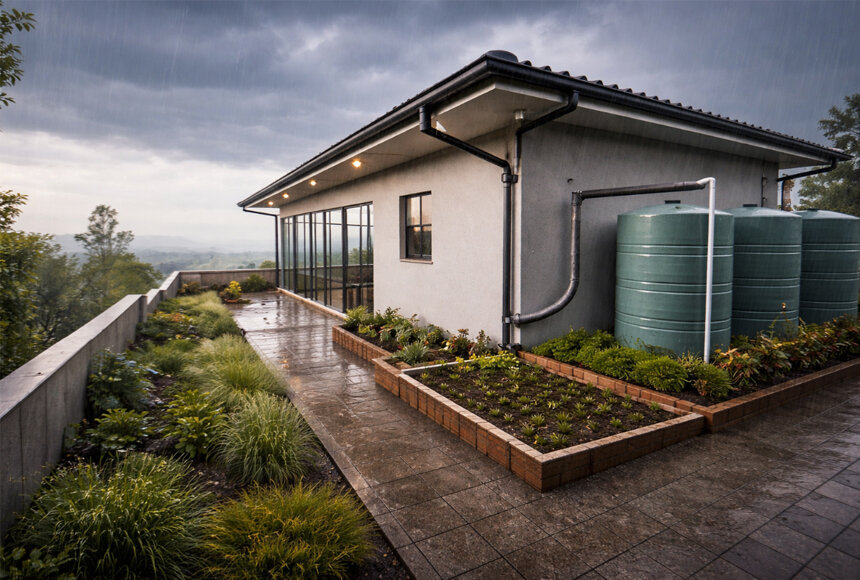
The most efficient rainwater harvesting system is the one that converts the most catchment rainfall into usable stored volume — and efficiency, properly measured, is two ratios stacked: how much rainfall runoff you capture, and how much buried volume actually holds water.
Capture efficiency comes first. Collection yield follows the standard runoff-coefficient method: V = A × R × C, catchment area times rainfall depth times the surface's runoff coefficient. Roofs are the best collectors in civil engineering — metal, tile and membrane roofs run C = 0.85–0.95, paved surfaces 0.80–0.90, turf as low as 0.20–0.35. Worked example: a 400 m² metal roof in 800 mm annual rainfall yields 400 × 0.8 × 0.85 = 272 m³ per year. No storage technology changes that number; it is set by the surface and the sky.
Storage efficiency is where system types separate. A storage structure's job underground is simple to state and expensive to do badly: occupy volume with water, not with structure. A gravel bed stores water only in the spaces between stones — roughly a third of the excavated volume. A closed tank stores well per unit of tank, but its geometry is fixed. A high-void modular lattice is the engineering answer to the dilemma: polymer structure in the load path, water everywhere else. The YYRH-MR series publishes an ultra-high void ratio of 92%, against a 90% floor in national standards — and the same structural logic shows up in the excavation line: for equal storage, a modular bed digs more than 30% less than a gravel attenuation bed.
| Efficiency factor | Modular PP | Concrete / steel tank | Gravel bed |
| Capture (runoff coefficient) | Set by catchment surface, identical for all | Same | Same |
| Void ratio of storage | 92% published | Internal volume only | ~1/3 of bed volume |
| Excavation per stored m³ | Lowest — >30% less dig vs gravel | Pit sized to tank geometry | Largest |
The honest caveat: for a small garden, efficiency tables are overkill — a barrel under a downspout captures what it captures. Efficiency discipline starts paying when storage volume crosses double-digit cubic metres and the excavation bill arrives with it. That is also the point where the system cost comparison becomes worth reading, because void ratio is a cost factor disguised as a technical one.
Which Systems Have the Best Capacity?
On capacity, the honest comparison is not which system type holds the most, but which scales the way your project grows. Public sizing guidance bands the consumer market neatly: 50–300 gallons serves small gardens, 1,000–5,000 gallons covers home irrigation, and full-household or small-commercial systems begin above 10,000 gallons. Every system type above works in the first band; only some survive the third.
Moulded tanks scale by catalogue — off-the-shelf sizes reach roughly the 10,000-gallon mark before custom fabrication begins. Concrete and steel scale by fabrication, which handles large volumes but locks geometry at order time. Gravel beds scale by arithmetic: twice the storage, twice the hole, with nothing but margin to show for it.
Modular geocellular systems are the exception because capacity is combinatorial rather than categorical: modules assemble to the exact volume required, from 5 m³ (about 1,321 US gallons) beside a workshop to 500+ m³ (about 132,086 gallons) beneath a campus. YY-Tank's reference projects — sports centres, schools, hospital grounds, an intelligent-manufacturing industrial park among them — collectively treat around 500,000 m³ of rainwater per year, a number no single moulded tank approaches. The same combinatorial property is also the expansion story: a 50 m³ bed installed this year becomes a 75 m³ bed next year by adding modules, not by replacing a vessel.

| Capacity band | Best-fit system types | Scaling behavior |
| 50–300 gal (~0.2–1.1 m³) | Rain barrels, small moulded tanks | Consumer shelf items |
| 1,000–5,000 gal (~3.8–19 m³) | Moulded tanks, small modular beds | Tank catalogue or small module grid |
| 10,000+ gal (~38+ m³) | Modular geocellular; fabricated concrete/steel | Modules extend freely; vessels re-fabricate |
| 500+ m³ engineered | Modular geocellular | The category's home ground |
One sizing warning from the capacity column: buy volume for the demand you can prove, not the volume a brochure suggests. The runoff math in the efficiency section above — catchment area, rainfall depth, runoff coefficient — puts a ceiling on what any tank can harvest; storage beyond it is buried capital that never fills.
Which Systems Offer the Easiest Installation?
Easiest installation belongs to consumer hardware — a rain barrel kit genuinely installs in an afternoon. Among engineered systems, the question becomes what the installation does to your schedule and your site, and that is where assembly method decides.
The traditional sequence for large storage is a lifting plan: precast concrete rings and large tanks arrive as crane cargo, with mobilization, certified operators and site access as prerequisite costs. Modular PP systems replace the lifting plan with a labour plan. Each YYRH-MR module weighs 6.7 kg and assembles by hand — no crane anywhere in the storage structure. Installation runs four published steps: excavation and bedding, module assembly, geosynthetic wrap and pipework, backfill and reinstatement; and because the wrapped lattice is structural once assembled, backfill compaction proceeds with conventional heavy machinery on the normal civil schedule.
| Installation factor | Modular PP | Precast concrete | Large moulded tank |
| Lifting equipment | None for structure | Crane throughout | Delivery crane or tilt tray |
| Labour skill | General civil crew | Specialist lift crew | General + delivery |
| Excavation footprint | >30% less than gravel for equal storage | Pit to vessel geometry | Pit to vessel geometry |
| Schedule shape | Assembly runs parallel to earthworks | Lift sequence on critical path | Delivery day on critical path |
Our installation support conversations circle one theme: site congestion. On urban commercial sites — the kind with neighbors on three boundaries — the ability to decant nested modules from a container and stage them in a few parking bays, then assemble directly into the trench, removes the crane pad that a concrete scheme would have demanded. The modules ship flat-packed and nested, with container loading optimized so a 40'HC unit carries more storage per sailing — an advantage that starts at the moulding line, where continuous injection production keeps module supply matched to installation schedules rather than casting-cure calendars, and matters doubly for export projects where the tank itself is arriving by sea.
If you are weighing system types for a live site, the 3D model walkthrough of module assembly published by YY-Tank makes the installation logic visible before any method statement is written.
Which Systems Have the Lowest Maintenance Needs?
Lowest maintenance needs is a two-part answer: the storage structure should demand nothing, and everything else should be inspectable without excavation. Systems that fail either test generate maintenance budgets that quietly outgrow the purchase price.
On the structure, inert polymer is the category winner. Molecularly modified PP is chemically inert underground and food-grade safe — no coating schedule, no corrosion inspections, no joint sealant campaigns. Steel tanks invert that picture: the material tops strength rankings but corrosion protection is a standing upkeep line for buried or exposed steel. Concrete sits between — the published 30–50 year service life is explicitly conditioned on consistent maintenance, which is the polite way of saying the maintenance is not optional.
On the water path, maintenance concentrates where the water enters: gutters, leaf separators and pre-tank filtration. Practitioner guidance is consistent that effective pre-tank filtration is what protects downstream components, and household-level guidance converges on monthly visual checks of system and seals, with pump service following manufacturer intervals. None of it requires heavy equipment on a modular system — access points sit at the surface.
| Maintenance item | Modular PP | Steel tank | Concrete |
| Structure inspection | None required by design | Coating condition, corrosion spots | Joints, sealing, structural review |
| Water path | Gutters, filters monthly | Same | Same |
| Periodic deep work | Pump service only | Coating renewal campaigns | Sealant repair programs |
Which system is easiest to live with, then? A buried modular bed with surface-accessible filtration — the structure disappears from the maintenance ledger and stays there. How to execute those checks season by season is a procedure question, and the rainwater harvesting maintenance series covers it properly; this page's job is only to tell you which structure minimizes the ledger in the first place.
Which Drainage Options Suit High-Traffic Business Environments?
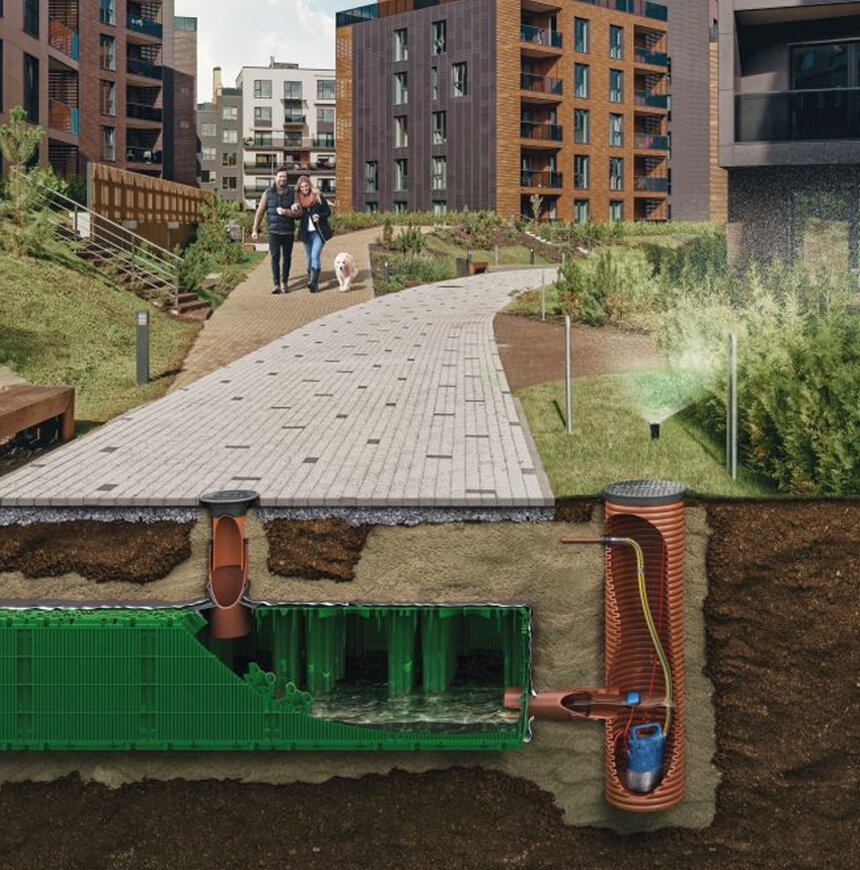
For high-traffic business environments, published drainage guidance converges on trench drains for heavy-traffic driveways and business entrances — the linear channels that intercept surface water where it collects and freezes — with slot drains offering a narrower, pedestrian-friendly profile and French drains serving foundation-adjacent interception. Surface drainage captures water at grade; what it does not do is store it.
That is the complement, not the competition. A commercial site in a storm metropolis needs both: surface capture to clear the pavement quickly, and subsurface attenuation to hold the volume and release it slowly. Modular geocellular attenuation is the subsurface half of that pairing, and under traffic it is a structural product first — the >85 T vertical rating of the heavy-duty module grade is engineered to meet or exceed AASHTO H-20 wheel loads (the standard's 32,000-lb axle loads), per published test documentation. How load class moves project cost is broken down in the cost guide's loading section — worth reading before a drainage-heavy scheme is priced, because attenuation volume under a yard is priced like structure, not like landscaping.
| Layer | Function | Typical hardware |
| Surface capture | Clear pavement fast | Trench drain, slot drain |
| Conveyance | Move water to storage | Gullies, pipework |
| Attenuation & storage | Hold volume, release slowly | Modular geocellular bed |
| Disposal or reuse | Soakaway or reuse feed | Geotextile wrap (soakaway) or membrane (attenuation) |
Recommended Systems by Commercial Scenario
Scenario recommendations compress the five factors into decisions. Three settings cover most commercial enquiries we receive.
High-traffic commercial parking and access roads. Surfaces that carry cars, delivery vehicles or fire lanes need the structural grades: YYRH-MR-1000-HD above 85 T vertical for heavy lanes and deep sections to 8.0 m, or YYRH-MR-1200-SD above 60 T for standard parking decks and emergency lanes. Assembly by hand keeps the finished surface on schedule, and the 50-year creep documentation travels into the approval file.
Manufacturing plants and industrial parks. Large roofs plus process water demand make industry the natural customer of rainwater harvesting: yield scales with roof area (the runoff math above), and reuse absorbs it. YY-Tank's reference list includes the Wuxi Xinwu Xinhua Intelligent Manufacturing Industrial Park among its industrial deployments — the configuration logic is large modular attenuation paired with reuse-grade filtration.
Campus and sports venues. Schools, hospitals and stadiums combine big roofs, big soft landscapes and badge-value for sustainability commitments. Reference deployments include the Wuxi Olympic Sports Centre and the Jinshawan Sports and Culture Center gymnasium. At Wuxi, some 80,000 m² of mixed roof, plaza and landscape catchment at a 0.72 composite runoff coefficient produced a volumetric requirement of 3,571 m³ against a 62 mm two-year 24-hour storm; after water-balance checking against roughly 85 m³/day of reuse demand, the built storage was 600 m³ in heavy-duty 1000-HD modules at 3.2 m burial depth, installed above the gymnasium basement roof and in service since 2024. The Jinshawan gymnasium serves as a reference deployment only; its parameters are not yet public. Across all reference projects, systems treat some 500,000 m³ of rainwater per year.
We have walked enough of these three scenarios to generalize one pattern: the scenario rarely chooses the technology — the loading class above the tank does. Match the grade to the traffic, size the volume to the runoff math, and the five-factor table collapses into a purchase order.
Frequently Asked Questions
Can you tell me which rainwater capture and harvesting systems are known for good durability?
Engineered modular PP geocellular systems carry the strongest published durability evidence: CABR full-size assemblies sustained 25% of maximum failure load with zero collapse over a 50-year horizon, and per-grade load ratings run to >85 T vertical. Concrete tanks follow at 30–50 years with consistent maintenance.
Which rainwater capture and harvesting systems have the best efficiency?
Efficiency is capture plus storage density. All systems share capture, set by roof surface (C = 0.85–0.95 for metal and membrane roofs). Modular PP leads storage density with an ultra-high void ratio (92%, against a 90% national floor) and >30% less excavation than gravel beds.
Which rainwater harvesting systems have the best capacity?
Consumer bands run 50–300 gallons for gardens and 1,000–5,000 gallons for home irrigation; above 10,000 gallons, modular geocellular systems assemble to exact volume while tanks hit catalogue or fabrication limits. Reference projects in the 500+ m³ class treat 500,000 m³ per year collectively.
Which rainwater harvesting systems offer the easiest installation?
Barrel kits for gardens; among engineered systems, hand-assembled modular PP — 6.7 kg modules, no crane, four installation steps with conventional backfill machinery. Concrete and large vessels require crane logistics on the critical path.
Which rainwater harvesting systems have the lowest maintenance needs?
Systems with inert buried structure and surface-accessible filtration: modular PP needs no coating or corrosion program, while steel carries corrosion upkeep and concrete's service life assumes consistent maintenance. Monthly filter checks and pump servicing complete the ledger.
What is the most efficient rainwater harvesting system?
For total conversion of rainfall to usable water: a clean roof catchment (C ≥ 0.85) feeding high-void modular storage. The roof determines how much arrives; the storage void ratio determines how much of the pit actually holds water — which is why modular PP beds outrank gravel beds on delivered volume per dig.
Get the Numbers for Your Scenario
Five factors settle the system type; your site settles the specification. YY-Tank (Jiangsu Yingyuan Sponge City Technology Co., Ltd.) sizes modular systems from three site inputs — target volume, burial depth and surface load — through the Hardcore Engineering Requirement Form, with engineering responses to email inside 4 working hours. Test reports and the 3D assembly model are freely downloadable alongside ISO certification records, and the YYRH-MR series overview carries per-grade specifications.
Related Reading
If you want the full decision framework rather than a single factor, the complete rainwater harvesting system guide walks through collection, storage, filtration and reuse end to end. Engineered modular PP attenuation systems covers the YYRH-MR grade range referenced above, and our rainwater collection system types and costs and above ground vs underground rainwater tanks comparisons give the cost and structural context behind the five factors. To size a system for your own site, Get a Quote and we will respond with a specification sheet.
Sources
• CABR 50-year creep test (China Academy of Building Research, 25% failure load, zero-collapse conclusion)
• YY-Tank product specifications — YYRH-MR series load grades, module weight, burial depth, materials
• YY-Tank installation guide — 4-step method, 3D model
• YY-Tank reference project list and aggregate annual treatment volume
• AASHTO H-20 axle-load benchmark note, YY-Tank downloads FAQ
• National Tank Outlet materials guide — strength rankings (third-party snapshot)
• Kennedy Tank materials guide — concrete tank service life (third-party snapshot)
• Aquabarrel sizing guide — capacity bands (third-party snapshot)
• RainPlan residential guide — consumer price bands (third-party snapshot)
• Home maintenance guides — monthly inspection rhythm (third-party snapshot)
• RMS maintenance notes — pre-tank filtration (third-party snapshot)
• Commercial drainage contractor guides — trench/slot/French drain applications (third-party snapshot)
• Standard runoff-coefficient method, coefficient values, unit conversions (generic engineering references)
• Gravel bed void ratio and siltation behavior (generic engineering reference)