


Technical Requirements for Installation of Modular Tanks in Rainwater Harvesting Systems
01 Mar 202401 Weld-resistant Leak-proof Geotextile
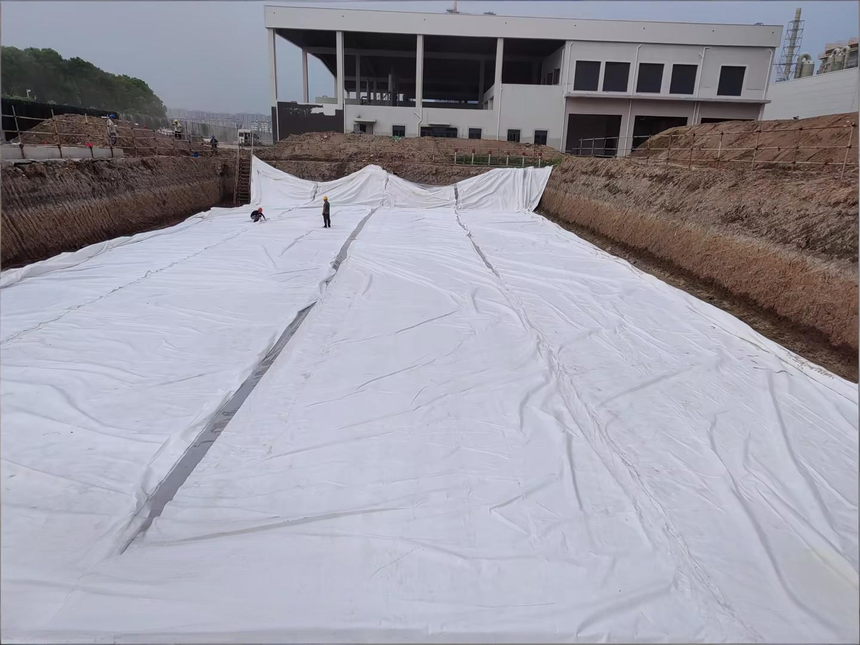
After the installation of the rainwater modules is completed, wrap the pre-welded composite geomembrane around the module frame and fold it along the creases. If the top is wrapped, the wrapping width on both sides shall be greater than 500 mm, and welding shall be carried out in accordance with the technical specifications for composite geomembrane welding.
The side length of the installation surface for the prefabricated sleeve and composite geomembrane shall be twice the pipe diameter, and the inner diameter of the sleeve shall be slightly larger than the pipe diameter.
Pipes and HDPE sleeves shall be fixed with double clamps.
The composite geomembrane is provided with cross openings, and pipelines are connected to the rainwater module tank via PE flanges.
To ensure sufficient allowance for the connecting fittings, open the fittings with geotextile, insert them into the modules, and fasten the clamps securely.
02 Installation of Rainwater Modules
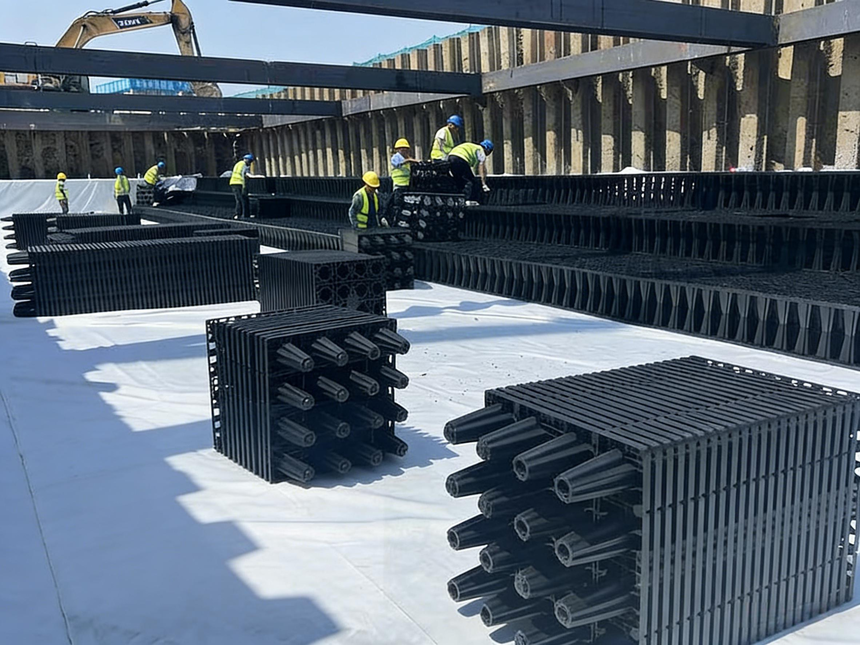
The rainwater modules shall be arranged neatly during installation to facilitate the fixed connection between the same layer and upper/lower layers.
Rainwater modules on the same layer shall be connected with horizontal plastic fixing clips. There shall be at least two fixing clips on the long side and at least one on the short side.
The upper and lower water storage tanks shall be connected with longitudinal water storage fixing rods, with two or more fixing rods between the upper and lower parts of each module group.
When connecting rainwater modules, vertical connection shall be avoided as much as possible. The upper layer shall be placed first, followed by the sequential arrangement of the lower layer.
03 Installation of Multi-functional Components and Connecting Pipes
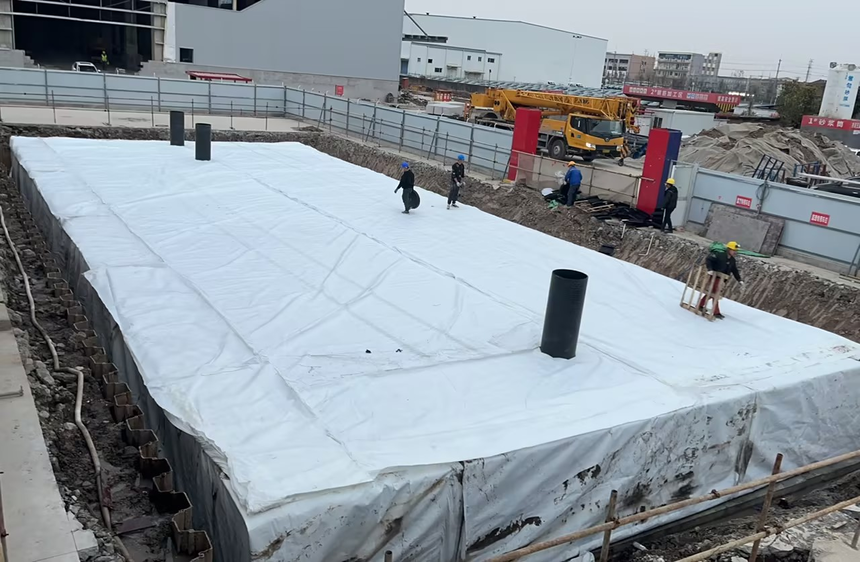
The installation and construction of rainwater wells, rainwater pretreatment equipment, sludge pumping wells, fresh water pumping wells, drain valve chambers and overflow wells, as well as their elevation and coordinate requirements, shall comply with the design specifications, and all pipelines shall be connected and installed correctly. The concrete cushion at the bottom of the foundation pit must be level, with a medium sand cushion of 20 mm or more on top. The coordinates of abandoned oil wells and gas wells can be adjusted according to the actual on-site conditions. Backfilling shall be carried out in layers with raw soil or coarse sand, compacted manually or mechanically, and the thickness of each layer shall not exceed 500 mm. A concrete cushion with a thickness of 200 mm and a width of more than 1500 mm shall be laid on the surface.
The backfilling method for the water inlet pipe of the equipment room is the same as that for the coarse sand inlet pipe.
04 Backfilling
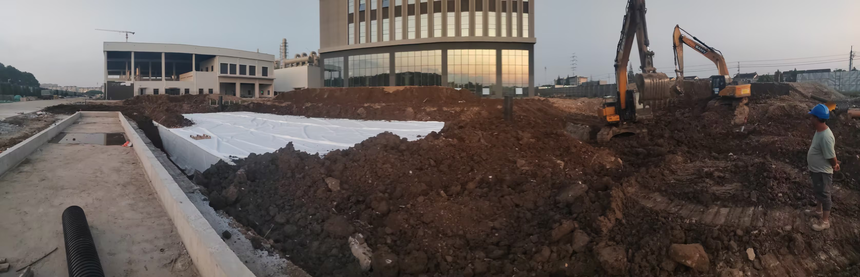
The backfilling method is as follows: first backfill a 100 mm thick layer of coarse sand adjacent to the composite geomembrane, then backfill with the original soil outside the coarse sand layer. Hard objects such as stones shall not be mixed into the coarse sand or stone powder during backfilling, so as to avoid direct contact with the geomembrane and prevent leakage. Each backfill layer shall be 300 mm thick and compacted up to the top surface.
After project completion, water quality testing shall be carried out. Upon arrival of the waste liquid filtration equipment and electrical equipment, equipment management personnel shall conduct unpacking inspection, acceptance and registration for procurement and use. Equipment installation must comply with relevant technical requirements. Online instruments shall be installed at correct positions and orientations with complete fittings. Instruments, valves, sampling ports, etc. shall be arranged evenly and at equal intervals. After installation of the integrated rainwater control cabinet, the entire system shall be commissioned until it operates normally. Upon successful commissioning, inspection and acceptance shall be conducted.