News


Stormwater Attenuation Tanks: How They Work & Sizing | YY Tank
02 Nov 2026Stormwater Attenuation Tanks: How They Work and How to Size Them
Stormwater attenuation tanks are storage structures that hold stormwater runoff at peak flow and release it at a controlled, pre-approved rate. Buried beneath parking lots, landscapes, or building footprints, they turn the moment of peak rainfall into a slow, managed drain-down. At that moment pipes and streams can absorb nothing more; the drain-down protects downstream networks from flooding and erosion. This page covers how they work, the sizing inputs, and the terms (detention, retention, attenuation) that plans and permits actually use.
How Does a Stormwater Attenuation Tank Work?
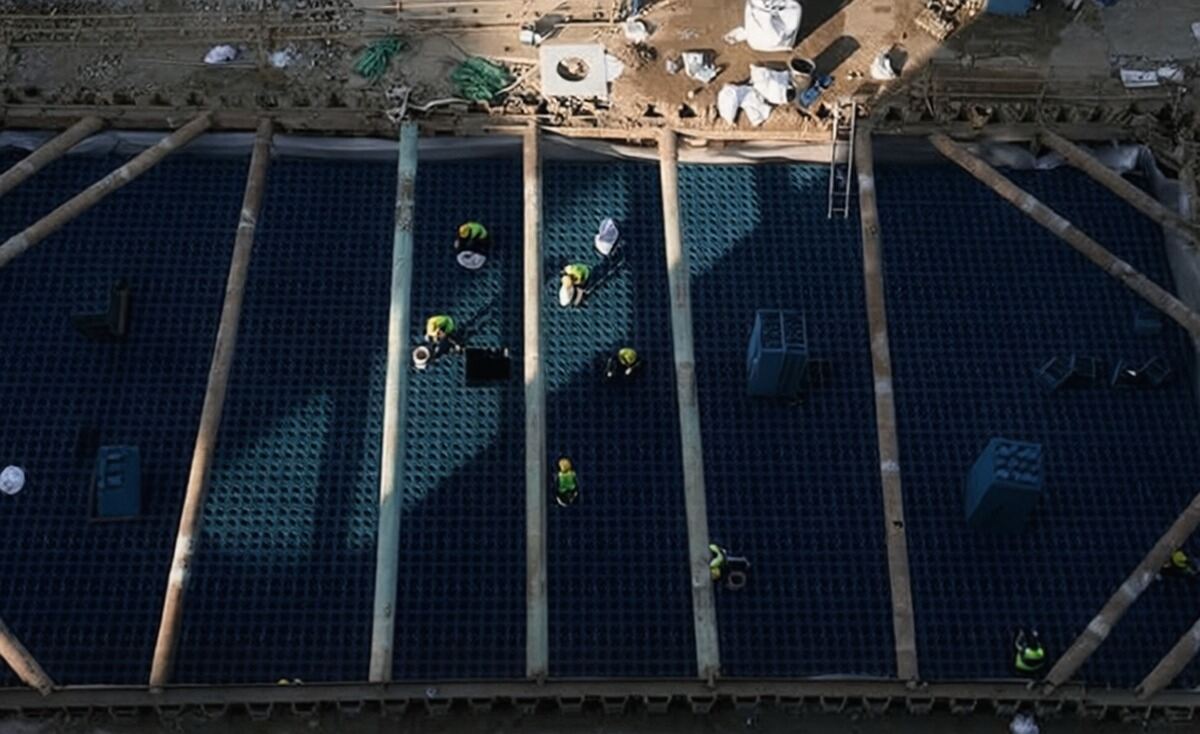
The working cycle is fill, hold, release. During a storm, runoff fills the tank faster than the outlet lets it leave.
Once inflow passes its peak, the tank drains down at the permitted rate through a flow-control outlet — an orifice plate, vortex valve, or weir. Drain-down continues until the tank is empty and ready for the next event.
Because the tank only meters flow and never needs the ground to absorb water, attenuation works in any soil. Tight clays and high water tables that rule out infiltration are exactly where attenuation is specified instead.
Modern attenuation hardware is modular: interlocking geocellular PP modules assemble into a structural matrix with a ≥92% void ratio. Every cubic meter of matrix nets 920 liters of net storage. The matrix is sealed with an impermeable geomembrane and wrapped in geotextile. The same modules carry verified vertical loads from >45 to >85 T/m², so the surface above stays in service.
Attenuation vs Detention vs Retention
• Attenuation (the standard US stormwater term) — temporary storage with a controlled outlet; the tank empties between storms.
• Detention — the same controlled-release duty; "detention system" is the common umbrella in US codes, "attenuation tank" the structure-level term. If your ordinance says OSD or detention, the attenuation hardware is what satisfies it.
• Retention — a permanent pool or stored volume kept in place; retention stores water, attenuation only borrows it.
One module line serves all three duties with different fittings: sealed with a geomembrane and fitted with a flow-control outlet, it attenuates. Sealed and pressurized for irrigation, it retains water for reuse. Left open to the soil, it infiltrates.
How Do You Size an Attenuation Tank?
Sizing starts from two regulatory numbers — the storm return period your drainage authority requires and the maximum discharge it permits — plus one site calculation. Runoff volume = catchment area × rainfall depth × runoff coefficient. Storage required = that runoff volume minus what may leave during the storm at the permitted rate.
A 400 m² catchment at 800 mm of annual rainfall produces roughly 272 m³ a year of runoff. The design storm fraction of that, less the permitted release, is the volume the tank must buffer.
Where the whole site water plan matters — compliance duties, water quality, and the reuse option — start from what is stormwater management.
Model-level specifications, load classes, and a sized module layout belong on the attenuation tank product page. Submit target volume, burial depth, and surface load to YY Tank for an engineered layout within 24 hours.
Frequently Asked Questions
What is the purpose of an attenuation basin? An attenuation basin exists to break the peak.
It receives runoff faster than the downstream network can accept it and stores that difference temporarily. It then releases the water at the rate the drainage authority permits.
The purpose is flood and erosion control downstream — plus land value upstream. A buried attenuation structure leaves the surface free for parking, fields, or buildings, while an open basin would take that land out of use.
What is the main difference between a rainwater tank and a stormwater tank? A rainwater tank stores water as a resource: it is sealed, and the water inside is kept for irrigation, toilet flushing, or process use. A stormwater tank manages water as a liability. It holds runoff only long enough to release it slowly at a permitted rate, and it empties between storms. Same hardware family, opposite objectives — one keeps water in, one meters water out — and one modular line can be fitted for either duty.
What is stormwater detention? Stormwater detention is the temporary holding of runoff and its slow, controlled release after the storm peak has passed. The water is held instead of running off all at once. A detention system drains down completely between storms — that is what separates it from retention, which keeps a permanent pool. Buried modular detention systems meter flow through an orifice or vortex outlet sized to the permit. That is why detention is the duty most US drainage ordinances actually require on new development.
What are the three types of water tanks? In stormwater practice the three types, classified by duty, are: storage tanks (rainwater harvesting — sealed, water kept for reuse). Detention or attenuation tanks are for temporary buffering with a controlled outlet. Infiltration tanks are perforated or open-based structures that release water into the surrounding soil. Classified by material the trio is usually steel, concrete, and modular polypropylene. Modular PP offers the highest void ratio (92–95% verified, against roughly 70–80% for concrete) and hand assembly without cranes.