News


Stormwater Management Solutions: Systems & Products
05 Nov 2026Stormwater Management Solutions: Systems and Products Guide
Two numbers anchor most stormwater management solutions: the volume a system must hold and the load rating of whatever stands above it. A commercial site order starts there — storage below a parking deck, loading for delivery trucks, and a permit that names the release rate. Between those anchors sits a whole family of systems. This guide maps it: every duty, the products that serve it, and a selection path from rainfall to contract.
What Are Stormwater Management Solutions?
A stormwater management solution is any engineered practice that controls runoff — moving it, holding it, soaking it in, or cleaning it. The umbrella covers several near-synonyms. A stormwater management system is the assembled whole. Stormwater systems and management products are its hardware, and stormwater management facilities are the same assets seen from the permit side. Stormwater collection systems name the front end of the chain, where inlets gather what rain delivers.
Rainwater management completes the umbrella from the other direction. It treats rainfall as a resource to harvest and reuse, not only a liability to drain. Modern site plans increasingly run both duties together, storing reuse water and metering storm releases from one buried footprint.
The discipline behind all of it is anchored in our stormwater management systems overview, which this guide extends into product territory.
The Stormwater Solutions Family Tree
Five duty families cover nearly every product on the market:
| Duty family | Function | Typical products and facilities |
|---|---|---|
| Conveyance | Move runoff safely | Storm drains, inlets, catch basins, culverts, swales, stormwater pipes |
| Storage — detention | Hold the peak, release slowly | Attenuation tanks, detention vaults, modular detention matrices |
| Storage — retention | Keep water on site | Retention basins, wet ponds, cisterns and reuse tanks |
| Infiltration | Return water to soil | Infiltration systems, permeable pavement, dry wells |
| Treatment | Remove pollutants | Hydrodynamic separators, filter media units, biofiltration, modular wetland systems |
One structure can serve several duties. A sealed geocellular matrix stores reuse water when the membrane is closed, and meters storm flow when an outlet controls it. That is why the storage row above carries the widest product range — and why an engineered quotation starts from duty, not from catalogue. The same matrix line covers detention, retention, and infiltration fittings; only the accessories change.
Projects larger than a single product work as treatment trains. A typical chain runs inlet, pre-treatment, storage or infiltration, then controlled release — each stage protecting the next. Designing the train, rather than stacking devices, is what separates a compliant site from a maintenance burden.
How to Choose a Stormwater Management System
The best storm water management system is the one your permit names and your crew can maintain — everything else is packaging. Four questions walk a site from problem to product:
1. What duty does your permit name? Ordinances speak in duties — release rate, water quality volume, retention standard. The named duty selects the family; everything else is refinement. Read the permit before the product sheets, because the two documents answer different questions.
2. What does the water carry? Roofs shed debris and sediment; roads add hydrocarbons and metals; parking adds grit. The pollutant profile decides whether treatment joins the train, and in which order. Pre-treatment always precedes fine treatment, or the fine media clogs early.
3. What does your site allow? Soil permeability, groundwater level, crane access, and surface loading constrain the structure. Tight urban sites favor hand-assembled modular storage over open basins. Floodplain and utility corridors add their own clearance requirements.
4. What does the lifecycle cost? Compare inspection access, maintenance frequency, and replaceable parts — not just installed price. Companies that publish testing and warranty terms are easier to specify with confidence. A structure nobody can inspect is a liability with a cast-steel lid.
Run the four answers together and the family tree collapses to two or three candidates. From there, sizing does the final sorting — our catchment area calculator produces the supply-side volume, and the permit produces the release side.
Four selection mistakes account for most callbacks. Matching the catalogue instead of the duty leaves a system that works on paper only. Ignoring maintenance access turns every inspection into an excavation. Skipping pre-treatment clogs the storage layer within a few seasons. And undersizing storage to win the bid simply reschedules the flooding.
Green Stormwater Infrastructure

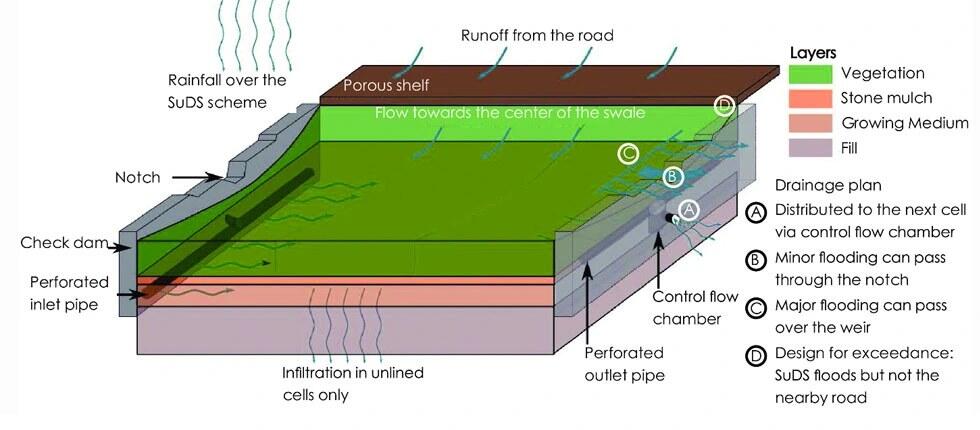
Green stormwater infrastructure is the vegetated branch of the family: rain gardens, bioswales, permeable surfaces, green roofs, and urban tree systems. These practices absorb the frequent small storms where they land, cutting both volume and pollution before pipes ever engage. They also cool streetscapes and earn credit in municipal stormwater fee programs, which is why planners reach for them first.
Green and gray are complements, not rivals. A green street absorbs the drizzle; a detention structure beneath it carries the cloudburst. Cities now routinely pair the two, using vegetation for water quality and buried storage for peak control. For the pollution-cleaning branch in depth, our stormwater pollution and treatment guide follows the contaminants themselves.
Design Documentation and Next Steps
Most of the products in this guide are specified through drawings, calculation sheets, and technical documentation rather than shelf purchases. A documentation set typically includes the product manual, load test references, and installation details. Request design documentation for any system shortlisted above — manufacturers issue current manuals and calculation packages on request. Normalize the comparison before deciding: load ratings, void ratios, and inspection intervals are documented differently by every maker. The runoff side of the story is covered in our stormwater runoff guide. The conveyance family gets its own walkthrough in stormwater drainage systems.
When the shortlist is set, send the storage volume, loading class, and ground conditions to YY Tank. We return a quotation within four hours and a full engineered layout within 24.
Frequently Asked Questions
What is the stormwater drainage system?
A stormwater drainage system is the conveyance half of stormwater management: inlets and catch basins collect runoff, pipes move it, and outfalls release it. It answers where the water goes, while storage and treatment systems answer how fast and how clean. Both halves appear in most municipal networks.
What is the importance of a drainage system?
A drainage system protects property, roads, and public health by moving stormwater before it floods. Without it, every storm ponds on streets and foundations, and the standing water becomes both damage and disease risk. Proper drainage also prevents erosion by keeping flow velocities within what channels can survive.
How to clean rainwater naturally?
Let biology and settling do the work. Vegetated buffers, rain gardens, and bioswales filter sediment and absorb nutrients as water passes through soil and roots. Avoid chemical use near the catchment, add a first-flush diverter to skip the dirtiest water, and let particles settle in storage before reuse.
What is a stormwater infiltration facility?
A stormwater infiltration facility returns runoff into the ground instead of piping it away. Dry wells, infiltration basins, and permeable pavements all hold water long enough for soil to absorb it. The practice recharges groundwater and shrinks downstream volume, but it depends on permeable soil and depth above the water table.
What is green stormwater infrastructure?
Green stormwater infrastructure is the plant-and-soil branch of stormwater practice: rain gardens, bioswales, permeable pavement, green roofs, and tree systems. These controls absorb frequent small storms where they land, filtering runoff naturally. Cities pair them with gray storage structures to handle the large design storms.