News


Large Underground Water Tanks: Sizes from 500 to 40,000 Gallons
24 Nov 2026Large Underground Water Tanks: Sizes from 500 to 40,000 Gallons
Large underground water tanks begin where the household barrel class ends. Past a few thousand gallons, most buyers have left the molded above-ground world and gone below grade. A 5,000 gallon underground water tank is usually where that shift starts. Underground storage wins this end of the market on one trade. The water volume disappears under a working surface instead of beside it. This page compares the five capacity classes buyers actually shop — 500, 1,000, 5,000, 10,000, and 40,000 gallons — and shows how structure, footprint, and pumping change with each step up.
Underground Water Tank Sizes Compared
The table is the decision. Footprint figures are planning derivations from the modular matrix storage density of 920 liters of net storage per cubic meter; final layouts come from the manufacturer.
| Capacity | ≈ Liters | ≈ m³ stored | Typical application | Matrix volume needed | Structure that fits |
|---|---|---|---|---|---|
| 500 gallon underground water tank | ≈1,890 | ≈1.9 | Small home garden, rain barrel upgrade | ≈2.1 m³ | Single molded cistern |
| 1,000 gallon underground water tank | ≈3,800 | ≈3.8 | Family home irrigation, toilet supply | ≈4.1 m³ | Molded cistern or small module array |
| 5,000 gallon underground water tank | ≈18,900 | ≈18.9 | Large home, small farm, landscape mains | ≈20.5 m³ | Modular crate array |
| 10,000 gallon underground water tank | ≈37,900 | ≈37.9 | Estate irrigation, light commercial reuse | ≈41.2 m³ | Modular crate array |
| 40,000 gallon water tank | ≈151,400 | ≈151.4 | Commercial campus, municipal reuse, fire reserve | ≈164.6 m³ | Multi-cell modular matrix |
Reading the table top to bottom: below roughly a thousand gallons, factory-molded cisterns are the practical answer, and the question is where to put them. From a few thousand gallons upward, the modular matrix takes over. A crate array builds to any footprint and any depth the site allows. A 5,000 gallon underground water tank needs about 20.5 cubic meters of matrix — a footprint on the order of 4 m × 4 m at typical array heights. That is why it fits under a lawn rather than beside the house.
The same logic runs at the bottom of the range. 500 gallon rainwater underground tanks work as barrel upgrades, but the class that satisfies a growing garden is usually the next row up.
Structure Types at This Scale
Two structures cover the whole range, and the boundary between them sits near a thousand gallons.
Molded cisterns are single-shell polyethylene or steel tanks, factory-molded at fixed sizes. They are the lowest-cost entry at the small end and install quickly. Their limits show at scale: fixed sizes, and a surface footprint that grows with volume.
Modular geocellular matrices are arrays of interlocking PP plates wrapped in a geomembrane. The array stores roughly 920 liters per cubic meter of excavation, carries verified vertical loads from >45 to >85 T/m², and builds to any footprint. Individual modules can be inspected and replaced without demolishing the structure, and arrays accept new sections later through standard pipe couplings.
Cast concrete holds a third position at the very top of the market. It suits very large, fixed civic volumes; the FAQ below weighs it against plastic in detail. For everything between a family home and a commercial campus, the modular matrix is the working default.
The crossover between the two main structures is worth stating as a rule of thumb. Below about a thousand gallons, ask what the cistern costs delivered and set. Above it, ask what the array costs excavated and backfilled. Get both answers before committing, because freight and excavation move in opposite directions as volume grows. The rule fails only on tight sites, where the footprint of a surface tank can disqualify it at any size.
5,000 vs 10,000 Gallons: How to Decide
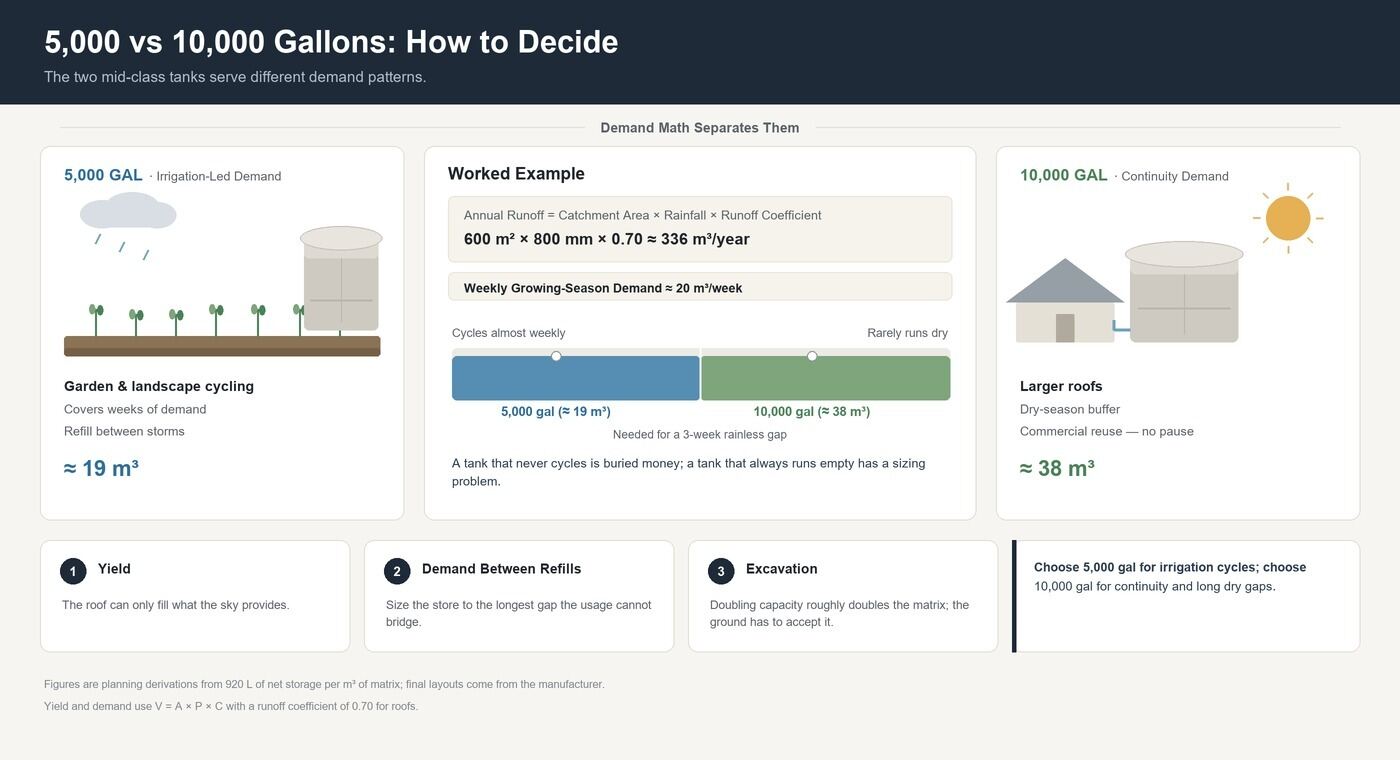
The two mid classes serve different masters, and the demand math separates them. A 5,000 gallon store suits irrigation-led demand. It covers weeks of garden and landscape cycling, refilling between storms. A 10,000 gallon store suits continuity demand — larger roofs, dry-season buffers, or commercial reuse lines that cannot pause while the sky refills.
A worked example shows the difference. Take an estate with a 600 m² roof at 800 mm of annual rainfall. The yield formula — catchment area × rainfall depth × runoff coefficient — puts annual runoff near 336 m³. If the landscape draws about 20 m³ a week in the growing season, a 5,000 gallon (≈19 m³) store cycles almost weekly. Stretch the dry season to three rainless weeks and the same estate wants the 10,000 gallon class. The tank that never cycles is money buried; the tank that always runs empty is a delivering system with a sizing problem.
Three checks finish the decision. First, yield: the roof can only fill what the sky provides. Second, demand between refills: size the store to the longest gap the usage cannot bridge. Third, excavation: doubling capacity roughly doubles the matrix, and the ground has to accept it.
Pump Pairing for Large Buried Tanks
Every tank below the lawn is a below-grade water source, and below-grade sources need a lift. Small systems use a surface suction pump. Larger systems use a submersible in the tank or a pressure set beside it. Pump hardware runs $80–$700 depending on head and flow. A 1,000 gallon underground water tank with pump is the classic residential package — the household pairing is detailed on the underground water tank for home page. Above the residential class, pump sizing follows delivery demand: irrigation zones, pressure targets, and duty cycles. A commercial reuse line adds controls — level sensors, mains switchover, and backflow protection — so the pump set is specified as a system, not an appliance.
The residential and commercial duties split along one line: who consumes the water. A residential tank serves irrigation and flushing, and its pump works in seasons. A commercial tank serves metered demand — vehicle washing, cooling make-up, process lines — and runs on schedule whether it rains or not. Same hardware family, different duty cycle, and the pump set is where that difference becomes concrete.
The cistern tradition sits at this scale too. A 5,000 or 10,000 gallon buried store is the modern form of the cistern. The hardware, materials, and drinking-water considerations behind that category are compared on the underground rainwater storage page. For households that stay small, the rainwater harvesting tank product line covers the above-ground end of the range.
Footprint, Burial Depth, and Ground Conditions
Three site facts shape any large buried tank, whatever its size.
Cover depth. Rated modular systems take typical cover to 3.5 m, and deep-burial variants go to 8 m. Deeper cover means traffic loads above stay welcome.
Load class. Verified vertical ratings run >45, >70, and >85 T/m² by model. The surface use — lawn, parking, or heavy vehicles — selects the rating, and the rating selects the model.
Groundwater. A high water table brings hydrostatic uplift. Anti-flotation measures (a concrete base slab or geogrid anchoring) are designed from the survey, never guessed. The geotechnical report comes before the tank order, in that order.
Across those constraints, modular PP keeps two quiet advantages: plates at roughly 6.7 kg assemble by hand, and phased builds connect to the existing array later. The full family context sits on the underground water storage tank pillar page, and the engineering behind the ratings is on the geocellular crates specification page.
Ordering and Shipping a Large Tank System
Logistics behave differently at this scale, and they favor the buyer more than most expect. Modular plates ship nested, which is the whole trick. A single 40' HQ container carries over 5,000 of the 1200-EW units, and container loading density runs 60–100% above conventional modules. Freight per stored cubic meter falls accordingly. Factory-direct supply from a source manufacturer removes the distribution margin from the middle of the transaction. YY Tank runs up to 150,000 m³ of annual module capacity. Assembly needs no crane and no cure time, which is why the tank schedule rarely drives the project.
Buried storage also holds one quality edge worth a line in the specification: water below grade keeps a stable temperature, around 12–15°C, in the dark. That stability suppresses the algae that above-ground tanks fight all summer. For reuse duty it means cleaner water at the tap with less treatment downstream.
Common Sizing Mistakes
Four mistakes repeat at this scale, and all four are cheap to avoid on paper. Sizing to maximum yield rather than real demand, which buries money in a tank that never cycles. Ignoring the demand between refills, so the system fails on the longest dry stretch rather than the average week. Ordering before the geotechnical survey, then paying for redesign when the water table argues. And mixing components across suppliers, so no warranty covers the whole train. The quotation process exists to catch all four — that is what the three inputs are for.
Approvals close the list. Most jurisdictions treat a buried reuse tank as a plumbing-and-structure question, so the permit conversation usually involves the building department and sometimes the water authority. Where a mains top-up backs up the tank, that backflow arrangement needs the utility's sign-off too. Bring the sizing sheet, the site plan, and the manufacturer's drawings to the first conversation. An approval that starts with documents tends to end without surprises.
Cost at these volumes is project-configured from three inputs: storage volume, loading class, and ground conditions. It belongs in a quotation, not a table. Send those three to YY Tank for an engineered layout within 24 hours.
Frequently Asked Questions
Are concrete water tanks better than plastic?
Each wins a different job. Cast concrete suits very large, fixed municipal volumes and lasts decades in the ground. It is heavy, slow to build, and roughly 70–80% of its volume stores water once walls are counted. Modular plastic (polypropylene) reaches 92–95% verified void, installs in a fraction of the time with hand-carried plates, and scales in any direction the site allows. For most private and commercial projects below municipal scale, the plastic modular matrix is the practical answer. For fixed civic reservoirs, concrete keeps its case.
What is the average size of a rainwater tank?
Household rainwater tanks commonly land between a few hundred and a few thousand gallons, with garden-irrigation systems clustering in the hundreds. The tanks on this page sit above that average by design. Large underground tanks start where surface space or demand has outgrown the household class. Above-ground averages belong to the standard home tier; underground sizing follows the demand calculation instead.
What is the formula for tank size?
Tank sizing starts from yield: volume = catchment area × rainfall depth × runoff coefficient (V = A × P × C). A 400 m² roof at 800 mm of annual rainfall sheds about 272 m³ per year. The tank does not store the whole year. It stores the demand between refills, so realistic usage, catchment yield, and a safety margin set the final figure together.