News


Rainwater Harvesting Systems: Components & Sizing | YY Tank
03 Nov 2026Rainwater Harvesting Systems: Components, Types, and Sizing
A rainwater harvesting system captures rain where it lands, stores it, and hands it back for reuse. The roof stops being a runoff source and becomes a water supply you control. Every configuration performs the same four jobs: collect, convey, store, and deliver water where it is needed. This page is the hub for the whole topic. It maps the components, the types, the sizing math, and the costs, then links all seventeen sub-topics in depth.
What Is a Rainwater Harvesting System?

Rainwater harvesting is the practice of catching precipitation and keeping it for later use instead of letting it drain away. A complete rainwater harvesting system adds engineered hardware to that idea.
The hardware gathers runoff from roofs and paved surfaces. It separates leaves and sediment before the runoff enters the storage reservoir. It holds the water in a cistern or a buried modular matrix, then pressurizes it for irrigation, flushing, or washdown.
The scale runs from tiny to very large. A single rain barrel on a downspout is a working system. A geocellular matrix the size of a commercial parking lot is one too. Rain harvesting systems of every size share the same logic, which is why the parts below look familiar at any scale.
Core Components of a Rainwater Harvesting System
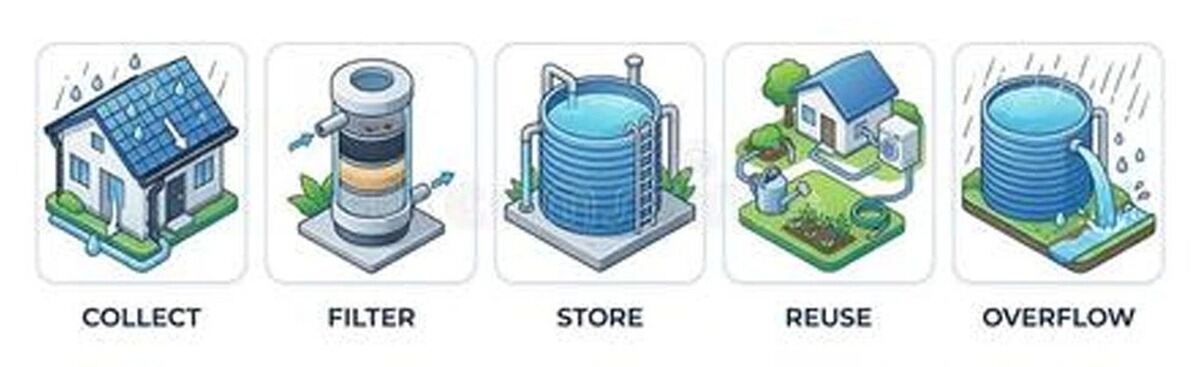
Five component groups appear in almost every design. Each one protects either the water quality or the quantity downstream of it.
• Catchment surface — the roof, or a paved yard that sheds water. The catchment area sets the ceiling on supply, so engineers measure it first.
• Conveyance — gutters, downpipes, and closed pipe runs that move water toward storage. Sizing them for peak flow prevents overflow at the tank inlet.
• Pre-filtration — leaf screens and first-flush diverters. They strip debris and discard the dirtiest first minutes of every storm.
• Storage — a cistern, a one-piece tank, or a sealed geocellular matrix. Sealed polypropylene matrices net 920 liters of storage per cubic meter of structure.
• Distribution — a pump, piping, and taps or irrigation manifolds. Pressure and flow at this stage decide what the water can actually do.
Skip the pre-filtration and stored water degrades quickly. Size the storage wrong and the rest of the system cannot compensate. Every component gets a deeper treatment in the navigation section below. For a quick orientation in one article, start with our component-by-component rainwater harvesting system components guide.
Types of Rainwater Harvesting Systems
Most rainwater harvesting projects choose between two storage positions: above ground or below it. The table compares them at a glance.
| Type | Storage form | Best for | Watch-outs |
|---|---|---|---|
| Above-ground | Rain barrels, slimline tanks, upright cisterns | Gardens, quick installs, low budgets | Freezing climates, visible footprint, limited volume |
| Underground | Buried cisterns or modular matrices | Whole-house supply, commercial sites, tight lots | Excavation cost, needs a pump, harder to inspect |
Above-ground systems win on cost and simplicity. You can see, clean, and swap them without excavation. For a garden rainwater harvesting system, a barrel bank beside the downspout is often all a household needs.
Underground systems win on capacity and land value. The matrix disappears beneath lawn or parking, and the surface stays in active use. Buried in stable soil, the water holds a steady 12–15 °C, which suppresses algae between uses.
Structural rating matters as much as volume underground. Modular polypropylene systems carry verified vertical load ratings above 45 to above 85 tonnes per square meter, so vehicular traffic can park on the surface above. Standard modules handle typical cover of about 3.5 meters in engineered installations.
Domestic rainwater harvesting at whole-house scale almost always ends up buried. For the surface option, see our above ground rainwater tanks page. For the storage hardware itself, see the rainwater harvesting tank product page.
A note on terms: in the UK, a soakaway is a crate-filled pit that lets water seep into the soil rather than storing it. Modular geocellular crates serve both duties — sealed with an impermeable geomembrane they store, left open-based they soak away. See geocellular crates for the structure behind both.
Rainwater Harvesting Systems by Scenario
The right configuration follows the demand, not the brochure. Start from what the water must do, then work backward to storage.
| Scenario | Typical configuration | Storage logic |
|---|---|---|
| Garden irrigation | Barrel or small above-ground tank on one downspout | Bridges the dry days between rains |
| Whole-home reuse | Buried cistern or matrix + pump + filtration | Covers toilet flushing, laundry, and irrigation |
| Commercial developments | Large modular matrix under parking, sized by roof area | The best rainwater harvesting solutions for commercial developments pair reuse storage with stormwater attenuation in one footprint |
| Farm and landscape | Large-capacity tanks or matrices at the low corner | Sized to bridge the longest dry period |
For installation, most owners begin by searching rainwater harvesting installation near me. The practical path combines a licensed local installer for excavation and plumbing with an engineered tank shipped to the site. The tank arrives first; the digging stays local.
A commercial rainwater harvesting project adds one more step. An engineer sizes the matrix against local rainfall records and the permit's release limits before anything is ordered. That step is what separates a supply asset from a flooded parking lot.
Explore the Rainwater Harvesting System in Depth
Seventeen sub-topics branch off this hub. Each guide below goes one level deeper, so start where your project is stuck.
What Is Rainwater Harvesting?
The plain-English definition, the step-by-step process, and how harvesting differs from stormwater management. Read the what is rainwater harvesting explainer.
Catchment Area and Yield Math
Your roof area times your rainfall equals your supply. The catchment area calculator walks through the formula and the unit conversions.
Is It Legal to Collect Rainwater?
No state fully bans residential collection, but a few regulate it. The state rules guide sorts out where.
Residential and Commercial Collection Systems
Sizing bands and configurations for homes, multi-unit buildings, and commercial sites. See the rainwater collection systems guide.
Rainwater Drainage
Collection is half the job; drainage moves what you do not store. The rainwater drainage system guide covers the release side.
Garden and Irrigation Setups
Barrels, drip lines, and gravity feed for beds and lawns. The garden rainwater collection page keeps it simple.
Filtration and Water Quality
Leaf screens, first-flush diverters, and cartridge filters keep stored water fit for its job. Details live on the rainwater filtration system page.
Reuse and Recycling
From laundry-to-landscape loops to process water, stored rain has a second life. The rainwater reuse and recycling guide maps it.
Harvesting Methods Compared
Rooftop, ground catchment, and traditional methods in one place. The rainwater harvesting methods overview compares them.
Kits and Starter Setups
A boxed kit covers the basics but not engineered volumes. The rainwater harvesting kits page explains the limit.
System Costs in Detail
Full cost stacks with retail anchors, line by line. The rainwater harvesting system cost guide has them.
Designing a System
Layouts, diagrams, and a sizing workflow for designers. The rainwater harvesting system design guide walks it.
The Benefits, Tallied
Water bills, drought buffer, and stormwater credits. The benefits of rainwater harvesting page adds them up.
Water Recuperation Systems
A near-synonym with its own niche. The water recuperation system page explains the difference.
Catchment Systems for Larger Roofs
When the roof itself is the product, integration matters. The rainwater catchment system page covers gutter-to-storage layouts.
The Storage Tank Itself
Sizes, materials, and fittings for the tank position. Start at the rainwater harvesting tank product page.
Above-Ground Options
Barrels and slimline tanks compared for surface duty. The above ground rainwater tanks page has the range.
How Much Does a Rainwater Harvesting System Cost?
Published retail anchors from our 2026 cost survey set the floor and the ceiling. All figures are installed, US-market dollars.
• Rain barrel setups: $300–$1,200 installed.
• Cistern and tank systems: $2,500–$15,000.
• Complete retail packages: $8,160–$21,500.
Above those bands sit engineered systems, quoted per project. Storage volume, loading class, and ground conditions drive that number — catalogue stickers do not. Budget a pump at $80–$700, and small-system filtration hardware at another $300–$500.
The offset side is quantifiable as well. Harvested water offsets mains supply at up to $4.60 per kiloliter in published utility values. One documented academic case reached roughly a ten-year payback on a $22,386 investment. The full cost stack, line by line, is in the rainwater harvesting system cost guide.
The Sizing Math in One Line
Annual harvestable supply equals catchment area times rainfall times runoff coefficient — the formula V = A × P × C. A 400 m² roof in an 800 mm rainfall zone yields about 272 m³ across a year. Even a fraction of that volume carries a household through an irrigation season. The coefficient compensates for surface losses: metal roofing sits near 0.90, while gravel absorbs roughly half of what lands on it.
Run your own roof through the catchment area calculator, then check the tank side against our tank sizing guide. When the layout needs an engineer's sign-off, send the roof area, demand profile, and location rainfall to YY Tank. We return an engineered layout within 24 hours.
Frequently Asked Questions
How much does a rainwater harvesting system cost? Rain barrel setups run $300–$1,200 installed. Cistern and tank systems run $2,500–$15,000, and complete retail packages list at $8,160–$21,500. Engineered modular systems are quoted per project from three inputs: storage volume, loading class, and ground conditions.
What is rainwater harvesting? Rainwater harvesting is the capture of rain from roofs and surfaces, its conveyance through gutters and pipes, and its storage for later reuse. Filtration keeps the stored water fit for irrigation, toilet flushing, washdown, or process use. The practice turns rainfall from a drainage problem into a supply.
How do I gather rainwater? Start at a downspout that drains a clean roof. Add a leaf screen and a first-flush diverter so debris and the dirtiest water stay out of storage. Route the flow into a sealed tank, then draw from it with a tap or a small pump. Capture, screen, store, deliver — that four-part chain is the whole skill.
What size rainwater tank do I need? Size follows the supply formula: roof area in square meters × annual rainfall in meters × runoff coefficient. A 400 m² roof in an 800 mm zone yields about 272 m³ a year, so a small fraction covers a household's irrigation. Match the tank to demand during the longest dry stretch, then confirm the figure against a sizing guide.
In what states is it legal to collect rainwater? It is legal in every US state; none fully bans residential collection. A few states regulate it — Colorado, for example, allows residential rooftop collection into two rain barrels totaling 110 gallons under its 2016 law (HB-16-1005). Rules do change, so confirm against the current state-by-state guide before you build.