News


Underground Cistern Tanks: Sizes & Water Systems
24 Nov 2026Underground Cistern Tanks: Sizes & Water Systems
An underground cistern tank is a sealed container buried below grade to store water — rainwater, well water, or delivered water — for later use. The cistern is the oldest storage idea in the book: dig, seal, cover, draw down. What has changed is the hardware. Where farmers once lined a pit with brick and plaster, today's hardware is different. A cistern water tank is now a molded polyethylene shell, a poured concrete vault, or an engineered module array. This page compares the sizes and materials, explains what drinking-water use demands, and covers the cleaning that keeps any of them safe. The full underground storage family it belongs to is mapped on the underground water storage tank pillar page.
Cistern Sizes: Household to Commercial
Cistern sizing scales with demand, and the demand line is easy to draw.
| Class | Typical size range | Serves | Notes |
|---|---|---|---|
| Compact household | 200–500 gallons | Garden taps, emergency reserve | Light excavation; sometimes surface-retrofitted |
| Standard home | 500–3,000 gallons | Irrigation, toilet supply, laundry | The common residential buried class |
| Large property / farm | 3,000–10,000 gallons | Landscape mains, livestock, outbuildings | Usually modular arrays |
| Commercial | 10,000 gallons and up | Campus reuse, process water, fire reserve | Engineered matrix systems |
Two sizing habits prevent most regret. Size to the demand between refills, not to the biggest number the budget allows — a tank that never cycles is just buried money. And check what the refill side can actually deliver. A cistern fed by a small roof or a slow well cannot support the size the spreadsheet wants. The full capacity table across the underground family, from 500 to 40,000 gallons, lives on the large underground water tanks page.
A worked example makes the rule usable. A family that irrigates three times a week through a dry season, washing cars on weekends, will cycle a 500-gallon tank in days. The same household bridging a two-week well-recovery gap wants the standard home class. Write the demand on paper first; the gallons follow.
Households on cistern water add one line the city forgets: the well or delivery contract is part of the storage design. A cistern that refills slowly is sized like a battery between charges, and the charge interval is a supply fact, not a preference. Rural suppliers can state the delivery cadence; wells have recovery rates; roofs have yield. All three belong on the same page of the sizing note.
Concrete vs Plastic Cistern Tanks
The material decision comes down to three honest comparisons.
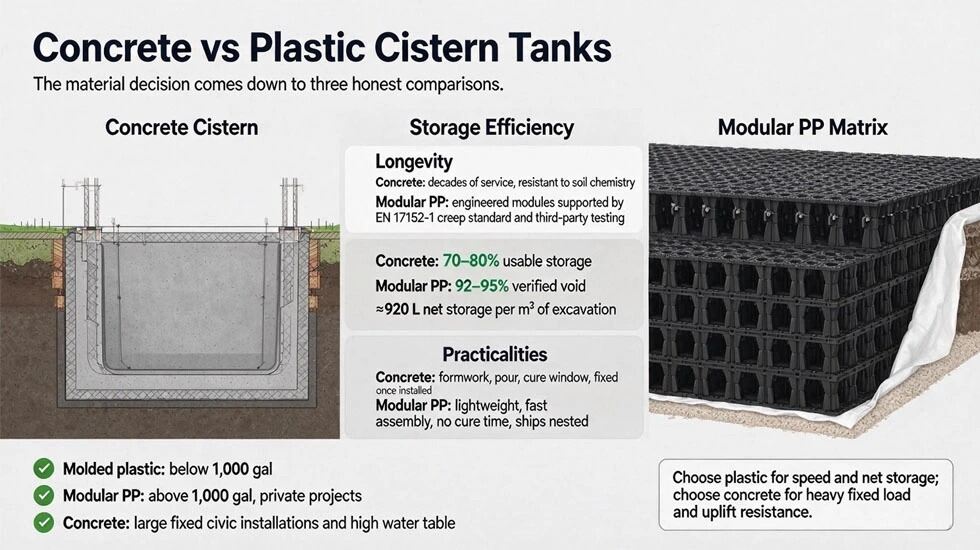
Longevity. Poured concrete lasts decades and shrugs at soil chemistry. Molded polyethylene carries a service life measured in decades as well, and engineered PP modules extrapolate to 50-year performance on the EN 17152-1 creep standard — with third-party creep testing behind the rating.
Storage efficiency. Concrete walls eat volume. A concrete cistern delivers roughly 70–80% of its footprint as usable storage. A modular PP matrix reaches 92–95% verified void — about 920 liters of net storage per cubic meter of excavation.
Practicalities. Plastic weighs a fraction of concrete, installs without curing time, and ships nested. Concrete needs formwork, a pour, and a cure window, and it does not move once poured. In return, concrete takes point loads without a load-rating conversation and suits sites that pour everything else in concrete anyway.
The working answer for most private projects is the plastic route — molded below a thousand gallons, modular above it. Concrete keeps its case in two places: the very large, fixed, civic end of the scale. And sites with a high water table, where its mass fights uplift for free.
Drinking Water from a Cistern: What It Takes
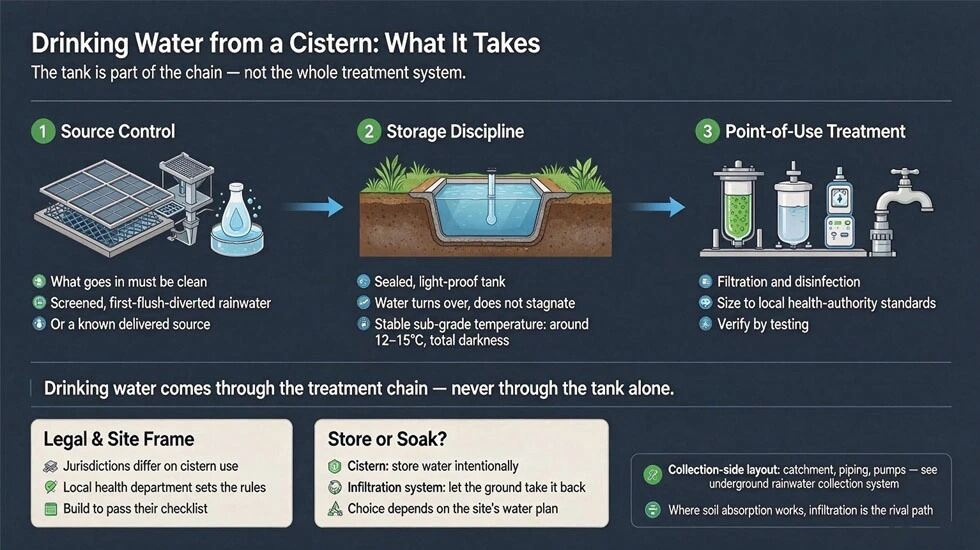
Drinking water cistern systems exist, and they are ordinary equipment in rural supply. But the water only becomes drinking water through a treatment chain — never through the tank alone. The chain has three stations. First, source control: what goes in must be clean, which means screened, first-flush-diverted rainwater or a known delivered source. Second, storage discipline: a sealed, light-proof tank whose water turns over rather than stagnates. Third, point-of-use treatment: filtration and disinfection sized to local health-authority standards, verified by testing.
The legal frame matters as much as the hardware. Jurisdictions differ on what a cistern may supply, and the local health department owns that answer. Build the system to pass their checklist, not the other way around. Underground storage helps the middle station quietly. Water held at stable sub-grade temperatures, around 12–15°C, and in total darkness does not grow the algae that sunlit tanks fight.
One boundary line finishes the picture. A cistern stores water on purpose; the alternative duty is letting the ground take it back. The collection-side layout around a buried cistern — catchment, piping, pumps — is covered on the underground rainwater collection system page. And where the soil can absorb the water instead of storing it, an infiltration system is the rival path. Store or soak: the site's water plan picks.
Cleaning and Keeping It Clean
An underground cistern is cleaned on a schedule, not on a crisis. The routine has four moves. Inspect the inlet screening and first-flush diverter each season. Keep the seal closed and the vents screened so light and debris stay out. Empty and wash the interior on the interval the local guidance sets, using food-safe practice end to end. And test the water whenever the use demands it — testing is the only measurement that counts. The full tank-cleaning walkthrough lives in the FAQ below.
Frequently Asked Questions
How long do underground cistern tanks last?
A well-made buried cistern is a decades purchase. Molded polyethylene tanks routinely serve for decades underground, away from the UV that ages plastics. Engineered modular PP systems carry a 50-year service life on the EN 17152-1 creep standard. The evidence is a 50-year creep test at 25% of failure load with zero collapse, backed by a 10-year limited warranty. Concrete lasts longer still in most soils — the honest comparison is service life against storage efficiency and build speed, not against a finish line.
What size cistern do I need for a home?
Size from demand, then check it against supply. Most households living partly on cistern water land in the 500–3,000 gallon class; a garden-only backup sits lower, and a whole-property supply sits higher. The demand between refills sets the target — daily use times the longest interval you want to bridge. Then confirm the refill side: roof catchment yield or well recovery has to keep up, or the size on paper is fiction.
Can cistern water be used for drinking?
Yes — through a treatment chain, not straight from the tank. Clean source control, a sealed and dark storage, and point-of-use filtration plus disinfection form the minimum. Local health-authority standards own the specifics, and testing verifies the result. The tank's job in that chain is to keep the water clean between source and tap. Sealed against light and debris, and cool enough to discourage growth — underground storage holds a stable 12–15°C.
How to clean water tank?
Empty the tank, then wash the interior walls and floor by brush or pressure washer. Rinse until the rinse water runs clean. Disinfect by an approved method before refilling, following the dosing your local health authority publishes rather than a generic recipe. Keep the inlet screen and first-flush diverter serviced while the tank is down, and let it refill fully before returning it to service. The cleaning interval follows your local guidance and how clean the incoming water is.
Compare cistern materials with your volume and ground on file — contact YY Tank for a modular layout.