News


Stormwater Pollution & Treatment: How Runoff Is Cleaned
25 Nov 2026Stormwater Pollution & Treatment: How Runoff Is Cleaned
Stormwater pollution is the load rain collects on its way across a city. Sediment, oil, metals, nutrients, and bacteria — all of it lifted from every roof, road, and lot the water crosses. The water moves fast, the pollutants ride along, and both arrive at the nearest stream untreated. Stormwater treatment is the practice of intercepting that runoff and removing the load before it discharges. This page covers what is in the water, why the problem is hard, and the treatment systems that clean it.
What Is in Stormwater Pollution?
The pollutant list is short, and each entry has its own source and its own fix.
| Pollutant | Where it comes from | Why it matters |
|---|---|---|
| Sediment | Construction sites, bare soil, winter sanding | Smothers stream beds; carries other pollutants stuck to particles |
| Nutrients (N, P) | Fertilizers, pet waste, organic litter | Drive algal blooms and low-oxygen dead zones |
| Metals (Cu, Zn, Pb) | Brake wear, roofing, galvanized metal | Toxic to aquatic life; accumulate in sediment |
| Oil and hydrocarbons | Leaking vehicles, parking lots | Sheen and toxicity; float or cling to particles |
| Bacteria | Pet and wildlife waste | Close beaches; touch drinking-water sources |
| Litter and microplastics | Packaging, tire and plastic wear | Visible harm; enter the food chain |
The table reads as a site-survey tool as much as a chemistry list. Walk any lot in the rain and the sources show themselves: the sand pile feeding sediment, the lawn feeding nutrients, the dripping car feeding hydrocarbons. Sources visible on foot are sources a treatment train can plan for.
Two facts make this list manageable rather than hopeless. First, the load is concentrated. The first flush of a storm carries a disproportionate share of the pollution, so treating the early runoff captures most of the problem. Second, each pollutant has a matching hardware answer — which is what the treatment train is built from.
Why Runoff Pollution Is Hard to Catch
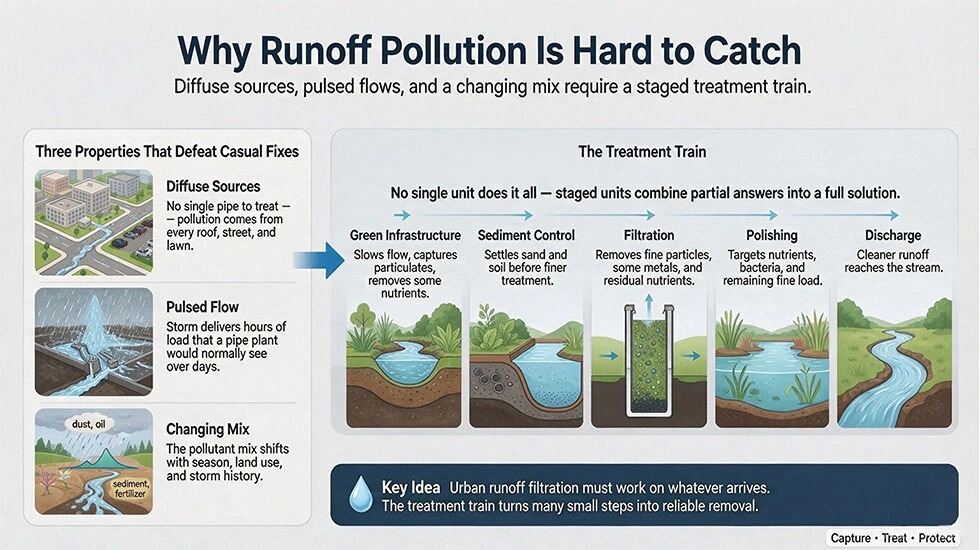
Three properties of stormwater runoff pollution defeat casual fixes. The sources are diffuse — every roof, street, and lawn contributes, so there is no single pipe to treat. The flow is pulsed — a storm delivers in hours what a pipe plant sees over days, and the peak overwhelms equipment sized for averages. And the mix changes — a summer storm scrubs dust and oil; a spring storm carries sediment and fertilizer. Urban runoff filtration has to work on whatever arrives.
The consequence is that treatment happens in stages rather than in one heroic device. No single unit removes sediment, nutrients, metals, oil, and bacteria at once. The treatment train assembles partial answers into a full one.
The Stormwater Treatment Train
Stormwater treatment systems are best read as a relay: each stage hands cleaner water to the next.
| Stage | Hardware | Removes |
|---|---|---|
| 1. Pre-treatment | Hydrodynamic separators, sump chambers, leaf screens | Grit, litter, floating oil |
| 2. Media filtration | Cartridge-media filter units (the technology family behind products like the Jellyfish filter) | Fine particles, attached metals and nutrients |
| 3. Biofiltration | Bioretention cells, planted swales, treatment wetlands | Nutrients, bacteria, residual metals |
| 4. Infiltration | Permeable pavement, infiltration systems | The remaining load, returned to the soil |
| 5. Storage | Detention and retention tanks, modular matrices | Flow control downstream of the cleaning |
Stage 2 needs a note. Cartridge-media filtration is an established product family with several brand-name suppliers. The Jellyfish filter is one well-known example of the type — a kerb-side unit where runoff passes upward through small filter cartridges. This page names the family, not the product. Which cartridge media, pretreatment capacity, and maintenance interval a site needs comes from the permit, not from a catalogue. Cost belongs to the same conversation — cartridge units are configured per site, so pricing is a quotation line, not a number to quote blind.
Stage 3 is biology doing the heavy lifting. In bioretention and planted wetland cells, vegetation and microbial communities take up nutrients while the media strain the rest. The modular-wetland version of this stage — treatment as prefabricated equipment — is detailed on the modular wetland system page, and this page stays at the train level.
Running costs follow the stages. Pre-treatment units get cleaned on schedule, and the vacuum-truck visit is the line item owners remember. Media cartridges get replaced on a cycle the supplier states. Planted cells need landscape-level care — weeding, mulch, and occasional media topping. None of it is exotic. All of it is budgeted, or it silently stops happening — and an unmaintained train is a concrete pipe with good intentions.
Matching Treatment to Site and Permit
Selection starts from the permit, because the permit names the pollutants that matter on your discharge.
A construction site owes sediment control first. A parking project owes oil and metals. A redevelopment in a nutrient-sensitive watershed owes the biological stage. The water quality storm — the storm size the treatment must handle — sizes every stage in the train.
From there the design questions run downstream in order. What does the pre-treatment see? What media match the target pollutants? Where does the treated flow go — to infiltration, to storage, or to the outfall? Sites that answer those three questions early pass review faster, because reviewers check a train the same way: inlet, treatment, outlet. The wider management frame around that review — and the full vocabulary of the discipline — sits on the what is stormwater management hub, and the solutions-level view of whole systems is on the stormwater management solutions page.
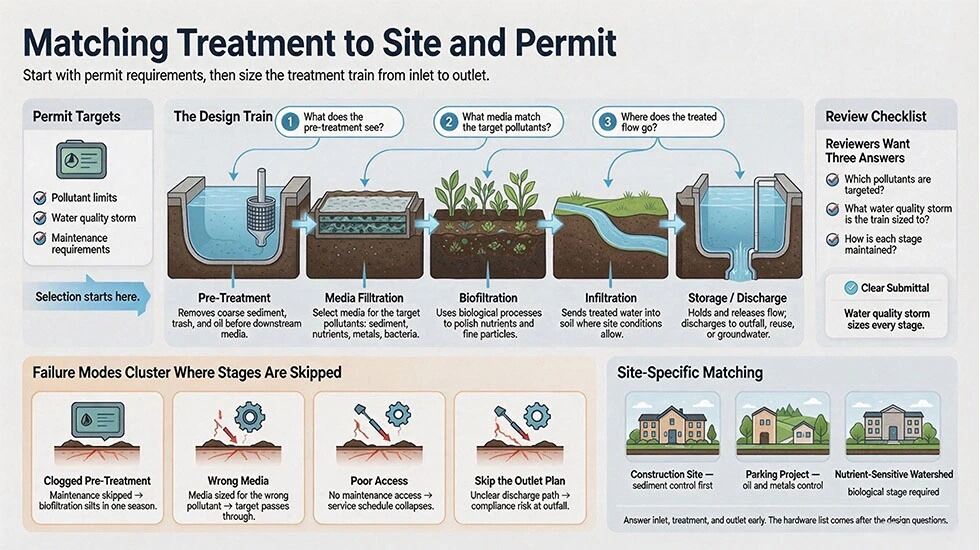
The permit conversation rewards preparation. Reviewers typically want three things on the treatment side. Which pollutants does the design target, what water quality storm is the train sized to, and how is each stage maintained? A submittal that answers those three in order reads like a review checklist and clears faster. A submittal that answers with product brochures reads like a delay.
Failure modes close the topic, and they cluster at the stages people skip. Pre-treatment that never gets cleaned stops protecting the media, and the biofiltration stage silts a season later. Media sized to the wrong pollutant passes its target straight through — a compliance failure with a clean-looking unit. And trains built without maintenance access bury their own service schedule. Every one of those failures is a design-stage decision, which is why the selection questions come before the hardware list.
The runoff itself — how it forms and why paved land makes more of it — is the starting concept, covered on the stormwater runoff page. Hardware-wise, stages 4 and 5 are modular by nature: an infiltration system handles the soil side, and geocellular crates build the storage stage in any footprint the site has left. Send the permit's numbers to YY Tank and the storage stage comes back as a layout within 24 hours.
Frequently Asked Questions
Why is stormwater pollution a problem?
Because the discharge point is usually the nearest stream, and the load is delivered all at once. Runoff crosses pavement, collects sediment, oil, metals, nutrients, and bacteria, and arrives untreated at waters people swim in, fish in, and drink from downstream. The pulse matters as much as the pollutants. A storm delivers the load in hours, which is why streams spike after rain and recover between storms.
What are the main pollutants in stormwater runoff?
Six carry most of the load. Sediment, nutrients (nitrogen and phosphorus), metals from brake and roof wear, oil and hydrocarbons, bacteria from waste, and litter including microplastics. Each has a known source in the urban landscape and a matching treatment stage. The first flush of any storm concentrates them, which is why treatment targets the early runoff hardest.
How is stormwater treated before discharge?
In stages, in order. Pre-treatment drops the grit and litter. Media filtration takes fine particles and what clings to them. Biofiltration — planted cells and wetlands — strips nutrients and bacteria. Infiltration returns what remains to the soil, and storage meters what leaves. A site rarely needs every stage; the permit names the pollutants that set the train's length.