




Rainwater Recovery System — How to Maximise Water Reuse Efficiency
18 Aug 2026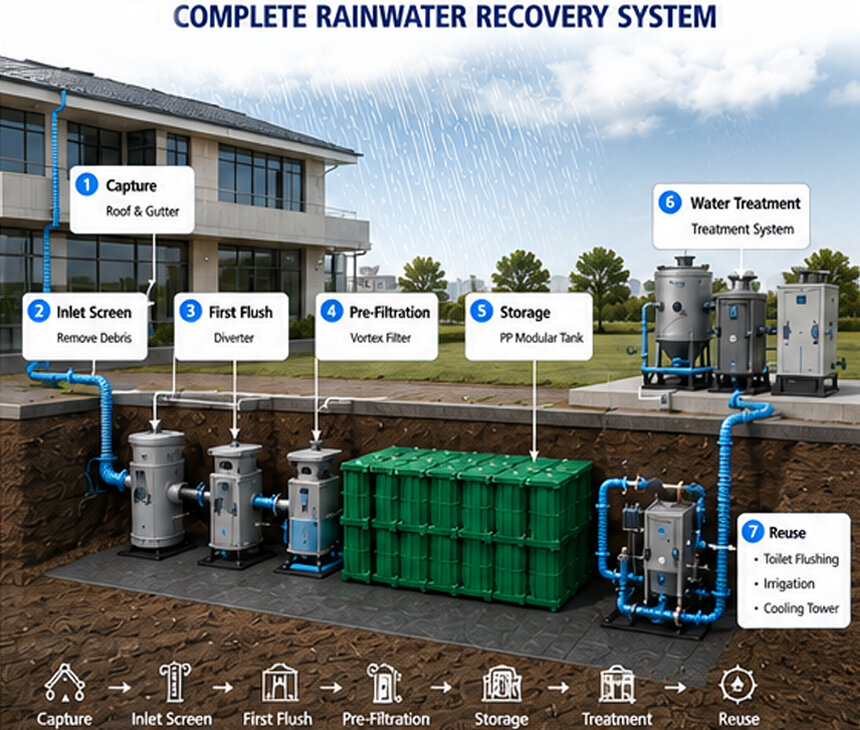
What a Rainwater Recovery System Actually Is
A rainwater recovery system is the complete loop from capture through filtration, storage, treatment, reuse, and monitoring. It is not the same as a collection system. Collection refers to getting water off a roof and into a tank. Recovery goes further — it measures how much of the rainfall that hits your site actually reaches a productive end use. The metric that matters is recovery efficiency: the ratio of water reused to water captured.
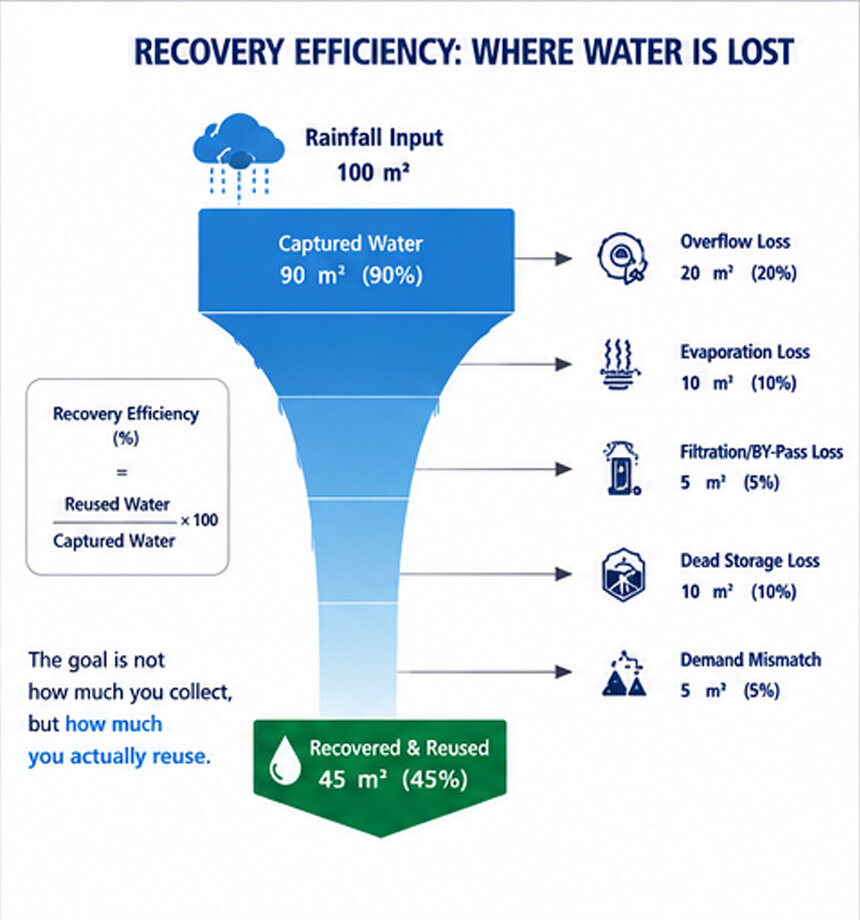
This distinction matters because losses accumulate at every stage. Overflow during intense storms, evaporation from exposed surfaces, bypass at undersized filters, dead volume in poorly configured tanks, and demand mismatches between supply and usage all erode the percentage of rainfall you actually put to work. A system that collects 100 m³ but only reuses 45 m³ has a recovery rate of 45% — the other 55 m³ was captured at cost and then wasted.
The global rainwater harvesting market reached 951 million in 2024 and is growing at a 6–7% CAGR. The broader stormwater retention market, which includes infiltration and detention for regulatory compliance, was valued at 891 million and is driven by urbanisation and the increasing frequency of extreme weather events. Commercial buildings that install rainwater recovery systems typically save 20–50% on water utility costs . For B2B buyers and project engineers, the question is no longer whether to install a system — it is how to design one that recovers as much water as possible.
How to Maximise Recovery Rate
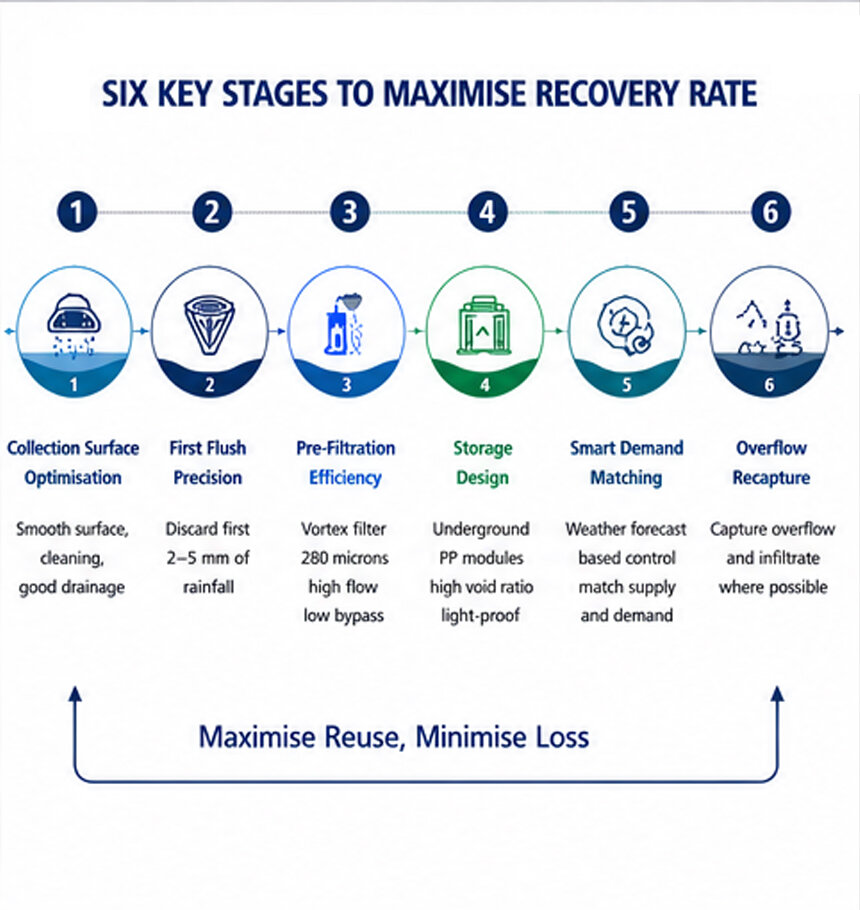
Recovery rate is determined by decisions made at six points in the system. Each stage introduces potential losses, and each can be optimised independently.
Collection Surface Optimisation
The collection surface is where losses begin. A smooth metal or membrane rooftop typically achieves 85–90% capture efficiency — meaning 85–90% of the rainfall that lands on the surface enters the conveyance system. Rough concrete or aged tile surfaces drop to 50–70% because water pools in surface irregularities and evaporates before it flows to the gutter.
Regular cleaning of collection surfaces adds 5–10 percentage points of capture efficiency. In industrial environments where airborne particulates accumulate rapidly, quarterly cleaning schedules are the minimum to maintain performance. Leaf screens and gutter guards prevent debris blockage that would otherwise redirect flow away from the downpipe.
First-Flush Precision
The first few millimetres of rainfall wash contaminants — bird droppings, pollen, atmospheric dust, roofing material residues — off the collection surface. Discarding this first flush is necessary for water quality, but over-discarding wastes usable water. The engineering target is to divert exactly the first 2–5 mm of rainfall, not more .
Automated vortex-type first-flush diverters achieve this without moving parts or electrical power. They use a calibrated standpipe that fills with the initial flow; once the standpipe is full, a vortex action redirects subsequent clean rainfall into the main conveyance. The standpipe volume is sized to the collection area to match the 2–5 mm target. Manual ball-valve diverters are cheaper but less consistent — they depend on someone resetting the valve between rain events.
Pre-Filtration Efficiency
After the first-flush diverter, water passes through a pre-filter before entering storage. Vortex-type filters rated at 280 microns retain approximately 95% of suspended particulates while passing 98% of the water volume to the tank. The 2% loss is inherent to the filtration process and is acceptable.
Problems arise when filters are undersized for the catchment area. An undersized filter reaches capacity mid-storm and triggers a bypass, sending unfiltered water — and any water that follows — directly to overflow. In practice, a bypass event during a moderate storm can waste 10–15% of the total flow from that event. Specifying the filter to handle the design flow rate (typically the 1-in-5-year storm intensity for the catchment area) prevents this loss.
Storage Design
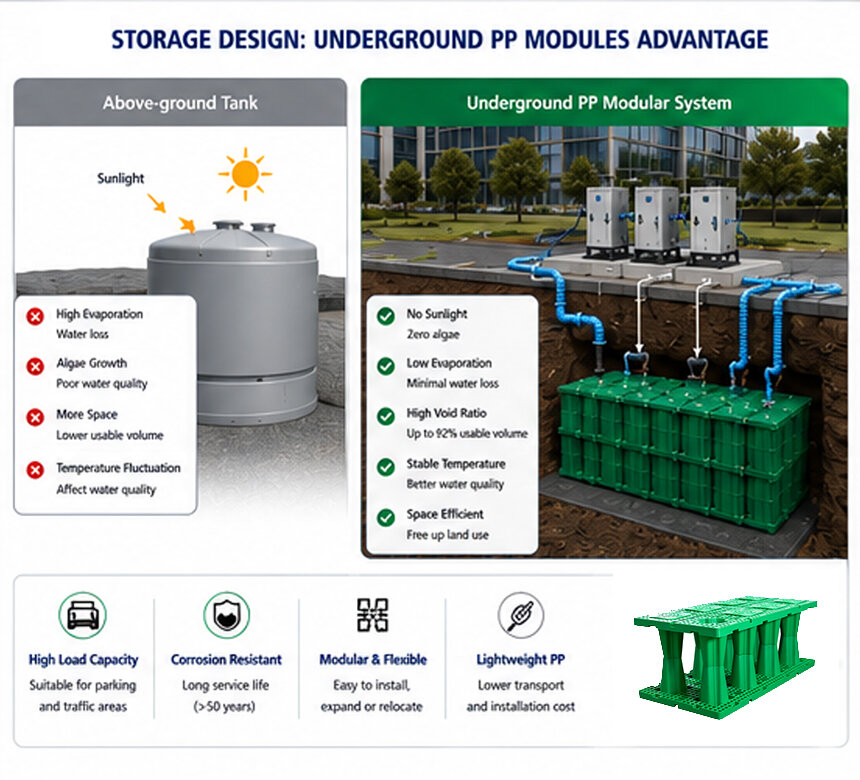
Storage is where underground PP modules have a structural advantage over above-ground tanks. Three factors work in their favour:
• Void ratio. Modular PP storage blocks achieve a 92% void ratio, meaning 92% of the installed volume is available for water. A concrete tank with 300 mm walls and internal baffles may offer only 70–75% usable volume for the same external footprint .
• Light exclusion. Underground, light-proof PP modules eliminate algae growth entirely. Algae degrades water quality, consumes stored oxygen, and necessitates chemical treatment — all of which reduce the proportion of stored water that is suitable for reuse. Modules tested to CJ/T 542-2020 standards maintain structural and material integrity over a 50-year design life .
• Thermal stability. Ground temperatures at typical burial depths (1–3.5 m) remain stable at 12–15°C in most temperate and subtropical climates . Above-ground tanks in hot climates lose 5–15% of stored volume to evaporation over a dry season. Underground modular systems reduce this loss to near zero.
Multiple test reports from independent laboratories confirm that PP modules maintain dimensional stability and hydraulic performance across the full temperature range encountered in buried installations. The ULS (ultimate limit state) failure mode testing protocol provides structural load data that engineers need to certify installations at depths up to 3.5 m .
Smart Demand Matching
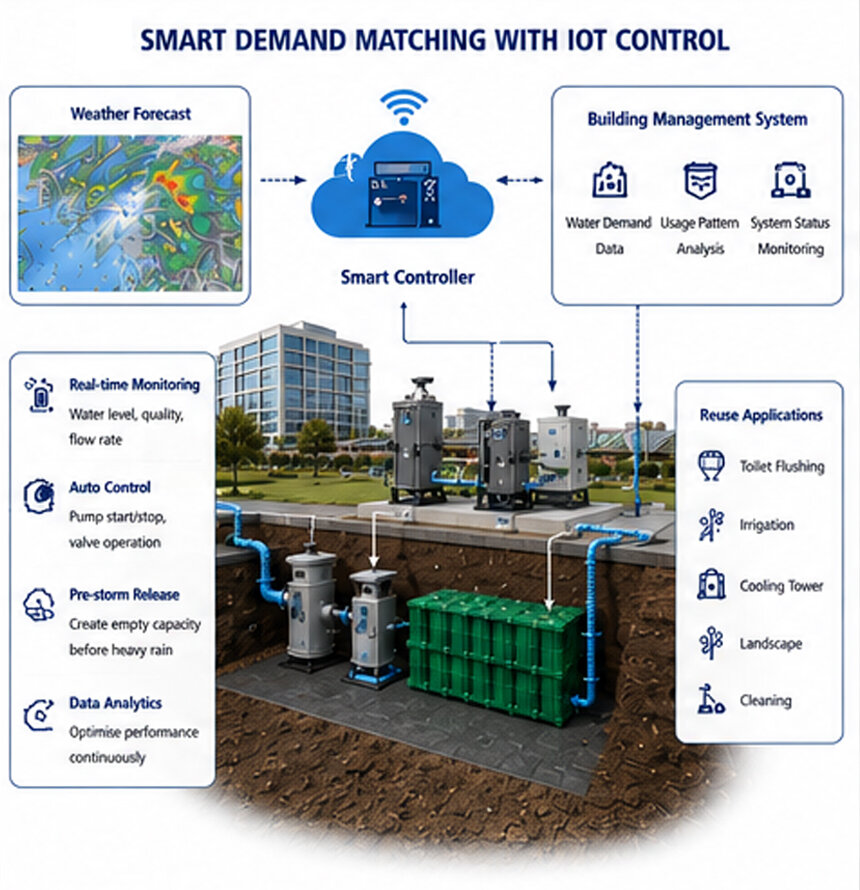
The most significant untapped source of recovery improvement is demand-side forecasting. IoT-connected rainwater management systems that integrate local weather forecasts can pre-emptively release stored water before a predicted storm event . If the system knows that 40 mm of rain is forecast in 18 hours, it can release stored water for irrigation or toilet flushing in advance, ensuring the tank has maximum empty capacity when the storm arrives.
Without this capability, a tank that is 80% full at the start of a storm can only capture the remaining 20% of its volume — the rest overflows. Field data from smart-controlled installations show that demand-matching algorithms increase annual recovery rate by 15–25% compared with passive systems that operate on level-triggered pumps alone .
Real-time monitoring also flags system faults — blocked filters, pump failures, sensor drift — that would otherwise go undetected and silently degrade recovery for weeks or months.
Overflow Recapture
Even in a well-designed system, overflow events are inevitable during storms that exceed the design storage capacity. Rather than discharging overflow directly to the storm drain, secondary overflow tanks or a connection to an infiltration gallery captures this excess water. Infiltration systems wrapped in geotextile return overflow water to the aquifer, contributing to groundwater recharge and satisfying SuDS compliance requirements even when the primary storage is full.
Reuse Application Matrix
Not all recovered rainwater needs the same level of treatment. Matching water quality to end use avoids over-treating water for applications that do not require it — and avoids under-treating water for applications that do. The table below organises reuse applications into four tiers.
| Tier | Treatment Level | Applications | Typical Quality Target | Est. Demand | Remarks |
| 1 — Low | Pre-filter only (280 micron) | Landscape irrigation, construction dust suppression, vehicle washing | TSS < 50 mg/L, no pathogen requirement | 2–5 L/m²/day | Agricultural irrigation, dust suppression and other typical scenarios only require this level |
| 2 — Medium | Pre-filter + cartridge filter (25 micron) + UV disinfection | Toilet flushing, cooling tower makeup, laundry | E. coli < 10 CFU/100mL, turbidity < 5 NTU | 15–25 L/person/day | In commercial buildings, these two items account for 30–60% of non-potable water demand, and treatment processes should be prioritized for them |
| 3 — High | Pre-filter + cartridge + UV + activated carbon | Process water, boiler feed, industrial washing | Conductivity < 500 µS/cm, turbidity < 1 NTU | Varies by process | — |
| 4 — Infiltration | No treatment; geotextile-wrapped modules | Groundwater recharge, SuDS compliance, baseflow augmentation | Infiltration rate per soil permeability test | Per SuDS design calc | — |
A tiered system built around PP modular storage allows different treatment paths to draw from the same underground storage array. Designing the treatment train specifically for the highest-volume applications — rather than treating all stored water to the highest standard — reduces operating cost and improves recovery rate, because less water is lost in unnecessary treatment.
Project Results
Nanjing Industrial Park, China
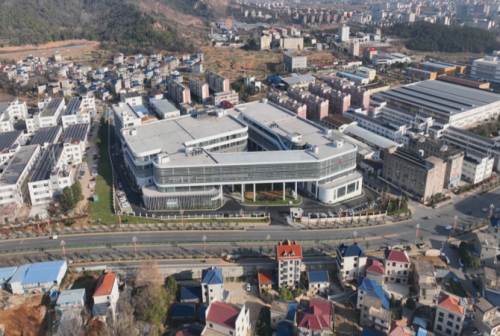
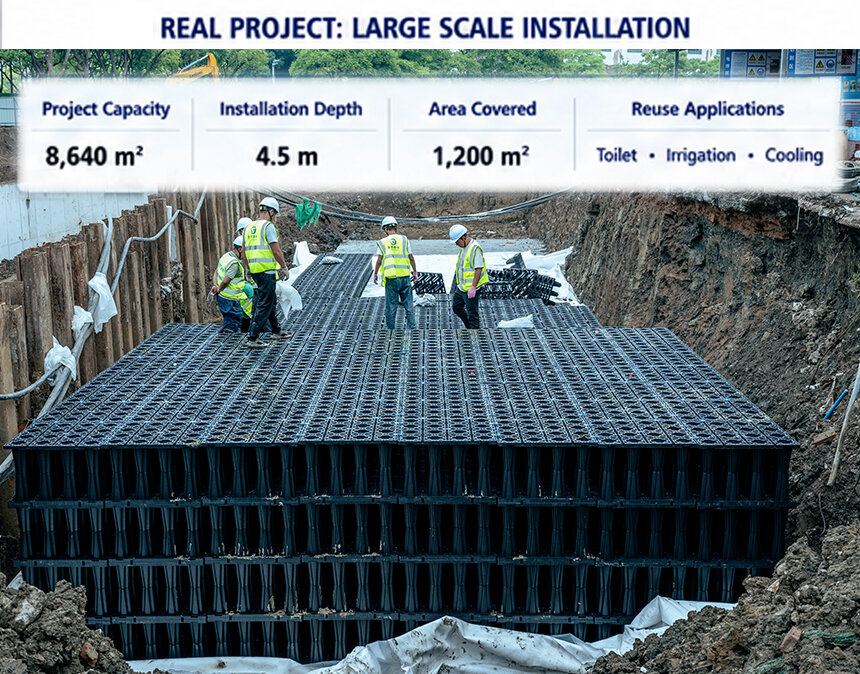
A 500 m³ silicon sand filter and PP modular storage system was installed at an industrial park in Nanjing to capture rooftop runoff from three manufacturing buildings . The total investment was 350,000 CNY. The system collects approximately 1,200 tonnes of rainwater per year, treating it to Tier 2 quality for landscape irrigation across the site. The operating cost for treatment is 0.8 CNY per tonne — compared with 4.2 CNY per tonne for municipal supply water. Based on these figures, the system achieves payback within 5–7 years . The PP module array was installed at 2.5 m burial depth and occupies a footprint that would otherwise have been a car park, demonstrating the space efficiency of underground modular storage.
Shopping Centre, Brazil
A large retail shopping centre in southern Brazil installed a rainwater recovery system collecting from both the building roof and the covered car park . Recovered water is treated to Tier 2 standard and used for HVAC cooling tower makeup. The system delivers over 30% annual water savings compared with the centre's previous reliance on municipal supply . The car park collection surface presented a higher contaminant load (oil, tyre rubber particulates) than the roof surface, so the design uses separate pre-filtration trains for each catchment before the flows merge in the shared PP module storage bank.
US Four-City Study
A research study covering four US cities evaluated rooftop rainwater recovery in commercial buildings . The study found that harvested rainwater replaced 30–60% of potable water previously used for flushing, depending on local rainfall patterns and building occupancy. Payback periods ranged from 3 years in cities with high water tariffs to 12 years in cities with low utility rates . The variation underscores that recovery system economics depend as much on local water pricing as on system design quality.
Frequently Asked Questions
What is the difference between recovery rate and collection efficiency?
Recovery rate determines your return on investment; collection efficiency only measures water entering the system.
• Collection efficiency: percentage of rainfall that enters the conveyance from the catchment surface.
• Recovery rate: percentage of collected water that reaches a productive end use.
• High collection (e.g., 90%) can yield low recovery (e.g., 40%) due to overflow, evaporation, filter bypass, and demand mismatch.
• Recovery rate is the number that directly reflects your ROI.
Can recovered rainwater be used for drinking water?
Technically yes, but cost- and regulation-prohibitive for most commercial projects.
• Requires multi-stage filtration, UV/ozone, and continuous monitoring to potable standards.
• Most projects target Tier 1/2 (irrigation, flushing) as the regulatory pathway is simpler.
• Drinking-water compliance adds significant maintenance and reporting burden.
How do smart controls improve recovery rate?
Smart controls boost annual recovery by 15–25% by using weather forecasts to pre‑release stored water before storms.
• Connect to weather forecast APIs and building management systems.
• Release stored water before a predicted storm to free up tank capacity.
• Prevent overflow and ensure the next rainfall event is captured in full.
• Automatically log performance, flag equipment faults, and generate compliance reports.
What recovery rate should I expect from a well-designed system?
A well-designed system (correct first-flush, pre‑filters, underground PP storage, smart controls) typically achieves 75–90% recovery.
• Systems without smart controls and with above-ground storage average only 50–65% due to evaporation and overflow.
• The 60–85% recovery gap stems from storage location, filter sizing, and demand‑forecasting choices.
• Choosing underground modular storage and smart controls significantly lifts recovery rate.
For more on applying recovered rainwater to outdoor uses, read our guide on rainwater harvesting for irrigation. If your project requires detailed treatment specifications, the rainwater filtration system guide covers filter selection and sizing. For high-capacity underground storage, review the Large 1200 modular PP system.