




Rain Water Collection System for Large-Scale Projects
15 Jul 2026"What qualifies as a 'large-scale' rain water collection system? It stores more than 500 m³ of water and collects runoff from over 5,000 m² of surface. These systems serve industrial parks, municipal infrastructure, and commercial complexes — going far beyond residential or small-commercial capabilities. At this scale, design challenges outgrow standard plumbing: multi-zone collection, distributed pump stations, SCADA (Supervisory Control and Data Acquisition) integration, and container-scale logistics demand professional project management."
Jiangsu Yingyuan Sponge City Technology manufacturesPP modular storage units at a rate of 150,000 m³ per year, with a product range that scales from a single 10 m³ garden array to municipal installations exceeding 2,000 m³. The global rainwater harvesting market reached $951 million in 2024, reflecting a compound annual growth rate (CAGR) of roughly 7–8% over the past five years — driven by increasing water scarcity, stricter stormwater regulations, and green building mandates. Modular plastic systems now capture 35–40% market share and are growing 1.5–2x faster than concrete alternatives, thanks to their scalability, lighter weight, and faster installation.
System Architecture for Large-Scale Projects
Large projects cannot be designed by simply multiplying a residential template. Five architectural features distinguish large-scale systems from their smaller counterparts.
1. Multi-Zone Collection
A 10,000 m² industrial complex typically has multiple roof zones (warehouses, offices, workshops) and surface zones (parking lots, loading bays, roads).
• Runoff characteristics: Metal roofs produce cleaner water than asphalt lots and should feed into dedicated pretreatment chains before merging at the storage array.
• Maintenance benefit: If one zone's pre-filter needs cleaning, the other zones continue operating independently. This zoning approach simplifies upkeep and improves system reliability.
2. Distributed vs Centralised Storage
Two strategies compete. Choose based on your site layout and budget:
• Centralised: One large module array beneath a central open area. Simpler plumbing, easier maintenance access. But requires large-diameter conveyance pipes from remote zones.
• Distributed: Multiple smaller arrays near each collection zone. Less pipe and pumping energy, but more maintenance nodes and separate pump stations.
• Recommendation: For most industrial parks, a hybrid approach works best — a central array serving the largest roof zone, with satellite arrays at remote buildings. Yingyuan's modular design supports both configurations, from 10 m³ to 2,000+ m³.
3. Redundant Pump Stations
Large systems serving occupied buildings (offices, schools, hospitals) cannot tolerate pump failure without backup.
• Standard setup: Twin-pump configuration with automatic failover for systems >100 m³.
• Critical facilities: For data centres and hospitals, use triple-pump with N+1 redundancy (meaning N units are operational and one extra unit is on standby).
• Failover mechanism: When the primary pump fails, the backup starts automatically — switchover completes in seconds, ensuring uninterrupted water supply.
4. SCADA / IoT Monitoring Integration

At the 500+ m³ scale, manual inspection is no longer practical. Smart monitoring integrates ultrasonic level sensors, flow meters, rainfall gauges, and pump status into a central dashboard.
• SCADA (Supervisory Control and Data Acquisition) platforms enable remote monitoring and automated alerts when parameters deviate from normal ranges — drastically reducing the need for physical site visits.
5. Overflow Management and Storm Bypass
During extreme rainfall events exceeding storage capacity, the system must safely divert excess water without flooding adjacent structures.
• Storm bypass pipes route overflow to a designated discharge point (municipal storm sewer or surface watercourse). The bypass activates automatically when the module array reaches a predetermined level.
With these five architectural principles in mind — multi-zone collection, storage strategy, redundancy, smart monitoring, and overflow management — we can now examine how they come together in real-world installations. The following case studies show two different scales and contexts.
Two Large-Scale Case Studies
Case 1: Nanjing Industrial Park — 500 m³ System
This industrial facility in Nanjing installed a 500 m³ PP modular rainwater harvesting system to supply landscaping, road washing, and fire-reserve topping water.
| Parameter | Detail |
| Storage volume | 500 m³ |
| Collection area | ~8,000 m² (multiple warehouse roofs) |
| Total investment | RMB 350,000 (~$48,000) |
| Annual harvest | 1,200 tonnes |
| Treatment cost | RMB 0.8/tonne |
| Payback period | 5–7 years |
| Module type | Standard 1000 (70T+) |
The system was installed beneath a landscaped courtyard, preserving the surface for pedestrian use. Yingyuan modules shipped in two 40HQ containers, with on-site assembly completed in 4 weeks by a crew of 6.
Case 2: Shanghai Lujiazui — Green Infrastructure Integration
Shanghai's Lujiazui financial district implemented a combination of green roofs, rain gardens, and modular storage as part of its sponge city retrofit programme. The project reduced the area's runoff coefficient (the fraction of rainfall that becomes surface runoff) from 0.72 to 0.35, meaning 65% of rainfall is now captured and managed on-site rather than discharging to the municipal sewer.
The modular PP storage component provides attenuation during peak storm events while retaining a reserve for landscape irrigation during dry periods. This dual-function design — attenuation plus reuse — is increasingly specified for dense urban environments where space constraints prohibit separate systems for each function.
These two examples — a mid-sized industrial park and a large district-level sponge city retrofit — demonstrate how the same modular platform adapts to different project goals (supply vs attenuation + reuse). Now, to help you replicate their success, we've broken the process down into a six-phase implementation roadmap.
Six-Phase Implementation Roadmap
Large-scale projects benefit from a structured implementation approach that prevents costly rework.The following six phases walk you from initial feasibility study through to handover and staff training. Each phase includes typical duration and key deliverables.
Phase 1: Feasibility Study and Hydrological Assessment (2–4 weeks)
• Analyse 10-year rainfall data for the site
• Conduct soil investigation and groundwater monitoring
• Map existing underground utilities
• Estimate harvestable volume and demand profile
Phase 2: System Design and Engineering (4–8 weeks)
• Multi-zone collection layout
• Module array sizing and configuration
• Hydraulic modelling of pipe network
• Pump station specification and redundancy design
• SCADA/IoT system architecture
Phase 3: Procurement and Logistics (4–6 weeks)
• Module quantity calculation and order placement
• Container planning: over 1,200 modules per 40HQ container
• Accessory procurement (geotextile, membrane, pipes, pumps)
• Shipping schedule coordination for international orders
Phase 4: Site Preparation and Installation (4–8 weeks)
• Excavation and base slab construction
• Geotextile/membrane installation
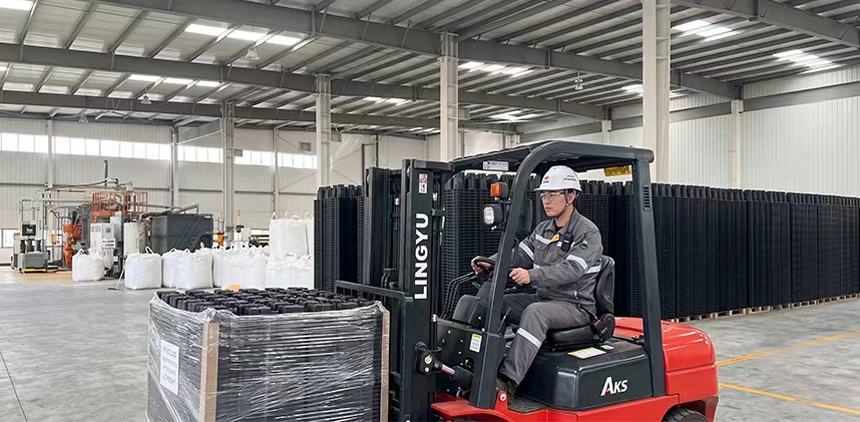
• Module assembly (approximately 10 m³ per day per crew of 2–3; a 100 m³ array thus takes about 10 days to assemble)
• Pipe network installation and pump station setup
Phase 5: Commissioning and Testing (1–2 weeks)
• Fill test: Fill the array with clean water and monitor for 48 hours for leaks
• Pump test: Verify flow rate and head at each delivery point
• SCADA test: Confirm sensor readings and remote access functionality
• Overflow test: Simulate extreme rainfall to verify storm bypass operation
Phase 6: Handover and Maintenance Training (1 week)
• As-built documentation package
• Operation and maintenance manual
• Training session for facility management team
• Spare parts inventory handover
Frequently Asked Questions
Q: How long does a large-scale rainwater collection project take from design to completion?
A: Typical timeline is 4–6 months from initial feasibility study through to commissioning. The critical path is usually procurement and shipping (4–6 weeks for international orders) running in parallel with site preparation. Module assembly itself is fast — the bottleneck is excavation, base slab curing, and pipe network installation.
Q: What is the typical cost per cubic metre of storage for large systems?
A: Cost per m³ decreases with scale due to fixed costs (excavation mobilisation, pump station, SCADA) being amortised over a larger volume. A 10 m³ residential system might cost $2,500–3,500/m³; a 500 m³ commercial system typically falls to $800–1,500/m³; and a 2,000 m³ municipal system can reach $500–900/m³ depending on site conditions .
Q: Do large systems need dedicated maintenance staff?
A: Systems above 200 m³ benefit from a designated maintenance technician with basic plumbing and electrical skills. The annual maintenance workload for a 500 m³ system is approximately 40–60 hours spread across quarterly inspections and annual deep-service. SCADA monitoring reduces the need for physical site visits by flagging issues remotely.
This article is part of our complete rainwater harvesting system guide. For ROI analysis, see our commercial harvesting ROI guide. For detailed cost data, see the complete system cost breakdown. For heavy-duty modules suited to large projects, explore the Hurricane HD.
Ready to start your large-scale project? Contact Yingyuan for a custom design and quotation tailored to your site conditions.